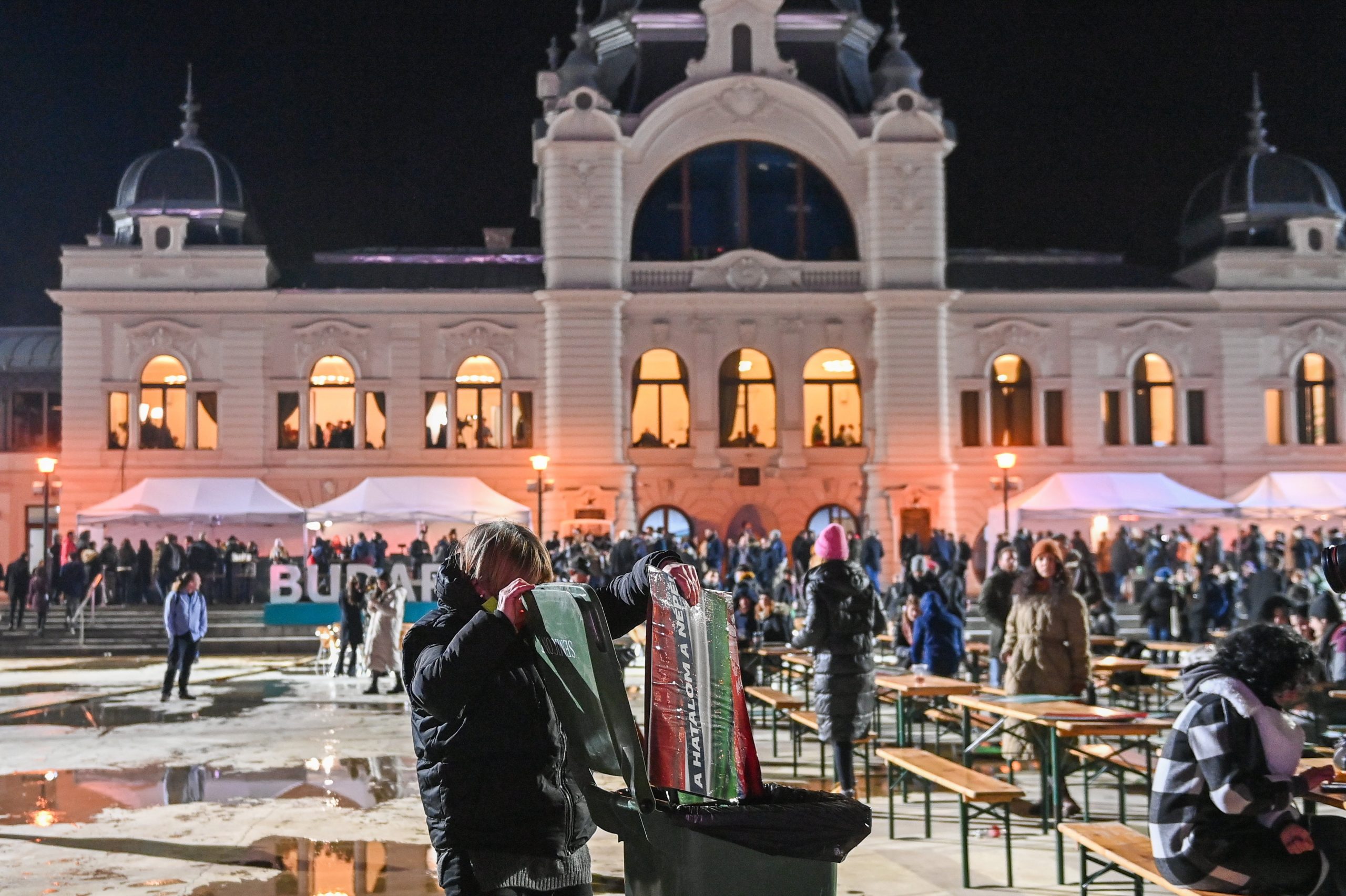
The international press is currently drunk on the narrative of a "democratic rebirth" in Budapest. They see an opposition win and immediately start typing up fantasies about a sudden pivot to Brussels, a flood of frozen EU funds, and a predictable, liberalized economy.
They are dead wrong.
Most analysts operate on a binary that doesn't exist. They think: Orbán equals "authoritarian risk" and the Opposition equals "market stability." This is a fundamental misunderstanding of Hungarian political economy. If you are betting on a smooth policy shift or a sudden drop in sovereign risk, you aren’t paying attention to the structural traps laid over the last two decades. An opposition win doesn't end the uncertainty; it weaponizes it.
The Deep State is Already Built
The biggest mistake outsiders make is assuming the Hungarian government is just a collection of ministries. It isn't. It is an ecosystem. Over the last 14 years, the current administration has outsourced the state's vital organs to "Public Interest Trust Foundations."
These aren't just charities. They control the universities, the energy assets, and the land. They are governed by boards with lifetime appointments.
Imagine a scenario where a new Prime Minister walks into their office only to find that the keys to the economy are held by people who cannot be fired and who answer to the previous guy.
That isn't a policy shift. That’s a hostage situation.
When the media talks about "policy normalization," they ignore the fact that the legal architecture of Hungary has been hardened into what legal scholars call "entrenchment." You can change the face on the posters, but you cannot change the law without a two-thirds majority—something a fractured coalition of six or seven different parties is almost guaranteed to lack.
The result? Total legislative gridlock. For an investor, gridlock is often worse than a predictable autocrat. It means the rules of the game can't change, even when they desperately need to.
The Coalition of Chaos
The "United Opposition" is an oxymoron. It is a fragile marriage of convenience between far-right nationalists, urban greens, and old-school socialists. Their only shared policy is "Not Orbán."
In the business world, we call this a merger without an integration plan. It never works.
Once the common enemy is defeated, the internal physics of the coalition take over. The greens want to shut down Paks II (the nuclear expansion); the nationalists want to keep the energy price caps; the liberals want to slash the deficit to please the IMF.
You don't get a "policy shift." You get a series of ego-driven vetoes.
I’ve watched private equity firms try to navigate "pro-business" transitions in emerging markets before. The pattern is always the same:
- The new government promises transparency.
- The internal factions start fighting over who gets to run the state-owned utilities.
- Foreign direct investment (FDI) freezes because nobody knows who will hold the power in six months.
If you think the Hungarian Forint ($HUF$) is volatile now, wait until you have a cabinet where the Finance Minister and the Prime Minister don't speak to each other.
The EU Funding Trap
The "lazy consensus" says that an opposition win automatically triggers the release of €30 billion in frozen EU RRF and cohesion funds. This is a fairy tale.
The European Commission doesn't just care about who is in charge; they care about the "milestones." These milestones require judicial reforms and anti-corruption measures that, again, require legislative majorities the opposition won't have.
Furthermore, the EU is a bureaucracy, not a revolutionary vanguard. They will move slowly. They will demand proof of "rule of law" that might take years to manifest. Meanwhile, Hungary’s budget deficit is sitting at levels that make the Maastricht criteria look like a joke.
Without an immediate cash injection, the new government will have to choose between two poisons:
- Austerity: Killing the very subsidies (like the utility price caps) that the working class relies on, leading to immediate social unrest.
- Debt: Borrowing at eye-watering yields to keep the lights on, leading to a currency death spiral.
The Myth of the Independent Central Bank
Let’s talk about the Magyar Nemzeti Bank (MNB). The central bank is supposed to be the pillar of stability. In reality, it has been the engine of the "unorthodox" monetary policy that fueled the current inflation crisis.
Even with a change in the Prime Minister’s office, the central bank leadership stays. The governor's term doesn't end just because the government changed.
This creates a "Monetary Cold War." You have a government trying to stimulate growth and a central bank that can hike rates or restrict liquidity just to spite the new administration. We saw this play out in various Latin American transitions in the 90s. It results in a "dead zone" for capital.
The "policy shift" the media promises isn't a shift to the center; it's a shift into a vacuum.
The Wrong Question
People keep asking: "How will the opposition change Hungary?"
The real question is: "Can the opposition even govern Hungary?"
The bureaucracy is filled with loyalists. The courts are packed. The media landscape is 90% controlled by holding companies friendly to the previous regime. This isn't a level playing field where a new team can just start playing their style of football. It’s a field where the grass has been replaced with landmines.
For a contrarian investor, the play isn't to buy the "recovery." The play is to hedge against the collapse of the transition.
The opposition's victory will be the start of Hungary's most unstable period since 1989. The "uncertainty ahead" mentioned by the mainstream press isn't a side effect—it is the main event.
Stop looking for the "Hungarian Spring." Start preparing for a long, cold, and legally complex winter.
The market loves a hero story, but Hungary is a tragedy of institutional capture. You don't fix 14 years of state-building with a single election night. You just find out how deep the rot actually goes.
Buy the rumor, but for God's sake, sell the "democratic" news.