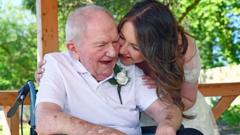
Executing a milestone event for an individual living with advanced neurocognitive decline—specifically Alzheimer’s disease or related dementias—presents a complex optimization challenge. The standard modern wedding operates on an axis of high sensory stimulation, rigid scheduling, and dense social interaction. For a patient experiencing cognitive fragmentation, this environment triggers immediate neurological overload, resulting in agitation, sundowning, or complete psychological withdrawal.
When a family decides to bifurcate a wedding into two distinct events—one hyper-localized, micro-scale ceremony specifically engineered for a compromised relative, followed by a traditional large-scale celebration—they are not merely performing an act of sentimentality. They are executing a highly structured risk-mitigation strategy. This approach solves for the tension between emotional utility (the desire for familial presence) and operational constraints (the patient’s cognitive threshold). Learn more on a connected issue: this related article.
The Cognitive Friction Coefficient in Event Design
To understand why a dual-wedding strategy is necessary, one must quantify the friction between standard event logistics and the neuropathology of dementia. Dementia progressively damages the brain's data-processing capacity, specifically targeting the prefrontal cortex and hippocampus. This manifests as a sharp decline in executive functioning, spatial orientation, and sensory gating—the mechanism by which the brain filters out irrelevant environmental stimuli.
A traditional wedding introduces four distinct neurological stressors: More analysis by Refinery29 highlights related perspectives on the subject.
- Sensory Decoupling: High-decibel audio, flashing photography lights, and rapid visual movement overwhelm a compromised nervous system that can no longer filter ambient noise from direct communication.
- Spatial Disorientation: Transporting a patient to an unfamiliar venue disrupts their reliance on environmental cues for stability, frequently inducing acute confusion or panic.
- Social Fatigue: The expectation to recognize faces, recall names, and engage in sustained conversation rapidly depletes the patient's limited cognitive reserve.
- Temporal Displacement: Events that extend past the early afternoon run directly into the window of "sundowning," a phenomenon where neuropsychiatric symptoms worsen as daylight fades.
When these stressors cross a critical threshold, the patient experiences a catastrophic breakdown in emotional regulation. By staging a localized, highly controlled micro-wedding 24 to 48 hours prior to the main event, the planners effectively reduce the cognitive friction coefficient to near zero.
The Dual Event Optimization Framework
The execution of a dual-ceremony strategy relies on a strict separation of variables. The first event optimizes for patient comfort and cognitive alignment; the second event optimizes for broader social obligations and standard celebration metrics.
Event A: The Micro-Scale Cognitive Ceremony
The sole metric of success for Event A is the preservation of the patient's psychological equilibrium. This requires a systematic strip-down of traditional wedding infrastructure.
- The Proximity Variable: The venue must be localized to the patient’s immediate environment. Staging the ceremony within a care facility, a familiar family home, or an adjacent outdoor space eliminates the logistical and psychological toll of transit.
- The Audience Cap: Attendance must be strictly capped at primary circle relations—typically fewer than ten individuals. This eliminates the "crowd effect" and prevents the patient from feeling scrutinized or overwhelmed by unrecognized faces.
- Temporal Compression: The entire sequence—arrival, ceremony, photography, and departure—must be compressed into a 30-to-45-minute window. The actual vows should take fewer than ten minutes. This aligns precisely with the peak alertness windows typical of mid-to-late-stage dementia patients, usually occurring in the late morning.
- Environmental Staging: Soundscapes must be acoustic and low-volume. Wardrobe choices for the bride and groom should be distinctly recognizable (e.g., traditional bridal whites) to provide immediate, unambiguous visual cues to the patient regarding the nature of the event.
Event B: The Standard Macro Celebration
With the patient's involvement successfully achieved and archived during Event A, Event B operates without the restrictive operational parameters required by neurocognitive decline. The couple can utilize high-capacity venues, extended timelines, late-night reception schedules, and high-impact entertainment systems without risking the health or dignity of their relative.
The Cost Function of Dual Event Execution
While the dual-event model offers a clear solution to cognitive constraints, it introduces distinct resource allocations and logistical trade-offs. Organizers must balance three primary cost variables.
Total Capital Allocation = Base Wedding Cost (Event B) + Incremental Friction Costs (Event A)
The incremental friction costs are not merely financial; they are emotional, physical, and temporal.
Financial Capital Distribution
Staging two events inevitably duplicates certain fixed costs. While Event A scales down variable costs like catering and venue rental, it incurs duplication in vendor fees. Photography and videography assets must be secured for two distinct days. Hair, makeup, and floral arrangements require two separate applications. To optimize this expenditure, planners should negotiate multi-day block rates with single vendors rather than hiring separate teams for each day, ensuring visual continuity across both archives.
Emotional and Physical Burnout
The bride and groom act as the central nodes in both systems. Running two consecutive events introduces a compounding fatigue factor. The emotional weight of managing a micro-wedding for a terminally ill or cognitively declining grandparent can cause severe emotional depletion right before the high-energy demands of a major social reception.
The Time Window Bottleneck
The temporal gap between Event A and Event B must be precisely calculated. If the gap is too short (e.g., less than 12 hours), the logistical overlap creates immense friction. If the gap is too long (e.g., more than 72 hours), the emotional momentum shifts, and the logistical burden stretches over a protracted period, increasing the risk of external complications like sudden health shifts in the patient. A 24-to-48-hour separation represents the operational sweet spot.
Digital Preservation as a Cognitive Bridge
A critical component of the dual-wedding framework is the deployment of media as a proxy for physical presence. The primary criticism of excluding a compromised relative from the main reception is the perceived loss of shared memory. However, in cases of advanced dementia, the patient will not retain the memory of the event regardless of its scale. The memory asset is preserved for the family, not the patient.
By capturing high-fidelity video and photo assets during Event A, two strategic objectives are met:
- The Reception Asset: The media captured during the intimate ceremony can be displayed or integrated into the programming of Event B. This allows the couple to publicly honor the grandparent's presence without subjecting them to the physical hazards of the main venue.
- The Artifact Utility: For the family, the media serves as a permanent record of a shared milestone achieved within the boundaries of safety and dignity. For the patient, if they retain short-term visual recognition, showing them prints or video clips from Event A in the days following can elicit short-term positive affect and a sense of calm, even after the contextual details of the wedding have faded from their memory.
Strategic Implementation Playbook
Families seeking to execute this dual-ceremony framework must approach it with clinical precision. Relying on improvisation during the event will lead to operational failure.
Phase 1: The Clinical Assessment
Consult with the patient’s primary care physicians or care facility staff two weeks prior to the target date. Establish the patient’s baseline behavioral patterns. Identify their peak cognitive hours and note specific triggers for agitation or confusion. If the patient relies on specific medications to manage anxiety or cognitive clarity, schedule the ceremony to coincide with the peak efficacy window of those pharmaceuticals.
Phase 2: Structural Minimalism
Strip Event A of all superfluous elements. There is no need for formal seating arrangements, complex processional orders, or extensive bridal parties. The bride, the groom, the officiant, and the patient form the core operational unit. The officiant should modify the language of the ceremony to be direct, concise, and easily comprehensible, avoiding long metaphors or complex historical narratives that require sustained abstract processing from the patient.
Phase 3: The Contiguity Plan
Establish an immediate extraction protocol for Event A. If the patient exhibits signs of distress—such as repetitive vocalizations, physical fidgeting, pacing, or verbal aggression—the ceremony must be paused or terminated immediately. A designated handler (someone familiar to the patient but not a primary member of the wedding party, such as a professional caregiver or a trusted family friend) must be positioned to guide the patient back to their private living space without disrupting the continuity of the day for the bride and groom.
Phase 4: Media Integration
Ensure the media team for Event A operates with minimal gear. Large setups, complex lighting grids, and intrusive drones will trigger paranoia and confusion in a patient with cognitive decline. Handheld cameras utilizing natural light are mandatory. The focus must be on speed and candid capture rather than staged, perfectionist posing which requires the patient to follow complex physical instructions.
The Strategic Play
The dual-wedding model demonstrates that accommodating severe health constraints does not require a compromise on the scope of life milestones. Instead, it demands a separation of design objectives. By treating the patient’s cognitive limitations as a fixed operational boundary, couples can engineer a bespoke event that honors family legacy with dignity, while preserving the freedom to execute a traditional celebration at scale. The success of this framework hinges entirely on moving away from emotional improvisation and adopting a disciplined, logistics-driven approach to event choreography.