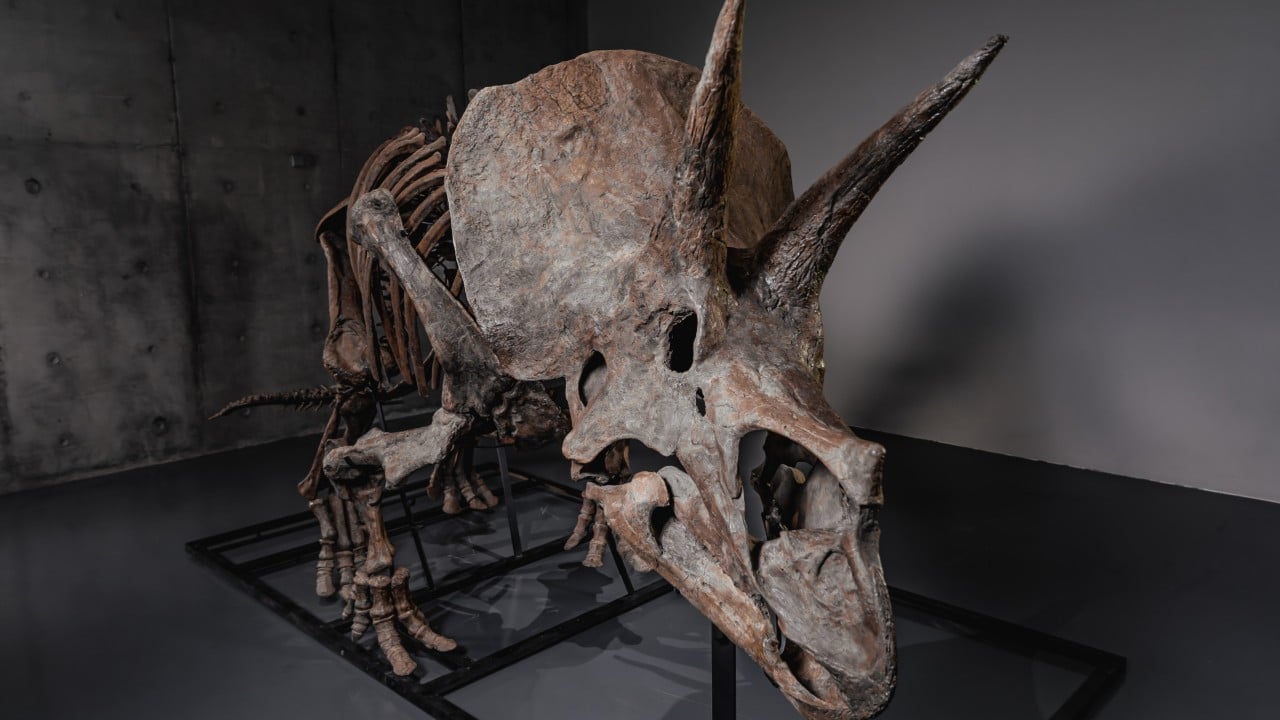
Trey is a 24-foot-long marvel of prehistoric evolution and he's about to become the most expensive piece of decor in someone’s mansion. When this Triceratops skeleton hits the auction block at Christie’s, it won't just be a win for paleontology. It’s a massive signal that the private fossil market has shifted from a niche hobby for eccentric scientists into a high-stakes asset class for the ultra-wealthy. We’re seeing a gold rush where the gold is 66 million years old.
If you’ve followed the "dino-mania" in the art world lately, you know this isn't an isolated event. First, there was Sue. Then Stan the T-Rex shattered records at $31.8 million. Now Trey is stepping into the spotlight. Found in the Hell Creek Formation of South Dakota, this specimen is remarkably complete. It’s not just a pile of broken fragments held together by hope and industrial glue. It’s a near-perfect snapshot of Late Cretaceous life.
Why Everyone Is Chasing the Triceratops Market
The demand for "hero" fossils—specimens that are large, recognizable, and relatively intact—has spiked faster than anyone predicted. A few years ago, you could snag a decent fossil for the price of a luxury SUV. Today? You're looking at the price of a Gulfstream jet.
Private collectors aren't just buying these because they like Jurassic Park. They're buying them because bones are finite. Unlike a Warhol or a Basquiat, you can’t exactly commission a new Triceratops. There’s a fixed supply buried in the earth, and the "good" ones are disappearing into private hallways at a rapid clip. Trey represents the peak of this trend. He's got the iconic three-horned silhouette that every kid recognizes, but with a level of preservation that makes even seasoned museum curators sweat.
The Hell Creek Gold Mine
Most of the big-name dinosaurs you see in the news come from the Hell Creek Formation. This geological treasure chest stretches across Montana, Wyoming, and the Dakotas. It’s where the world’s most famous T-Rexes and Triceratops lived right before the big asteroid hit.
Trey’s discovery in this region adds a layer of "provenance" that collectors crave. In the auction world, where a fossil comes from matters almost as much as what it is. If it’s Hell Creek, it’s top-shelf. The soil there has a specific chemistry that replaces bone with minerals in a way that preserves incredible detail. When you look at Trey’s skull, you aren't just looking at a rock shape. You’re looking at the actual texture of the bone that supported a massive frill and horns designed for combat.
The Ethical Battle Over Trey’s Price Tag
It’s impossible to talk about Trey without addressing the massive elephant—or ceratopsian—in the room. Paleontologists are generally furious about these auctions. When a skeleton like Trey sells to a private individual, it often disappears from the public eye forever.
- Data Loss: If a scientist can’t access the bones, they can’t study growth patterns or diseases.
- Price Inflation: Public museums simply cannot compete with billionaire hedge fund managers.
- Legal Loops: In the U.S., if you find a dinosaur on private land, it’s yours to sell. This is wildly different from countries like Mongolia or Brazil, where fossils are considered national heritage.
Critics argue that we’re turning history into furniture. They’ve got a point. But the auction houses counter that these sales actually fund more digs. They claim that without the high prices, many of these bones would just erode into dust on a ranch somewhere because nobody would have the financial incentive to dig them up properly. It’s a messy, capitalist reality that isn't going away anytime soon.
What Makes Trey Different From Your Average Fossil
Not all Triceratops are created equal. You’ll often see "composite" skeletons in smaller museums. Those are basically Frankenstein monsters—bones from six or seven different animals stitched together to look like one.
Trey is different. He is an "associated" specimen. Most of those bones belonged to the same individual. That’s incredibly rare. Think about the odds. An animal dies, scavengers tear it apart, floods wash the bones away, and millions of years of tectonic shifts crush them. To find 75% or more of a single skeleton in one spot is a statistical miracle.
That completeness is exactly why Christie's expects the bidding to be aggressive. You aren't just buying a skeleton; you're buying a singular individual's life story. You can see where he might have had an injury or how he aged. For a collector, that’s the ultimate "story-piece" for a foyer.
The Financials of Prehistoric Assets
Let's talk numbers. The dinosaur market has seen a 500% increase in some sectors over the last decade. It’s outperforming many traditional stock indices.
If you're looking at Trey as an investment, you have to consider maintenance. These aren't just "set it and forget it" items. You need climate control. You need an armature specialist to ensure the weight of the fossilized stone—which is what these bones actually are—doesn't cause the skeleton to collapse under its own weight.
- Insurance: Finding a provider for a $20 million skeleton is a nightmare.
- Authentication: You need rigorous CT scans to prove what’s real bone and what’s "restoration" (plaster filler).
- Liquidity: Selling a dinosaur takes months, if not years, of planning. You can't just flip it on an app.
Is This a Bubble Ready to Burst
Some experts think we're in a fossil bubble. They point to the 1990s when Japanese buyers drove up prices for certain collectibles before the market tanked. But dinosaurs seem different. They have a universal appeal that transcends culture or language. A wealthy buyer in Dubai wants a Triceratops for the same reason a tech mogul in Silicon Valley does. It’s the ultimate symbol of power and deep time.
The reality is that as long as there’s a surplus of billionaires and a deficit of complete skeletons, prices for things like Trey will keep climbing. We've reached a point where "natural history" is the new "contemporary art."
If you’re serious about entering this space, stop looking at the small stuff. Teeth and claws are fun, but they don't appreciate like a full skeleton. The real value is in the "mount"—the full, standing display. If you have the capital and the ceiling height, keep a close watch on the Trey auction. It’s going to set the floor for the next five years of sales. Check the auction catalog for the "percentage of original bone" metric. Anything over 70% is blue-chip territory. If Trey hits his marks, expect a wave of ranch owners in the Midwest to start hiring commercial dig teams by the dozen this summer.