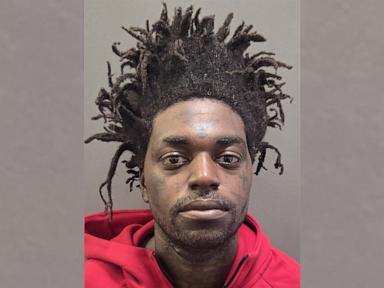
The asphalt on a Florida highway at midnight doesn’t just hold heat; it vibrates with it. It is a humid, heavy stillness that smells of exhaust and salt air. When the blue and red lights begin to strobe against the palm fronds, the world shifts. It stops being about a man in a car and starts being about a cycle that refuses to break.
Bill Kapri, the man the world knows as Kodak Black, found himself standing in that strobe light again. This wasn't a stage light. There was no bass dropping, no crowd chanting his name, no diamond-encrusted grill reflecting the camera flash of a music video. There was only the grit of the roadside and the cold click of metal around his wrists.
The facts are as dry as the police report they originated from. A purple Dodge Durango. A generic traffic stop for an expired registration. A search that uncovered 31 small white tablets of oxycodone. A stash of cash totaling nearly $75,000. These are the skeleton of the story, but the marrow is something much more haunting.
To understand why this matters, you have to look past the mugshot. You have to look at the anatomy of a recurring nightmare.
The Weight of the Durango
Imagine for a second that you are twenty-five years old and you have already lived three lifetimes. You have been a child prodigy of the streets, a chart-topping sensation, a federal prisoner, and a recipient of a presidential pardon. Your face is a map of your journey, literally tattooed with the history of where you’ve been. Every time you close your eyes, you hear the cheers of Rolling Loud and the heavy slide of a cell door.
When the Florida Highway Patrol pulled over that Durango in Ft. Lauderdale, they weren't just stopping a vehicle. They were colliding with a trajectory.
The struggle of the "celebrity arrest" is often framed as a tale of arrogance—the idea that fame grants a shield of invincibility. But if you sit with the reality of addiction and the relentless gravity of the environment that birthed you, the narrative changes. It’s not about feeling invincible. It’s about feeling hunted.
The tablets found in that car represent more than a "trafficking" charge by weight. In the state of Florida, the law is a blunt instrument. If you carry a certain amount of a controlled substance, the intent is legally baked into the charge. It doesn't matter if you were selling them or if you were consuming them to quiet the ghosts of a violent past. The law sees a number. The law sees a predator.
But the human eye sees a young man who, despite having millions in the bank and the world at his feet, still keeps seventy-four thousand dollars in cash in his center console. That isn't the behavior of a businessman. That is the behavior of someone who doesn't trust banks, someone who feels he might need to run at any given second. It is the behavior of a man who still lives in a state of emergency.
The Invisible Stakes of the Pardon
There is a unique cruelty to this specific chapter of the Kodak Black saga. This wasn't supposed to happen.
In January 2021, the highest office in the land intervened. A commutation from Donald Trump was supposed to be the ultimate "get out of jail free" card. It was a reset button that most people in the system would die for. It was a chance to rewrite the ending.
When the news broke of the oxycodone discovery, the collective sigh from the public wasn't just about the drugs. It was about the squandered miracle. We want our stars to be phoenixes. We want to believe that if we give someone a second, third, or fourth chance, they will finally walk toward the light and stay there.
But the light is blinding.
Consider a hypothetical young man—let's call him Elias—raised in the same Pompano Beach projects as Kodak. Elias sees the rapper as a god. Not because of the music, but because he got out. Every time Kodak is arrested, a little bit of the floor drops out from under Elias. If the man with the private jets and the presidential pardon can’t outrun the handcuffs, what hope does a kid with a bike and a notebook have?
The stakes aren't just Kodak's freedom. The stakes are the very idea of redemption. When the system finally "gives in" and offers mercy, and that mercy is met with another mugshot, the door slams a little harder for everyone else behind him.
The Chemistry of the Quiet
We rarely talk about the "why" behind the pills. We talk about the "how much" and the "where."
Oxycodone is a monster. It is a chemical blanket that smothers physical pain and emotional trauma with equal efficiency. For a person who has survived multiple shootings, who has seen friends disappear into the earth or the Department of Corrections, the "high" isn't about partying. It is about the silence.
The tragedy of the Ft. Lauderdale arrest is the silence it failed to provide.
http://googleusercontent.com/image_content/245
The legal system in Florida is famously unforgiving regarding opioids. The "trafficking" label carries mandatory minimum sentences that can swallow decades. By the time the bond was set at $75,000—ironically, almost the exact amount of cash found in his car—the narrative had already been set in stone. He was the "repeat offender." He was the "unreformable."
But look at the pacing of his life. It is a frantic, breathless sprint. Music, court, jail, studio, court, hospital, jail. There is no rhythm of peace. There is only the rhythm of the chase.
The $74,960 in cash is perhaps the most telling detail of the entire police report. It is a specific, jagged number. It represents a lifestyle where wealth is portable because stability is a myth. You carry your life in your pockets because you never know if you'll be allowed back into your house. It is the ultimate sign of a man who, despite his fame, still feels like a nomad in his own hometown.
The Mirror on the Highway
We watch these stories not because we care about the legalities of vehicle registration or the specific milligram count of a pill. We watch them because they are a mirror.
We see our own failures magnified. We see our own inability to break bad habits. Most of all, we see the terrifying reality that money cannot buy a new soul. You can change your car, you can change your clothes, and you can change your tax bracket, but you cannot change the wiring of a brain that was forged in fire.
The headlines called it a "bust." The fans called it a "setback." The prosecutors called it "justice."
But if you look at the footage of that night—the dark highway, the purple SUV glowing under the streetlamps, the quiet resignation of a man who has been searched a thousand times—it looks like something else. It looks like a funeral for a future that hadn't happened yet.
The legal battle will involve high-priced lawyers and debates over probable cause. They will argue about the expired tags and the validity of the search. They will fight over the "trafficking" definition versus "simple possession."
None of that changes the image of the man on the shoulder of the road.
As the sun began to rise over the Broward County jail the following morning, the heat returned to the asphalt. The world moved on. The charts continued to spin. But somewhere in a cell, the man who was supposed to be the exception to the rule sat waiting for the next strobe light.
The tragedy isn't that he got caught. The tragedy is that, for some, the road always leads back to the same stretch of highway, no matter how fast the car is or how bright the headlights shine.
The cycle doesn't just repeat; it echoes. And in the echo, the music starts to fade, leaving nothing but the sound of the wind through the palms and the heavy, humid silence of what could have been.