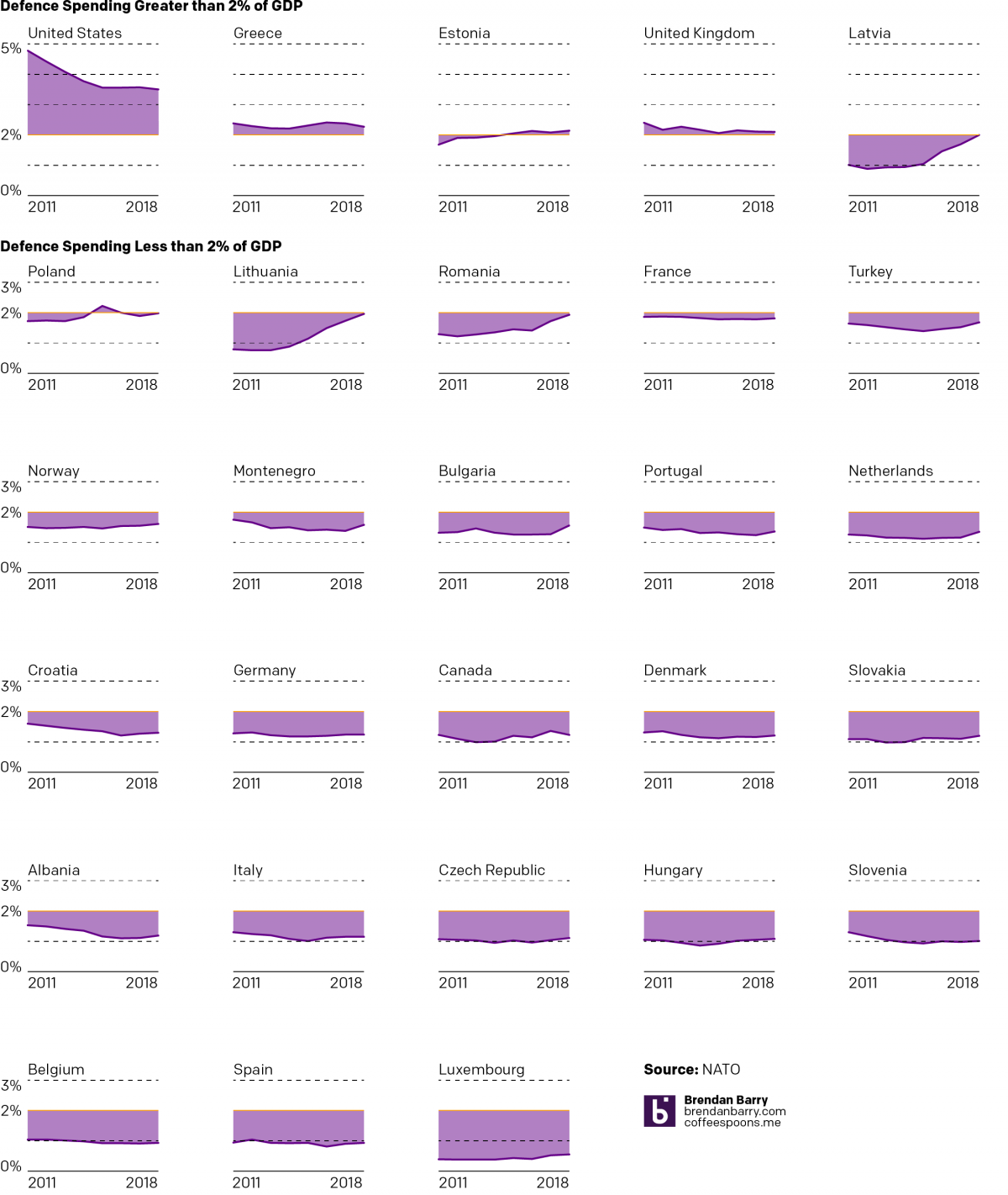
The structural tension within the North Atlantic Treaty Organization (NATO) has shifted from a debate over collective defense to a disagreement over theater priority and resource allocation. While the traditional friction point remains the Two Percent Mandate—the 2014 Wales Summit pledge for members to spend 2% of GDP on defense—the introduction of the Middle East, specifically Iran, as a litmus test for alliance utility represents a fundamental pivot in American foreign policy. This shift moves NATO from a regional security pact to a transactional global coalition where European security is leveraged against American interests in the Persian Gulf.
The Mechanics of Defensive Reciprocity
The alliance operates on the principle of indivisible security, but the operational reality is governed by a Burden-Sharing Ratio. This ratio measures the disparity between the United States' defense outlays and the collective contributions of the other 31 member states. When the U.S. administration criticizes the alliance’s "boss" or its member states, the critique targets three specific structural failures:
- The Under-Capitalization of European Forces: As of 2026, several key European economies continue to lag behind the 2% threshold. This creates a "security free-rider" effect where the U.S. provides the strategic nuclear umbrella and the bulk of intelligence, surveillance, and reconnaissance (ISR) capabilities while European budgets prioritize social spending over kinetic readiness.
- Mission Creep vs. Mission Focus: The U.S. demand for NATO to address Iran suggests a desire to multilateralize the maximum pressure campaign. By expanding NATO’s scope to the Middle East, the U.S. seeks to dilute the political and financial cost of Iranian containment.
- Strategic Autonomy vs. Atlanticism: France and Germany have frequently pushed for "European Strategic Autonomy," a concept that suggests Europe should handle its own security. The U.S. counter-argument is that if Europe cannot meet its 2% commitment, it remains functionally dependent on the U.S., thereby forfeiting its right to dissent on American out-of-area priorities like Iran.
The Iran Variable in the Transatlantic Equation
The integration of Iran into NATO discourse is not a tangential grievance; it is a calculated effort to redefine the alliance’s geography. The U.S. view posits that Iranian regional hegemony and its ballistic missile program pose a direct threat to the alliance’s southern flank.
The Threat Vector Analysis reveals why this causes friction:
- Energy Security: The U.S. is now a net exporter of energy, whereas Europe remains deeply dependent on stable flows through the Strait of Hormuz. The U.S. logic dictates that Europe should bear the primary burden of securing these sea lanes if it expects continued U.S. protection against Eastern European threats.
- Proximal Risk: European capitals are within the reach of Iranian medium-range ballistic missiles. The U.S. administration uses this technical reality to argue that Iran is a "NATO problem," not just a "Middle East problem."
- The JCPOA Schism: The Divergence between the U.S. withdrawal from the Iran nuclear deal and European efforts to maintain trade via mechanisms like INSTEX created a trust deficit. The demand for NATO involvement in Iran is a mechanism to force European alignment with U.S. sanctions regimes.
The 2% Constraint and the Readiness Gap
The obsession with the 2% figure is often dismissed by critics as a crude metric, but it serves as a proxy for Combat Sustainability. Defense spending is not merely a bank balance; it translates into specific operational variables:
Equipment Modernization
A significant portion of the 2% mandate requires 20% of defense spending to be allocated to "Major Equipment." This is where the gap is most visible. U.S. forces operate on a high degree of interoperability, whereas European forces remain a patchwork of non-communicating systems. The U.S. critique of the NATO Secretary General often centers on the failure to enforce this 20% modernization rule, which leaves the alliance unable to project power outside of its borders without massive American logistical support.
The Logistics of Deployment
If NATO were to engage in an "out-of-area" mission regarding Iran, the heavy lifting—heavy lift aircraft, mid-air refueling, and satellite communication—would fall almost exclusively on the United States. This creates an asymmetric risk profile: the U.S. provides the infrastructure, while Europe provides a symbolic "coalition" presence. The current administration views this as a depreciating asset for American taxpayers.
Geopolitical Leverage and the Transactional Pivot
The shift in tone toward NATO leadership signals a transition from Value-Based Diplomacy to Interest-Based Transactionalism. The U.S. is signaling that the North Atlantic Treaty is no longer a "set-and-forget" insurance policy. Instead, it is a dynamic contract subject to performance reviews.
The "Iran Test" serves as a benchmark for this new era. If NATO members refuse to coordinate on Middle Eastern security, the U.S. threatens to recalibrate its commitment to Article 5. This is not necessarily a threat to leave the alliance, but a threat to deprioritize European defense in the American global strategy.
The Cost-Benefit Matrix for the U.S. is being recalculated:
- Investment: $860+ billion in annual defense spending.
- Benefit: A stable Europe that facilitates global trade.
- Opportunity Cost: Resources that could be pivoted to the Indo-Pacific to counter China or to the domestic economy.
The friction observed in high-level meetings between the U.S. President and the NATO Secretary General is the visible manifestation of this recalculation. The Secretary General’s role has shifted from a diplomatic coordinator to a "debt collector" for Washington, constantly pressuring European capitals to pay their dues to keep the U.S. engaged.
Structural Bottlenecks to Compliance
European states face internal political constraints that make rapid defense scaling nearly impossible. These bottlenecks include:
- Debt-to-GDP Ratios: Strict EU fiscal rules often prevent member states from running the deficits required to fund massive military procurement programs.
- Public Sentiment: In nations like Germany, there is a historical and cultural aversion to military expansion. Increasing defense spending is often a "third rail" in domestic politics.
- Industrial Protectionism: Many European nations want to spend their defense budgets on domestic firms rather than buying American-made F-35s or Patriot systems. This creates a "Buy American" vs. "Buy European" conflict that further stalls modernization.
The Multi-Domain Threat Environment
NATO's traditional focus was on the "Suwalki Gap" and the defense of the Baltics. However, the modern threat environment includes cyber warfare, energy blackmail, and proxy conflicts in the Levant. The U.S. argument is that a 20th-century alliance structure cannot survive 21st-century threats if it remains geographically confined.
By criticizing NATO over Iran, the U.S. is attempting to force an evolution. If NATO becomes a "Global Security Manager," its value to the U.S. increases. If it remains a "European Border Guard," its value diminishes relative to the rising threats in the Pacific and the Middle East.
The Strategic Path Forward
The alliance must resolve the Reciprocity Deficit to remain viable through the end of the decade. The following maneuvers are necessary for NATO to avoid irrelevance or fragmentation:
- The Implementation of a Variable-Speed Alliance: Recognizing that not all members will reach 2% simultaneously. The U.S. may begin to offer "Tiered Security Guarantees," where members meeting the threshold receive higher-level intelligence sharing and more frequent joint exercises.
- Formalization of the Southern Flank: NATO must create a permanent Mediterranean and Middle East Command structure that specifically addresses Iranian proxy activity and maritime security. This would bring the Iran concern into the formal NATO framework rather than leaving it as a point of bilateral contention between the U.S. and individual members.
- The Decoupling of Procurement from Politics: Establishing a NATO-wide procurement fund that prioritizes interoperability over national industrial interests. This would reduce the "waste" in European defense spending, where billions are lost to redundant research and development across 31 different nations.
The future of NATO depends on its ability to transition from a regional defense pact to a global security franchise. The U.S. administration's pressure regarding Iran and spending is not an attempt to destroy the alliance, but a "stress test" designed to force a reorganization. The alternative is a slow drift into obsolescence, where the U.S. seeks security through ad-hoc coalitions of the willing, leaving a fragmented Europe to manage its own borders against an increasingly assertive East.
The strategic play for NATO members is to offer a "Grand Bargain": accelerated defense spending in exchange for a seat at the table in defining the West’s Middle East policy. Failure to make this trade will likely result in the U.S. unilaterally withdrawing high-value assets from European soil, regardless of the rhetorical commitments made in Brussels.