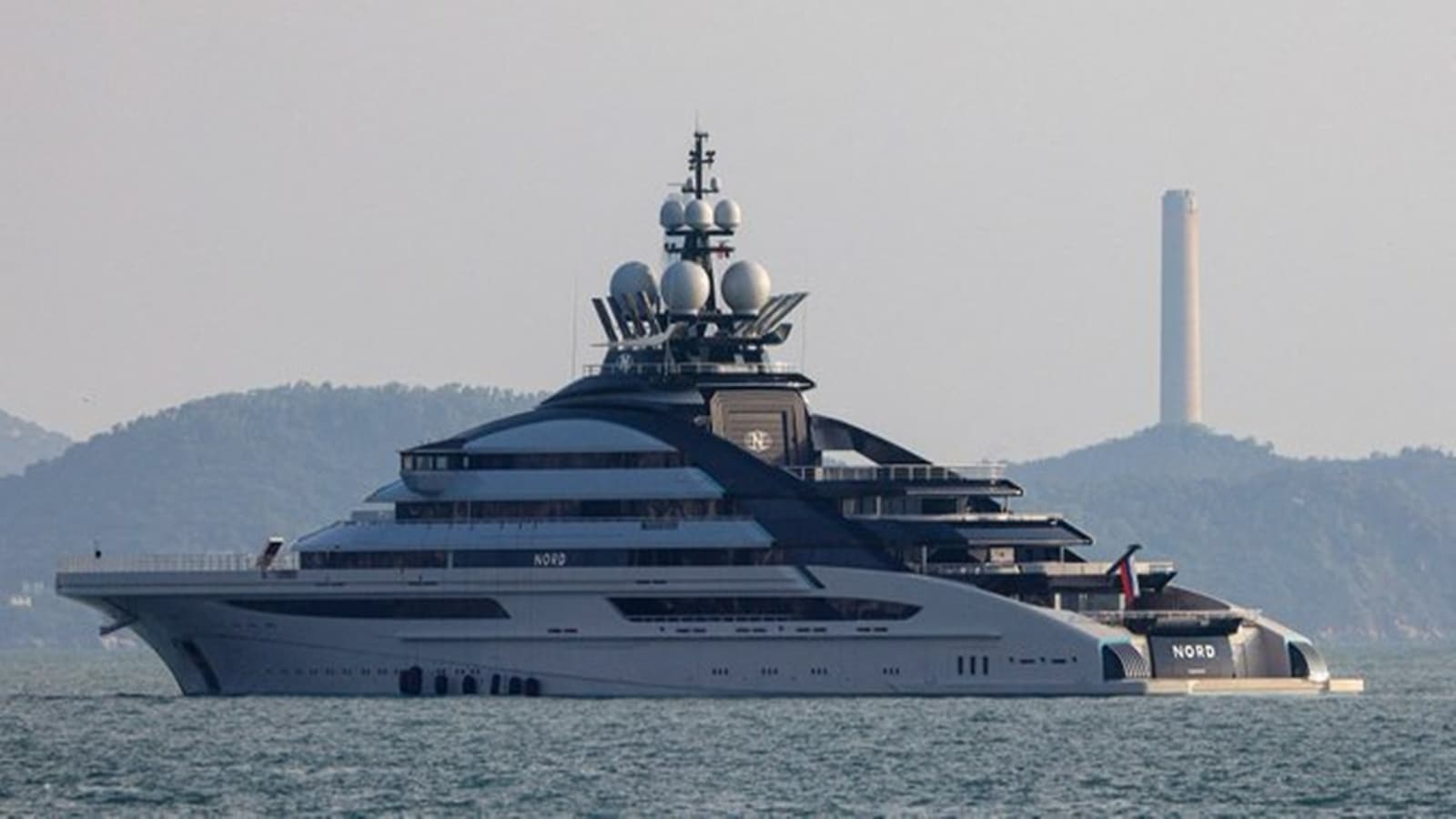
The mainstream media loves a ghost story. For the past week, newsrooms have been hyperventilating over a $500 million Russian superyacht "breaching" a blockaded Strait of Hormuz. They paint a picture of a high-stakes maritime heist—electronic warfare, silent engines, and a daring escape through an Iranian naval wall.
It is total fiction.
The narrative that a luxury vessel "evaded" a blockade is built on a fundamental misunderstanding of how maritime law, AIS spoofing, and the geography of the Persian Gulf actually function. You aren’t looking at a tactical miracle. You’re looking at a standard bureaucratic loophole wrapped in expensive teak wood. The Strait of Hormuz isn't a brick wall; it’s a toll booth, and for the right price—and with the right flag—the gate is always open.
The Blockade Is a Political Theater Not a Physical Barrier
Stop imagining a line of warships shoulder-to-shoulder across the water. The Strait of Hormuz is roughly 21 miles wide at its narrowest point. However, the actual shipping lanes—the Traffic Separation Scheme (TSS)—consist of two-mile-wide channels for inbound and outbound traffic, separated by a two-mile buffer zone.
When the press screams "blockade," they imply a total stoppage of flow. In reality, the Iranian Navy and the IRGCN (Islamic Revolutionary Guard Corps Navy) practice asymmetric harassment, not total interdiction. They target specific tankers tied to Western interests to drive up insurance premiums.
A Russian-owned superyacht is the safest vessel in those waters. Why? Because Moscow and Tehran are currently deep in a strategic marriage of convenience. To suggest the yacht "breached" the blockade implies it was a target to begin with. It wasn't. It was a guest. If you have a Kremlin-linked hull and a Russian-friendly crew, you don't need to "sneak" past the IRGCN. You wave at them.
The AIS Dark Mode Fallacy
Every analyst is pointing to the vessel’s "dark" AIS (Automatic Identification System) as proof of a covert operation. This is amateur-hour reporting.
Switching off AIS is not a "stealth mode" that makes a 400-foot white palace invisible. Any radar operator on a coastal battery or a patrol boat can see a vessel that size from miles away. AIS is a collision-avoidance tool, not a cloaking device.
In the shipping world, going "dark" is a legal signal, not a tactical one. It provides plausible deniability for the port authorities and insurance underwriters. If the yacht’s transponder is off, the digital paper trail for the "breach" becomes murky. It allows the vessel to dock in "grey" ports without triggering immediate automated sanctions alerts.
The yacht didn't go dark to hide from the Iranians; it went dark to hide from Western maritime regulators and the Office of Foreign Assets Control (OFAC). It’s a tax and sanctions dodge, not a military maneuver.
The Physics of the Superyacht vs. the Warship
Let’s dismantle the "High-Speed Escape" theory.
The competitor article suggests the yacht used its superior speed to outrun interceptors. This is a technical absurdity. While a modern superyacht might hit 20 or 30 knots, an IRGCN fast attack craft (FAC) can easily push 50 to 60 knots.
If Iran wanted to stop that boat, they would have stopped it. You cannot outrun a missile, and you cannot outpace a swarm of Bladerunner-class speedboats in a narrow channel.
The yacht moved through the Strait because it was permitted to move. The "escape" was a choreographed transit. We see this constantly in the industry: owners pay for "security consultants" who are essentially well-connected fixers. These consultants don't carry guns; they carry satellite phones and bank account numbers for offshore transfers. They buy the "window" of time where the coastal patrols happen to be looking the other way.
Insurance Is the Real Weapon
If you want to understand why the $500 million vessel moved, stop looking at the hull and start looking at the Protection and Indemnity (P&I) Club data.
Most people don't realize that a blockade’s primary power isn't the threat of sinking; it’s the threat of making a ship uninsurable. Once a zone is declared "War Risk," premiums skyrocket to the point where moving a vessel is a financial suicide mission.
However, Russian assets have increasingly pivoted to domestic insurance or "shadow" insurers based in jurisdictions like the UAE or India. These insurers don't care about Western "blockades." The yacht didn't "defy" the blockade; it operated outside the financial ecosystem that makes the blockade effective.
"I’ve seen owners spend $2 million on 'tactical security' just to feel like James Bond, when a $50,000 bribe to a local port captain would have cleared the path in ten minutes."
The Logistics of Longevity
Where is the yacht going to refuel? How does it maintain its stabilizers? A superyacht is a fragile ecosystem. It requires specialized parts, specific lubricants, and a constant supply of high-grade marine diesel.
A vessel "fleeing" a blockade doesn't just disappear into the sunset. It needs a friendly destination. The real story isn't the transit through the Strait; it’s the network of "neutral" ports in the Indian Ocean that are actively middle-manning Russian luxury assets.
We are seeing the rise of a Parallel Maritime Economy. On one side, you have the regulated, AIS-monitored, Western-insured fleet. On the other, you have a growing fleet of "ghost" tankers and oligarch toys that move with total impunity because they use non-Western GPS alternatives (like GLONASS) and non-Western financing.
The Reality of Electronic Warfare at Sea
There was talk of "signal jamming" being used by the yacht to scramble regional sensors. Let’s be clear: mounting military-grade electronic countermeasure (ECM) suites on a civilian yacht is a great way to get yourself blown out of the water by a nervous destroyer.
Jamming isn't a bubble of silence; it’s a giant "HERE I AM" beacon for any ELINT (Electronic Intelligence) aircraft. If that yacht was actually jamming signals, every NATO asset in the region would have had a weapons-grade lock on it within seconds.
What actually happened? Likely GNSS Spoofing. It’s a common tactic in the region where a vessel’s reported position is manipulated to appear several miles away from its actual location. This isn't high-tech wizardry; you can buy the hardware to do this for less than the price of a Rolex. It creates enough "clutter" in the digital record to satisfy a cursory audit, but it doesn't fool a human with a pair of binoculars on a patrol boat.
The Failure of Modern Maritime Sanctions
This incident exposes the toothless nature of current maritime enforcement. We rely on digital compliance. We assume that if we see a red dot on a screen, we control the ship.
But the red dot is a lie.
The $500 million superyacht didn't "beat" the system. It simply ignored a system that no longer has the stomach for physical enforcement. Unless a coastal state is willing to put a boarding party on the deck of a Russian-flagged vessel and risk a direct kinetic confrontation with a nuclear power, the "blockade" is nothing more than a series of strongly worded emails.
The "blockade" exists for the law-abiding. For the ultra-wealthy with sovereign backing, the ocean remains exactly what it has always been: a lawless expanse where the biggest checkbook wins.
The yacht didn't sneak through the Strait of Hormuz. It sailed through the front door while the world was busy staring at a broken transponder.
Stop looking for a tactical masterstroke. Start looking at the map of who owns whom. The Russians didn't breach the blockade; they simply realized the blockade wasn't meant for them.
The next time you see a headline about a "miraculous" escape at sea, ask yourself one question: who benefits from the drama? The media gets the clicks. The security firms get the contracts. The owner gets the legend. And the blockade? It stays exactly where it is—blocking the people who can't afford to ignore it.