The air around London Bridge Station usually tastes of diesel, burnt coffee, and the frantic, invisible energy of a hundred thousand deadlines. It is a place designed for the kinetic—for the human being in a state of constant, forward motion. We march across the gray pavers, eyes locked on glowing departure boards, oblivious to the fact that we are walking through a biological desert.
But if you stop. If you actually stand still near the Tooley Street entrance and lower your gaze toward the ground, you will see that someone has built a city for the small.
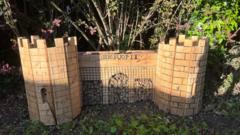
These are not just wooden boxes. They are architectural echoes. Here stands a miniature Shard, its sharp angles mimicking the glass giant towering overhead. Beside it, a tiny version of the Guy’s Hospital tower. They are intricate, hand-crafted, and oddly moving. They are "bug hotels," but that clinical term fails to capture the stakes of what is actually happening here. We are witnessing a desperate, creative peace treaty between our concrete ambitions and the fragile creatures that actually keep our world running.
The Great Disconnect
To understand why these miniature landmarks matter, we have to look at the ground beneath our expensive boots. In the heart of London, soil is a luxury. Greenery is often "managed"—which is a polite way of saying it is pruned, sprayed, and stripped of the messy decay that life requires.
Consider a solitary bee. Unlike the social honeybee, she doesn't have a hive. She doesn't have a queen to protect her or a legion of sisters to help build a home. She is a freelancer. She needs a hollow stem, a crack in a wall, or a patch of undisturbed earth to lay her eggs. In a modern city, we have sealed those cracks with mortar. We have paved the earth. We have replaced the wild complexity of the Thames banks with "clean" lines and sterilized surfaces.
We see a tidy garden. The bee sees a wasteland.
The problem isn't just aesthetic; it’s a quiet collapse. When the insects vanish, the birds follow. The urban ecosystem doesn't die with a bang; it just stops humming. We lose the pollinators that keep the nearby parks blooming. We lose the natural recyclers that turn waste into life. We are left with a city that is efficient, shiny, and profoundly lonely.
Building for the Invisible Guest
The project near London Bridge, spearheaded by Team London Bridge and local partners, addresses this void with a touch of whimsy and a lot of science. By recreating the local skyline in wood and recycled materials, they have turned a boring conservation effort into a conversation piece.
The design is intentional. Each "floor" of these miniature skyscrapers is packed with different textures. There are logs with holes drilled into them for solitary bees. There are tight bundles of bamboo for lacewings. There are layers of dry leaves and pinecones for ladybirds seeking shelter from the biting wind that whips off the river.
Think of it as a multi-generational apartment block for the misunderstood. While we rush to catch the 17:02 to Brighton, a beetle might be settling into the "Guy’s Hospital" basement to survive a frost. A spider might be weaving a web in the rafters of the "Shard," keeping the local fly population in check without a single drop of pesticide.
It’s an admission of guilt, in a way. We built the big city for ourselves, so we build the small city to apologize for taking up all the space.
The Human at the Station
There is a specific kind of magic that happens when a commuter notices these structures. I watched a man last Tuesday—sharp suit, briefcase, the kind of person who looks like he measures his life in six-minute billable increments. He was halfway to the ticket barrier when the miniature Shard caught his eye.
He stopped.
He leaned over, squinting at a piece of hollow bamboo. For thirty seconds, the train didn't matter. The emails didn't matter. He was looking for a sign of life. When he finally walked away, his shoulders were lower. He looked less like a cog in a machine and more like a person who remembered that he shared the planet with other things.
That is the invisible dividend of urban rewilding. It isn't just about the bugs. It’s about the psychological relief of knowing that we aren't alone in the concrete. These structures serve as a bridge. They remind us that the "environment" isn't something that happens "out there" in the countryside; it is something that happens under our feet, even in the shadow of a railway station.
Why the Landmarks Matter
By choosing to mimic the local landmarks, the creators have tapped into a powerful psychological truth: we protect what we recognize. If these were just generic wooden crates, they would be ignored. They would be seen as clutter. But by giving them the shapes of our own triumphs—our hospitals and our skyscrapers—we grant them status.
We are saying that the habitat of a masonry bee is just as vital to the functioning of London as the offices of a global bank. It’s a radical statement disguised as a craft project.
These miniature cities are also a masterclass in local sourcing. The materials aren't high-tech. They are bits of the city repurposed. Old pallets, fallen branches from nearby parks, discarded bricks. It’s a closed-loop system. It’s a reminder that nature doesn't need us to build high-tech solutions; it just needs us to stop being so tidy. It needs us to leave a little room for the rot, the rough edges, and the wildness.
The Ripple Effect
One bug hotel at a station won't save the world. But it changes the map. When you create a "stepping stone" of habitat, you allow species to move through the city. An insect can travel from a balcony garden in Bermondsey to the bug hotel at London Bridge, and from there to the green spaces of the City of London.
Without these stops, the city is an impassable wall. With them, it becomes a corridor. We are essentially building a transit system for wildlife that runs parallel to our own. The station becomes a hub for two different kinds of travelers.
The success of these projects is measurable, but the most important metrics aren't the ones you find on a spreadsheet. You find them in the return of the goldfinches, who come for the insects. You find them in the health of the flowers in the window boxes three streets away. You find them in the curiosity of a child who sees a ladybird crawling into the miniature Shard and realizes, for the first time, that the city is alive.
The Cost of Doing Nothing
The alternative is a sterile perfection. We can have our clean streets and our polished stone, but it comes at a price. A city without insects is a city that is slowly suffocating. We rely on these tiny engineers for everything from waste decomposition to the very air we breathe through the plants they pollinate.
The "dry" facts of biodiversity loss are easy to ignore. They feel distant. But when you see the effort required to build a home for a creature no bigger than a fingernail, the scale of our impact becomes clear. We have made the world so difficult for them that we have to build them replicas of our own buildings just to give them a fighting chance.
It's a humbling realization. We like to think of ourselves as the masters of the urban environment, but we are actually its most dependent tenants.
The next time you find yourself at London Bridge, ignore the clock for a moment. Look for the little Shard. Look for the life hiding in the cracks of the wood. There is a whole world happening beneath the noise of the city, a tiny, buzzing civilization that doesn't care about the stock market or the delays on the Jubilee Line. They are just trying to find a place to stay the night.
In giving them a room, we might just be saving a room for ourselves in the future.
The shadows of the great skyscrapers stretch long over the pavement as the sun sets, but in the hollows of the miniature towers, the lights are just turning on. A beetle settles into a bed of dry moss. A bee vibrates its wings to stay warm. The station roars above them, a tidal wave of human ambition, but here, in the quiet wood, the city is finally at rest.