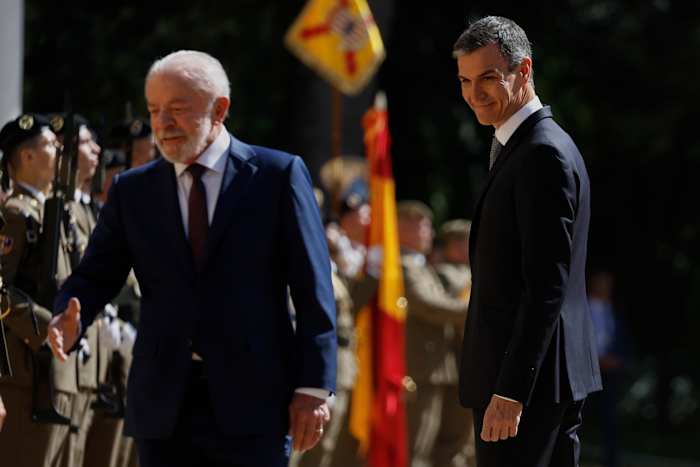
The air in Barcelona has a way of thickening when the humidity rolls off the Balearic Sea, turning the city’s grand boulevards into a humid stage for the theater of history. On this particular afternoon, the stakes weren’t measured in trade volume or tax brackets. They were measured in the survival of an idea.
Luiz Inácio Lula da Silva, the man who rose from shoeshine boy to the presidency of Brazil, sat across from Pedro Sánchez, the Spanish Prime Minister who has turned political survival into a high-art form. They didn't look like men discussing dry policy. They looked like two captains on a leaking ship, trying to figure out how to plug the holes before the tide of global populism swallows the remaining center-ground.
The world they represent is shrinking.
Imagine, for a moment, a small-town baker in the suburbs of Madrid or a factory worker in São Bernardo do Campo. To them, the "Progressive International" is a phrase that tastes like cardboard. What they feel is the rising cost of bread, the heat of a summer that never seems to end, and the nagging suspicion that the people in charge have forgotten how to speak their language. Lula and Sánchez were in Barcelona to prove that they haven't. But the walls are closing in.
The Ghost at the Banquet
While the headlines focused on the handshake, the real story was the invisible guest at the table: the far-right. From the pampas of Argentina to the halls of the European Parliament, a different kind of energy is winning. It’s loud. It’s angry. It’s simple.
Lula knows this better than anyone. He spent 580 days in a prison cell while his country drifted toward an era of fire and fury under Jair Bolsonaro. When he looks at Sánchez, he sees a mirror image of his own struggle—a leader trying to govern a house divided against itself, where every legislative win is met with a digital scream from the fringes.
They aren't just fighting for "progressive values." They are fighting for the relevance of the state itself.
Consider the metaphor of the lighthouse. For decades, the democratic center-left was the steady beam that guided the ship of state through the storms of the 20th century. Now, the bulb is flickering. The voters are no longer looking for a steady beam; they are looking for a flare that matches their own internal fire.
A Language Without a Dictionary
The struggle in Barcelona was, at its heart, a struggle over vocabulary. How do you talk about climate change to someone whose house just flooded, but who also can't afford the new electric car you're subsidizing? How do you talk about global cooperation when the person across the street believes that every international treaty is a secret plot to steal their sovereignty?
Sánchez and Lula are trying to draft a new dictionary.
They spoke of "democratic resilience," but what they meant was "how do we stop people from wanting to burn the whole thing down?" They spoke of "social justice," but the subtext was "how do we make the economy feel human again?"
The facts of the meeting are straightforward:
- A push for a global tax on the super-rich.
- Coordination on green energy transitions.
- A unified front against the disinformation campaigns that act like a digital virus across the Atlantic.
But these are just bullet points on a briefing paper. The reality is much more visceral. It is the sound of two men trying to convince a skeptical public that the slow, grinding work of democracy is still better than the fast, explosive promise of autocracy.
The Barcelona Protocol of the Soul
The venue was deliberate. Barcelona is a city of rebels and dreamers, a place that has seen the best and worst of ideological fervor. By meeting here, Lula and Sánchez were tapping into a historical current that runs deep through the Spanish-speaking world and its former colonies.
There is a shared trauma in these cultures—the memory of dictatorships that lasted for decades. This isn't an abstract concern for them. It is a family history. When Lula speaks about protecting the Amazon or Sánchez talks about European integration, they are building a wall against the return of the "Strongman."
But walls are expensive. And they require maintenance.
The "Invisible Stakes" of this summit were found in the eyes of the young activists standing outside the perimeter. They weren't cheering. They were waiting. To them, the progressivism of the past feels like a suit that no longer fits. It’s too tight in the shoulders and too long in the sleeves. They want a radicalism of the center—a way to be bold without being broken.
The Gravity of the Moment
History doesn't happen in a vacuum. It happens in the gaps between what we are promised and what we actually receive.
The Barcelona meeting was an attempt to bridge that gap. If Lula can’t show the Brazilian worker that democracy puts meat on the table, that worker will look elsewhere. If Sánchez can’t show the Spanish youth that there is a future beyond temporary contracts and skyrocketing rents, they will listen to the voices on the edges who promise to tear the system apart.
There is a specific kind of exhaustion that comes with being a moderate in an age of extremes. It’s the exhaustion of having to explain why nuance matters when the world wants a slogan.
Lula and Sánchez are leaning into that exhaustion. They are betting that if they can link their two continents—the raw potential of South America and the institutional weight of Europe—they can create a gravity well strong enough to pull the world back toward some form of sanity.
The Unwritten Ending
The cameras eventually packed up. The motorcades wound through the narrow streets, heading back toward the airport and the palace. The official communiqués were filed, full of the usual diplomatic fluff about "deepening ties" and "shared horizons."
But the real outcome of the Barcelona summit won't be found in those documents. It will be found in the next election cycle. It will be found in whether or not the "Global South" feels like a partner or a project. It will be found in the kitchen table conversations of people who didn't even know the meeting was happening.
We are living through a massive, unscripted experiment. We are testing whether a compassionate, slow-moving democracy can outrun a fast-moving, grievance-fueled movement.
Sánchez and Lula are the lead scientists in this experiment. They are mixing volatile chemicals in a room full of open flames. They are trying to prove that the middle is not a place of weakness, but a place of incredible, quiet strength.
The Mediterranean sun set over the city, casting long, distorted shadows of the Gothic spires. The shadows looked like giants, but as the light faded, they were revealed for what they were: just the outlines of old stones, waiting for someone to give them a new purpose.
The ship is still leaking. The captains are still arguing over the map. But for one afternoon in Barcelona, they at least agreed on the direction of the wind.
Whether the crew follows them is another story entirely.