The efficiency of an urban police response to a violent blade-related incident is determined by the intersection of three critical variables: the speed of initial containment, the precision of tactical deployment, and the management of public safety corridors. On a Monday afternoon in Edinburgh's New Town, specifically the Great Stuart Street and Queensferry Street corridor, these variables were tested during a high-stakes intervention involving an armed suspect and multiple casualties. To understand the operational reality of this event is to analyze the structural friction between public order and sudden, localized violence.
The Architecture of Response
The police response in Edinburgh followed a rigid hierarchy of escalation designed to minimize lethality while neutralizing a dynamic threat. This hierarchy functions as a decision tree where the presence of a "bladed weapon" automatically triggers the deployment of Specialist Firearms Officers (SFOs).
- Notification and Triaging: The initial reports of a man with a knife near Great Stuart Street initiated a Grade 1 emergency response. In this phase, the primary objective is not yet apprehension, but the establishment of a "cordon of influence" to prevent the suspect from migrating into high-density retail zones like Princes Street.
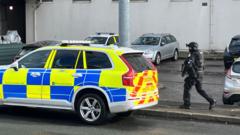
- Specialist Mobilization: The arrival of armed units signifies a shift from patrol-level containment to tactical resolution. The use of SFOs in a non-firearm capacity (such as the deployment of TASER or tactical distraction) is a calculated move to provide a disproportionate force options profile, ensuring the suspect has no viable path to further violence.
- Casualty Extraction: Simultaneous to the tactical engagement, the Scottish Ambulance Service (SAS) and the Specialist Operational Response Team (SORT) must operate within a "Warm Zone"—an area where the threat is contained but not yet neutralized.
The Casualty Calculus
Two individuals sustained injuries during this incident. From a clinical and operational perspective, the nature of these injuries dictates the post-incident investigative priority. If injuries occur prior to police arrival, the focus is on "motive and proximity." If injuries occur during the intervention, the focus shifts to "tactical proportionality."
The logistics of the medical response involved:
- Two ambulances.
- One trauma team.
- The aforementioned SORT unit.
The presence of a trauma team suggests that the severity of the injuries required advanced pre-hospital interventions, likely to stabilize patients before they could be safely transported to the Royal Infirmary of Edinburgh. This medical footprint indicates a high kinetic energy event where the window for life-saving intervention was narrow.
Tactical Friction in High-Density Urban Environments
Edinburgh’s New Town presents unique challenges for tactical units. The Georgian architecture and narrow "mews" lanes create significant lines-of-sight issues.
The Perimeter Constraint
Large-scale cordons were established across Great Stuart Street and its intersections. These cordons serve two functions:
- Information Siloing: Preventing the public from entering the "Hot Zone" where the suspect is active.
- Tactical Buffer: Providing a sanitized space for SFOs to maneuver vehicles and equipment without civilian interference.
The closure of these arterial roads creates a secondary crisis: the paralysis of urban mobility. This trade-off is the "Security-Mobility Paradox." For every minute a primary thoroughfare like Queensferry Street is closed, the logistical pressure on the city’s transport network increases exponentially, forcing police to balance the thoroughness of a forensic sweep against the necessity of reopening the city.
Forensic Reconstruction and Evidentiary Chains
Once the suspect was detained—a process confirmed by Police Scotland shortly after the initial reports—the scene shifted from a tactical operation to a forensic one. This phase is governed by the "Principle of Exchange," where investigators must map the physical relationship between the suspect, the victims, and the weapon.
- Weapon Recovery: The recovery of the knife is the primary evidentiary goal. Its location relative to the suspect at the time of "tactical contact" determines the legal framework for the arrest.
- Bloodstain Pattern Analysis (BPA): In the outdoor environment of Great Stuart Street, environmental factors (wind, rain, pavement porosity) degrade evidence quickly. The speed of the forensic team’s arrival is the bottleneck for accurate reconstruction.
- Digital Footprint: In a modern urban setting, the physical evidence is supplemented by CCTV from local businesses and "citizen journalism" via mobile devices. This creates a multi-angle timeline that often contradicts or clarifies initial witness statements.
The Operational Bottleneck
The primary limitation in these scenarios is the "Information Lag." Between the first 999 call and the arrival of the first armed unit, there is a period of "unmanaged risk." During this window, the suspect’s movements are unpredictable. The Edinburgh incident highlights that while the tactical response was rapid, the initial casualties occurred within this unmanaged window. This confirms that urban security is not a preventative shield but a reactive mechanism designed to truncate the duration of an active threat.
Strategic Priority for Urban Stakeholders
For businesses and residents in the West End and New Town, the takeaway is the necessity of "Dynamic Lockdown" protocols. When a Grade 1 incident is initiated, the time to secure a perimeter is measured in seconds, not minutes. The transition from a civilian space to a tactical theater happens without warning.
The focus for the next 48 hours will be the criminal processing of the 31-year-old male suspect and the stabilization of the two casualties. From a strategy perspective, the city must now execute a "Confidence Restoration" plan, ensuring that the heavy police presence—which can inadvertently signal a lingering threat—is replaced by clear communication regarding the isolated nature of the event.
Immediate action: Establish a standardized "Incident Notification" bridge between Police Scotland and major West End commercial entities to reduce the Information Lag in future Grade 1 events. This protocol should bypass traditional news cycles and provide real-time perimeter data to facility managers to trigger internal safety lockdowns before the suspect reaches their vicinity.