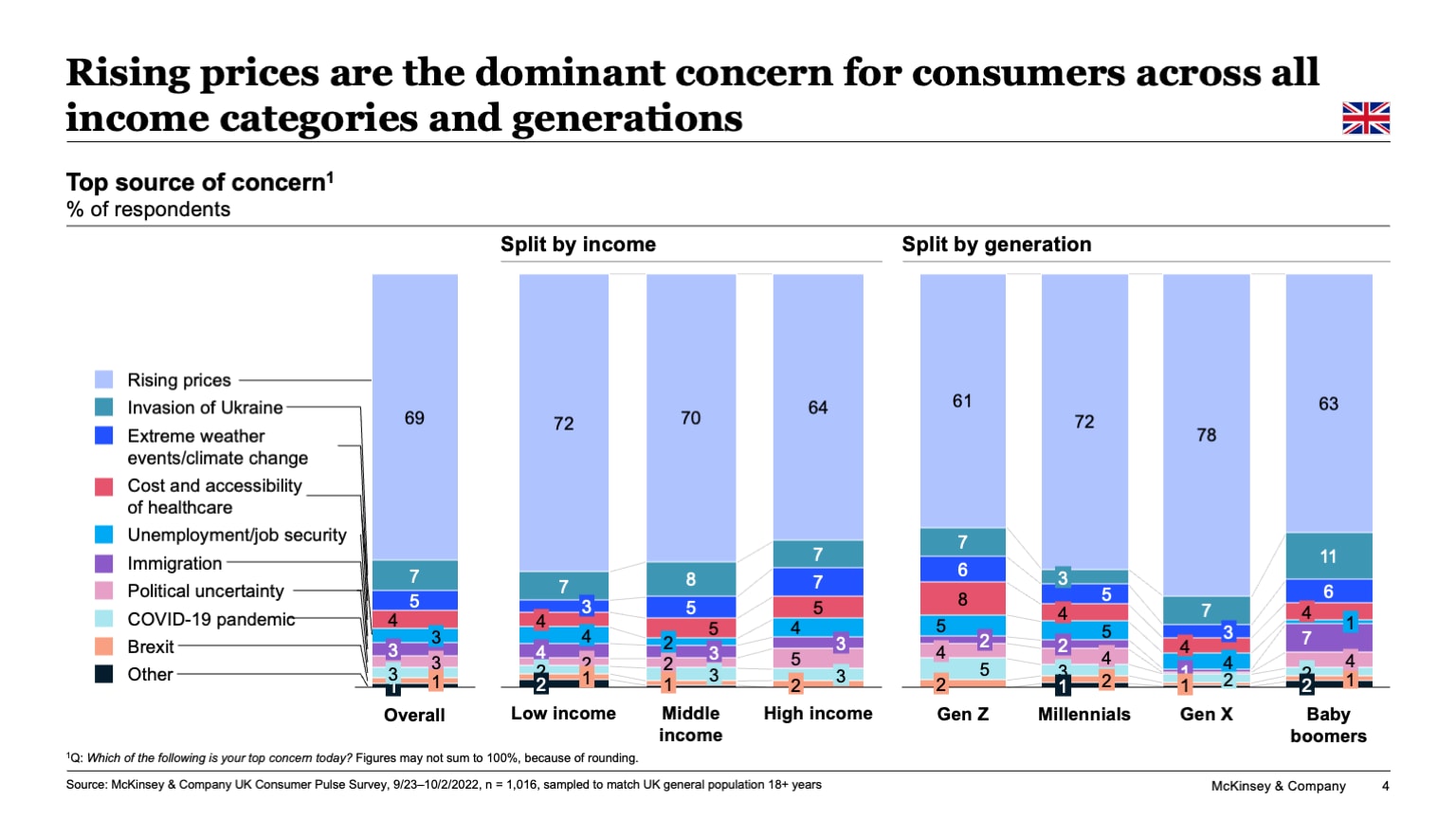
UK household sentiment has decoupled from topline inflationary cooling, signaling a fundamental shift in the domestic cost-absorption capacity. While headline Consumer Price Index (CPI) figures suggest a return toward central bank targets, the GfK Consumer Confidence Index has regressed to levels not seen since early 2024, effectively erasing the "recovery narrative" built during the preceding quarters. This divergence indicates that consumer behavior is no longer being driven by the rate of price increases, but rather by the cumulative exhaustion of disposable income and a structural recalibration of long-term economic expectations.
The Triad of Sentiment Erosion
To understand why confidence is collapsing despite a stabilizing macro-environment, we must isolate the three primary drivers of the current UK contraction. This isn't a singular reaction to a news cycle; it is a compounding failure of three distinct economic pillars. For a more detailed analysis into similar topics, we recommend: this related article.
1. Cumulative Price Level Fatigue
Inflation is a derivative of price, not the price itself. A drop in inflation to 2% does not mean goods are cheaper; it means they are becoming more expensive at a slower rate. UK consumers are currently operating at a price plateau roughly 20% higher than in 2021. The "felt" economy is defined by the absolute cost of the weekly shop and utility bills, which remain at historic highs. When nominal wage growth fails to significantly outpace this accumulated price jump, the result is a permanent reduction in discretionary margins.
2. Fiscal Anticipation and Tax Friction
The UK consumer is currently pricing in "fiscal drag" and anticipated tax hikes. With the government signaling a need to fill "fiscal black holes," households are preemptively tightening belts. This is a rational response to Ricardian Equivalence—the economic theory suggesting that consumers curtail spending today in anticipation of higher taxes tomorrow. The psychological weight of an upcoming Budget often does more damage to retail velocity than the actual policy changes themselves, as uncertainty functions as a hidden interest rate on consumer activity. To get more information on the matter, detailed analysis can be read on MarketWatch.
3. The Mortgage Renewal Cliff
The transmission of monetary policy in the UK has a significant lag due to the prevalence of fixed-rate mortgages. Hundreds of thousands of households continue to roll off 2% or 3% deals onto rates exceeding 5%. For these families, the "cost of living crisis" is just beginning. This creates a staggered suppression of confidence as different cohorts of the population hit their personal interest rate reset dates at different times, ensuring that the aggregate sentiment remains depressed for an extended period.
Quantifying the Discretionary Deficit
The primary bottleneck for UK economic growth is the shrinking Discretionary Income Margin (DIM). We can express the pressure on a typical household through a basic cost function:
$$DIM = NI - (H + U + F + D)$$
In this equation, NI represents Net Income, H is Housing (rent/mortgage), U is Utilities, F is Food/Essentials, and D is Debt Servicing.
Structural shifts in the UK economy have increased the coefficients of H, U, and F simultaneously. When these non-negotiable costs rise, the DIM does not just shrink; it often enters a negative feedback loop where consumers use high-interest credit to bridge the gap, increasing D in the next cycle and further suppressing future confidence. This explains why the GfK’s "Major Purchase Index"—a proxy for the willingness to buy big-ticket items—has seen a sharper decline than the general sentiment index. Consumers are prioritizing survival over expansion.
The Velocity of Negative Expectations
Economic sentiment acts as a self-fulfilling prophecy through the "Expectations Trap." When the GfK survey records a drop in "Personal Financial Situation over the next 12 months," it triggers a specific sequence of defensive behaviors:
- Precautionary Saving: Even those with stable incomes increase their savings rate as a hedge against perceived instability. This removes liquidity from the high street.
- Trade-Down Substitution: Consumers shift from premium brands to private labels and from mid-market retailers to discounters. This compresses margins for businesses, leading to reduced corporate investment.
- Delayed Lifecycle Events: Major life decisions—buying a home, starting a family, or upgrading a vehicle—are postponed. This creates a secondary stagnation in the housing and automotive markets.
This sequence suggests that the UK is not facing a temporary dip, but a structural realignment where the "middle class" consumer is adopting the spending habits of lower-income tiers to maintain solvency.
Regional and Demographic Variance
The decline in confidence is not uniform. A granular analysis reveals a widening gap between asset-rich demographics and those reliant solely on labor income.
- The Generational Divide: Older demographics with paid-off mortgages and inflation-linked pensions (via the Triple Lock) show significantly higher resilience. Their confidence remains relatively stable, buoyed by high interest rates on their savings.
- The Renting Cohort: Younger and urban populations are facing the dual pressure of wage stagnation and record-high rents. In London and other major hubs, the rent-to-income ratio has reached a breaking point, making any positive sentiment statistically impossible for this group.
- The Geographic Split: Industrial and formerly "red wall" areas are experiencing a faster decline in confidence than the Southeast. This is linked to the higher energy intensity of businesses in these regions, leading to greater fears of local unemployment.
The Institutional Credibility Gap
The Bank of England and the Treasury face a crisis of confidence that transcends data points. When institutions repeatedly forecast a "soft landing" or a "turning of the corner" while the average household's bank balance continues to dwindle, the credibility of official narratives erodes.
This creates a "noise-to-signal" problem. Consumers stop listening to headline economic growth figures (GDP) because they no longer correlate with their standard of living. If GDP grows by 0.2% but real-terms disposable income falls by 1.5%, the GDP figure is viewed not just as irrelevant, but as deceptive. This cynicism is a potent fuel for the "lowest in two years" sentiment readings.
Strategic Realignment for UK Enterprises
Businesses operating in this environment must move beyond traditional "promotional" strategies. High-trust, value-oriented models are the only sustainable path forward until the macro-volatility subsides.
The Inventory De-risking Strategy
Retailers must assume the Major Purchase Index will remain in negative territory for at least three to four quarters. Carrying high levels of luxury or non-essential inventory is now a high-risk gamble. The focus must shift to "essentialized" marketing—positioning products as investments that save money over the long term (e.g., energy-efficient appliances) rather than lifestyle upgrades.
Pricing Elasticity Testing
The window for aggressive price hikes has closed. Consumers have developed a high sensitivity to "shrinkflation" and "skimpflation." Brands that attempt to maintain margins through hidden quality reductions risk permanent brand damage. A more effective strategy is the "Tiered Value Architecture," offering a bare-bones entry-level version of a product to capture the cost-conscious segment while maintaining a premium tier for the asset-rich demographic that remains insulated from the crisis.
Labor Optimization vs. Retention
The natural corporate reaction to falling consumer confidence is to freeze hiring or reduce headcount. However, in a tight labor market, this can lead to a "service death spiral" where reduced staff levels lead to poor customer experiences, further alienating a shrinking customer base. Firms should instead pivot toward productivity-linked incentives, ensuring that the existing workforce is optimized through better technology rather than just being spread thinner.
The Pivot to Defensive Positioning
The bottoming out of UK consumer confidence is not an anomaly; it is the market reaching an equilibrium point after three years of sustained shocks. The "V-shaped recovery" is a myth in this context. We are looking at a "L-shaped" or "U-shaped" stagnation period where the primary objective for both households and businesses is capital preservation.
The decisive factor for the next 12 months will be the government's ability to provide a clear, long-term fiscal roadmap that reduces the "Uncertainty Tax" currently weighing on the public psyche. Until then, the contraction of the Major Purchase Index will dictate the pace of the economy. The smart move for any entity exposed to the UK consumer is to prepare for a "Low-Velocity Economy" where growth is found through capturing market share from failing competitors rather than expecting an overall increase in the size of the pie.
Total consumer spending is unlikely to return to its 2019 trendline in real terms until the mortgage renewal cycle has fully washed through the system—a process that will take until at least 2027. Success in this landscape requires a brutal acceptance of these constraints. Firms must optimize for a smaller, more cynical, and highly price-sensitive audience. The era of easy growth fueled by cheap credit and optimistic sentiment has ended; the era of the disciplined, data-driven survivalist has begun.


