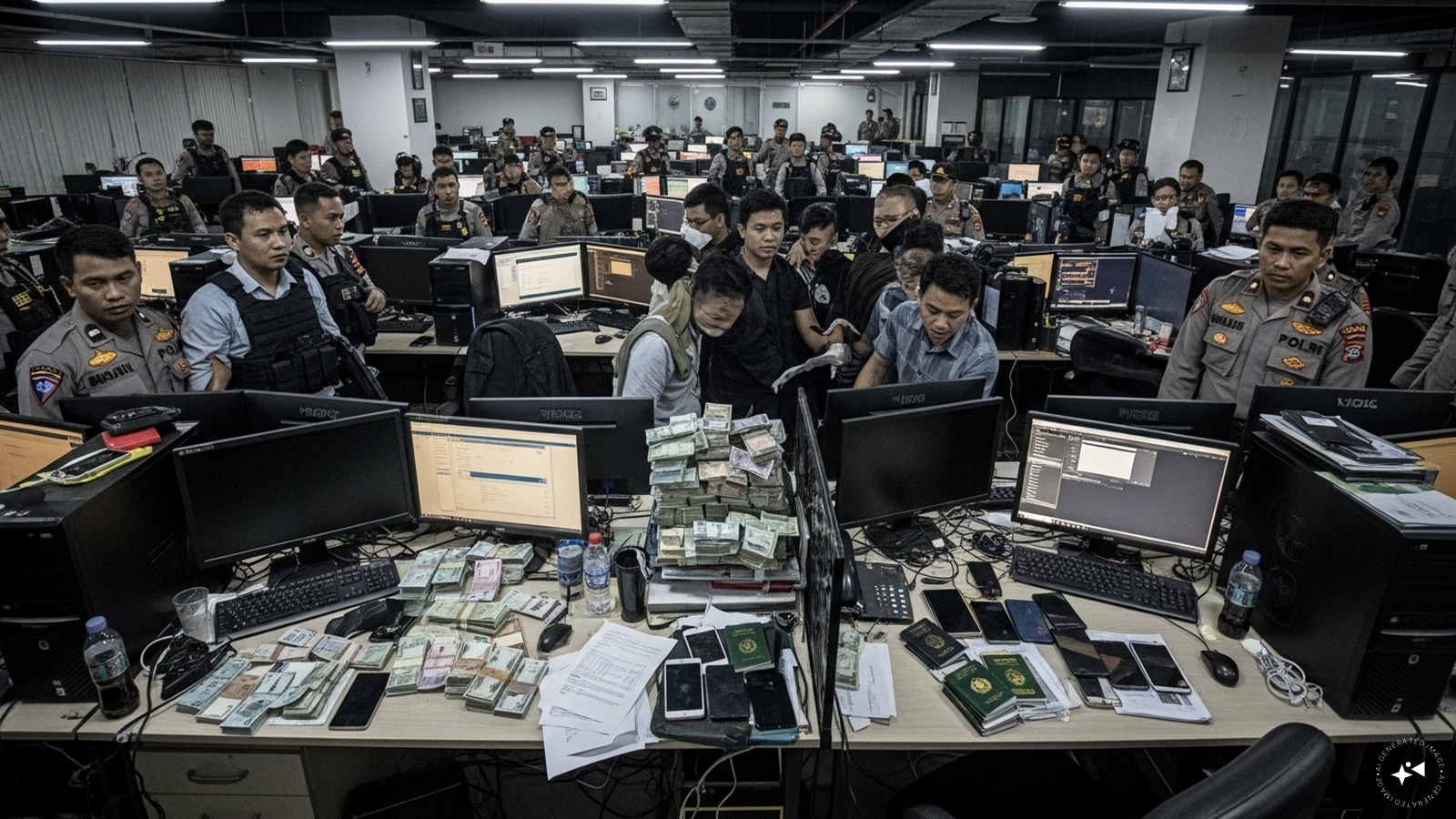
The arrest of 321 foreign nationals across 75 online betting platforms in Indonesia is not an isolated law enforcement success but a data point revealing the industrialization of digital shadow economies. This operation exposes a sophisticated operational model that treats sovereign borders as latency buffers and regulatory loopholes. To understand why Indonesia has become a primary theater for these syndicates, one must look past the headlines of the raid and analyze the structural convergence of high mobile penetration, fragmented payment gateways, and the labor arbitrage of displaced foreign workers.
The Tripartite Architecture of Transnational Betting Operations
The modern online gambling syndicate functions via a decentralized infrastructure designed to minimize localized risk while maximizing regional reach. These 75 sites do not operate as independent businesses; they are nodes in a wider network characterized by three distinct functional layers.
1. The Technological Core (Offshore Hosting)
Most betting platforms utilize white-label software provided by developers typically based in jurisdictions with permissive licensing, such as the Philippines (PAGCOR) or Curacao. The back-end logic, including RNG (Random Number Generation) algorithms and odds-making engines, rarely sits on servers within the country of operation. By hosting the core "brain" of the platform in a third-party jurisdiction, the syndicate ensures that even a physical raid on an operations center—like the one conducted by Indonesian police—does not result in the destruction of the gambling platform itself. The business remains live; only the local fulfillment cell is neutralized.
2. The Operational Fulfillment Layer (Local Hubs)
The 321 individuals arrested represent the "Human Capital" component of the fulfillment layer. This layer handles the high-touch aspects of the business that cannot be easily automated or outsourced to a different time zone:
- Customer Acquisition and Support: Real-time chat in local dialects or the primary language of the target demographic.
- Social Engineering: Managing thousands of fake social media profiles to bypass advertising bans on platforms like Meta and X.
- Technical Redundancy: Maintaining a rotation of "mirror sites" and alternative URLs to circumvent DNS blocking by the Indonesian Ministry of Communication and Information Technology (Kominfo).
3. The Financial Clearinghouse (Shadow Banking)
Online betting in Indonesia thrives on the friction between formal banking and the rise of e-wallets. Syndicates utilize a "Mule Account" system where local bank accounts are purchased or rented from Indonesian citizens. These accounts act as the initial collection point for small-dollar deposits. From there, funds are layered through various digital assets or underground "Hawala" style transfers to be moved offshore. The sheer volume of 75 sites suggests a highly efficient, high-velocity money laundering pipeline that likely processes trillions of Rupiah monthly.
The Labor Arbitrage of Migrant Cyber-Workforce
The presence of over 300 foreign nationals—predominantly from neighboring Asian countries—indicates an intentional strategy to bypass local loyalty and increase operational security. This "Migrant Workforce Model" offers the syndicate several strategic advantages:
- Language Specificity: Many of these operations target their home countries from Indonesian soil, utilizing Indonesia as a "safe harbor" to attack foreign markets. Conversely, if targeting Indonesians, the syndicate uses foreign managers to oversee local staff to prevent internal whistleblowing.
- Coercive Control: Foreign workers operating on temporary or fraudulent visas are easier to control. Their legal status is tied to the syndicate's protection, creating a high barrier to exit and reducing the risk of cooperation with local authorities.
- Operational Isolation: By housing workers in concentrated residential or commercial compounds, the syndicate creates a closed-loop environment. This minimizes the "surface area" of the operation, making it invisible to the local community until a centralized police action occurs.
The Failure of Digital Prohibition
The Indonesian government’s aggressive stance on gambling—rooted in both legal and cultural mandates—faces a fundamental "Hydra Effect." For every 75 sites shuttered, the low barrier to entry for digital storefronts allows 150 more to emerge. The current enforcement mechanism relies heavily on URL filtering and physical raids, both of which are reactive.
The core of the problem lies in the Incentive Asymmetry. For the state, enforcement is a cost-heavy, perpetual drain on resources. For the syndicate, the "Cost of Goods Sold" is remarkably low. Digital assets are infinitely replicable, and the labor pool for "grey-area" tech work is vast. When a raid occurs, the syndicate treats the loss of hardware and the arrest of low-level staff as a "tax" on operations—a predictable capital expenditure rather than a terminal event.
Identifying the Bottleneck: Payment Gateway Friction
While the technical infrastructure is resilient, the financial infrastructure is the syndicate’s most vulnerable point. The "last mile" of gambling—getting money from a gambler’s pocket into the system—requires a bridge to the local economy.
- Payment Aggregator Exploitation: Syndicates often masquerade as legitimate e-commerce entities to gain access to payment APIs.
- QRIS Vulnerability: The rapid adoption of QRIS (Quick Response Code Indonesian Standard) has provided a standardized, high-speed rail for micro-transactions that are difficult for traditional anti-money laundering (AML) software to flag in real-time.
To effectively dismantle these networks, the focus must shift from the visibility of the "storefront" (the website) to the invisibility of the "ledger" (the payment flow).
Strategic Vector: Integrated Financial Interdiction
The arrest of 321 operators serves as a temporary disruption, but it does not alter the market dynamics that make Indonesia a hub for online betting syndicates. A definitive shift in strategy requires moving beyond physical enforcement toward a multi-stakeholder financial blockade.
- Algorithmic AML for E-Wallets: Financial institutions must implement specific pattern recognition for high-frequency, low-value transfers that characterize gambling deposits, particularly those peaking during high-profile sporting events.
- Cross-Border Jurisdictional Harmonization: Since the syndicates operate across borders, law enforcement must focus on the "Service Providers"—the white-label software firms and server farms—rather than just the "End-Users" or "Fulfillment Staff."
- Digital Identity Integrity: Strengthening the KYC (Know Your Customer) requirements for prepaid SIM cards and e-wallet registrations is the only way to break the "Mule Account" cycle that allows these 75 sites to process payments with impunity.
The survival of these syndicates depends on their ability to remain "liquid and local." Neutralizing the physical staff is a tactical win; neutralizing the ability to move currency across the digital border is the strategic necessity.

