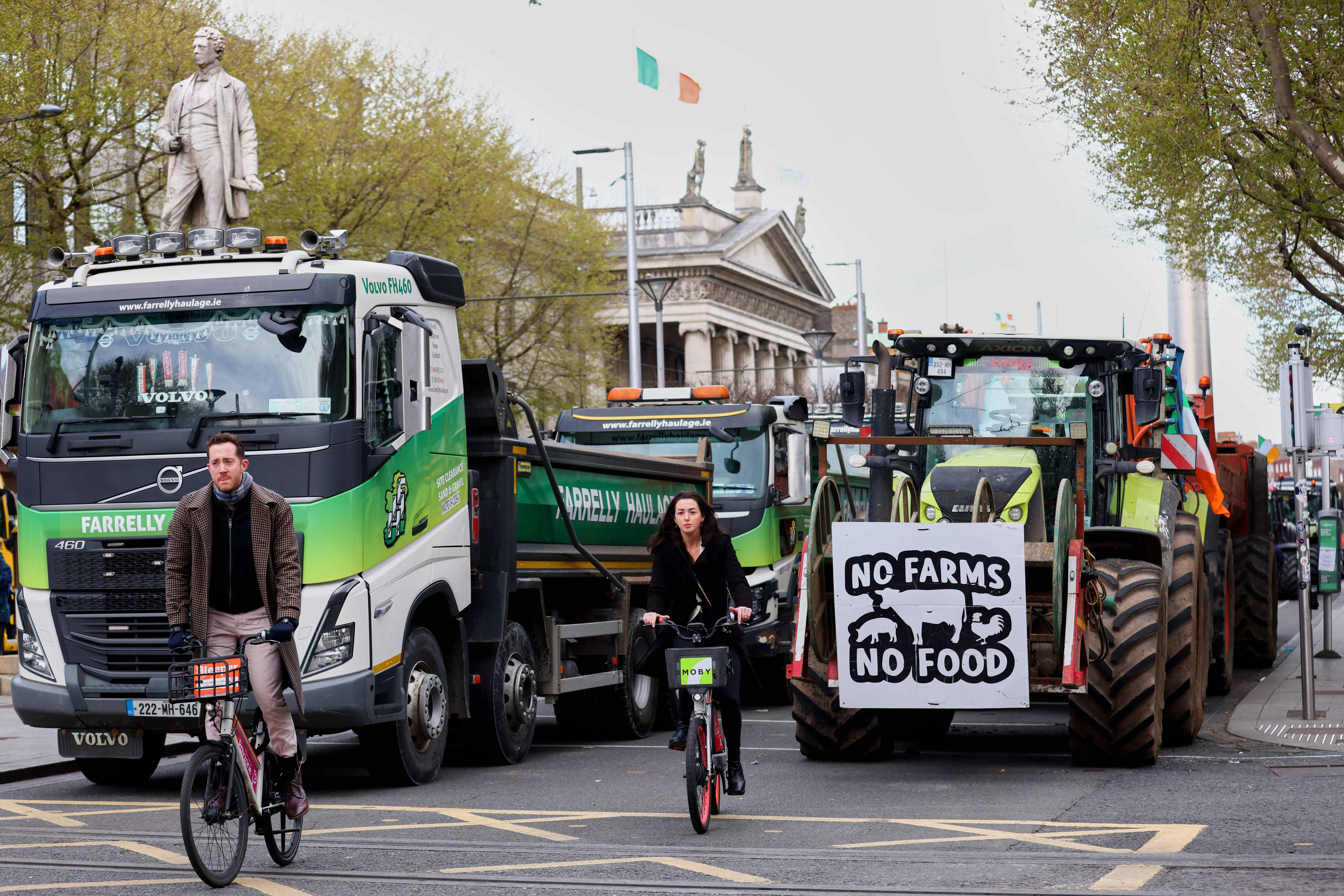
The stability of the Irish government is currently being tested not by ideological shifts, but by a failure to manage the intersection of energy inflation and tax policy. A no-confidence vote is the terminal symptom of a breakdown in the social contract between the state's fiscal requirements and the citizen's cost of living. To understand this crisis, one must look past the optics of protests and analyze the structural rigidity of Ireland’s fuel tax regime, the logistics of rural dependence, and the mathematical impossibility of maintaining current carbon tax trajectories without a robust alternative energy infrastructure.
The Trilemma of Irish Fuel Pricing
The volatility in Irish fuel prices is governed by three conflicting variables: global crude markets, the EU’s Environmental Policy Framework, and the State’s reliance on excise duties. Unlike fixed costs, these variables interact to create a "pricing floor" that the government cannot lower without breaching international climate commitments or creating a massive fiscal deficit.
- The Fiscal Anchor: Ireland’s tax on petrol and diesel is not a single levy but a composite of Excise Duty, Carbon Tax, and Value Added Tax (VAT). Because VAT is a percentage (23%), any increase in the base cost of fuel yields a proportional increase in tax revenue. This creates a perverse incentive structure where the state technically benefits from higher prices, even as public pressure to provide relief mounts.
- The Carbon Escalator: Under the Finance Act 2020, Ireland committed to a predetermined annual increase in carbon tax, aiming for €100 per tonne by 2030. This is a non-discretionary legislative mechanism. While it serves a long-term environmental goal, it functions as a regressive tax in the short term, disproportionately impacting the bottom two quintiles of the income distribution.
- The Supply Chain Inelasticity: As an island nation, Ireland’s energy security is tied to the physical constraints of shipping and storage. The lack of domestic refining capacity for modern fuels means the "spread" between global crude prices and local pump prices is wider than in mainland Europe, due to high transportation and logistics overheads.
Rural Dependency and the Logistics of Discontent
The fuel protests are not a monolithic movement; they are a manifestation of the "Rural-Urban Infrastructure Gap." The government’s failure to differentiate between discretionary and non-discretionary fuel use has created a geographic flashpoint for political instability.
In Dublin, transport infrastructure allows for a degree of price elasticity—users can switch to the Luas or DART as fuel prices rise. In rural counties like Donegal, Mayo, or Cavan, fuel demand is perfectly inelastic. There is no alternative to the internal combustion engine for the transport of goods, school commutes, or healthcare access. When the government applies a blanket carbon tax, it essentially imposes a geographic penalty on rural residents.
This creates a Cost-Push Inflation Spiral:
- Fuel Input Costs: Hauliers and farmers face immediate margin compression.
- Pass-Through Pricing: To survive, transport companies increase freight rates.
- Consumer Impact: The price of groceries and essential goods rises, compounding the initial fuel cost increase.
- Political Friction: The resulting "cost-of-living crisis" erodes the legitimacy of the sitting coalition, leading to the current no-confidence threat.
The Mathematics of the No-Confidence Vote
The threat of a no-confidence motion is a tactical maneuver by the opposition to capitalize on a specific parliamentary vulnerability: the shrinking majority. In a coalition government, the "Pivot Point" is the handful of independent TDs or junior coalition members who must balance their local survival against national party loyalty.
The probability of the government falling can be expressed through a simple Political Survival Function:
$P(S) = (M \cdot L) - (V_{cost} \cdot D)$
Where:
- M: The nominal seat majority.
- L: The level of internal party discipline.
- V_cost: The perceived electoral cost of supporting the government during a crisis.
- D: The intensity of public discontent (measured by protest frequency and polling).
As fuel prices remain above the psychological threshold of €1.80-€2.00 per liter, the $V_{cost}$ increases. For an Independent TD in a rural constituency, the risk of losing their seat in a general election outweighs the benefits of supporting the government’s budget. The opposition realizes that if they can drive $V_{cost}$ high enough, the government’s $M$ will vanish through defections.
Systematic Failures in Mitigation Strategy
The government’s response has historically relied on "one-off" payments and temporary excise cuts. From a strategy perspective, these are tactical patches for a structural wound. They fail for two primary reasons:
- Temporal Lag: Tax cuts at the pump take weeks to filter through the supply chain, whereas price increases are passed to consumers almost instantly. This creates a "perception gap" where the public feels the relief is insufficient or non-existent.
- Market Absorption: There is significant risk that fuel retailers will absorb a portion of tax cuts to repair their own squeezed margins, meaning the full benefit never reaches the consumer.
A more robust analytical approach would have involved a Floating Excise Mechanism. Under this framework, the excise duty would inversely correlate with the global price of Brent Crude. As the market price rises, the tax rate drops to keep the pump price within a stable corridor. The failure to implement such a dynamic system has left the government with only blunt instruments to fight a surgical economic problem.
The Energy Transition Paradox
The core of the political crisis is the "Energy Transition Paradox": The state is forcing a transition to Electric Vehicles (EVs) and heat pumps through financial pressure (carbon taxes) before the infrastructure is ready to support that transition.
- Grid Capacity: Ireland’s national grid requires massive upgrades to handle the projected load of a fully electrified fleet.
- The Used-Car Market: Low-income households cannot afford the capital expenditure of a new EV, even with grants. They are "locked in" to older, less efficient diesel vehicles, making them the most vulnerable to the very taxes designed to force them out of those vehicles.
- Infrastructure Deficit: Charging networks in rural areas remain sparse, making the "transition" a theoretical concept rather than a practical option for a large portion of the electorate.
Strategic Assessment of the Coalition’s Position
The government is currently trapped in a defensive posture. To regain the initiative and survive a no-confidence motion, the executive branch must shift from reactive "relief packages" to a structural "Stability Framework."
The current strategy of highlighting "International Factors" (the war in Ukraine, global supply chain disruptions) is failing because it abdicates responsibility without offering a domestic solution. While the factors are real, voters hold the government accountable for the Domestic Multiplier—the portion of the price that is under sovereign control (taxation and regulation).
The survival of the current Dáil depends on whether the government can decouple the Carbon Tax from the immediate cost-of-living index. If the scheduled October tax increases are not deferred or neutralized by a corresponding reduction in VAT, the political pressure will reach a breaking point. The no-confidence vote is not merely a parliamentary hurdle; it is a signal that the government's environmental strategy has outpaced its social and economic reality.
The final strategic play for the administration is the immediate implementation of a Rural Fuel Rebate. This would bypass the broad market and target the most inelastic consumers—hauliers, farmers, and rural commuters—via a direct tax credit rather than a pump-price reduction. This preserves the "green" price signal for the general population while providing a localized pressure-relief valve for the demographic most likely to force an early election. Without this targeted intervention, the government’s majority will likely continue to evaporate as local representatives choose self-preservation over coalition cohesion.