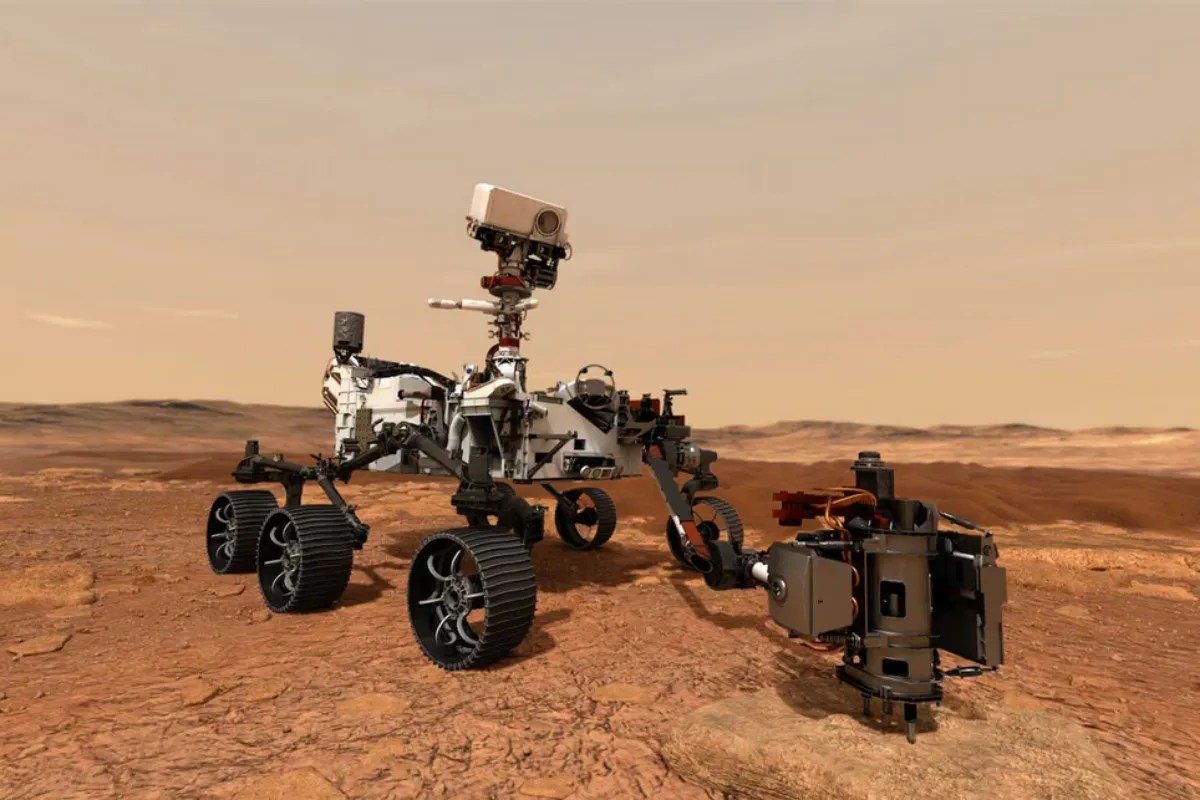
NASA’s Curiosity rover was never supposed to be a marathon runner. When the car-sized laboratory touched down in Gale Crater in 2012, its primary mission was slated for a mere 23 months. Fourteen years later, the machine is still climbing mountains. It is doing so on wheels that resemble shredded soda cans, powered by a decaying nuclear heart, and navigating a terrain that has proven far more hostile than the simulations at the Jet Propulsion Laboratory (JPL) ever predicted.
The headlines often frame Curiosity as a "zombie" or a lucky survivor. That is a lazy interpretation. The rover’s continued operation is not a matter of luck; it is a brutal masterclass in remote engineering and the desperate necessity of stretching every dollar in a space program that cannot afford a replacement. While the newer Perseverance rover grabs the limelight with its sample-collection mission, Curiosity remains the workhorse providing the fundamental data on whether Mars could have ever supported life. It is doing the heavy lifting while literally falling apart.
The Engineering of a Slow Motion Disaster
The wheels are the most visible sign of the rover’s mortality. Curiosity is equipped with six solid aluminum wheels, each about 50 centimeters in diameter. Designers expected them to handle the soft sand and rounded pebbles of a dried lakebed. Instead, Curiosity encountered "ventifacts"—sharp, wind-sculpted rocks anchored firmly into the Martian crust.
Unlike loose stones that shift under weight, these rocks act like fixed obsidian blades. By 2013, barely a year into the mission, engineers noticed the first punctures. By 2017, the zig-zag treads, known as grousers, began to break. This was a crisis of mechanical integrity that threatened to turn the multi-billion dollar asset into a stationary weather station.
JPL didn't panic. They improvised.
They developed "traction control" software to match the speed of the wheels to the terrain, reducing the pressure on the leading edges. They began mapping paths that avoided the sharpest ridges, even if it meant taking the long way around. Most importantly, they accepted the damage as a baseline. The rover is currently operating with holes large enough to put a hand through, yet it continues to move. This isn't just "making do." This is a calculated gamble where the wear and tear is measured in millimeters per kilometer, a grim accounting of a machine's remaining life.
The Nuclear Half Life
Beyond the structural failures, Curiosity faces a silent, invisible deadline. Unlike the smaller Spirit and Opportunity rovers, which relied on solar panels and eventually succumbed to dust storms, Curiosity is powered by a Multi-Mission Radioisotope Thermoelectric Generator (MMRTG). It runs on the heat of decaying Plutonium-238.
This power source provides 2,000 watts of thermal power, which is converted into roughly 110 watts of electrical power. The problem is physics. Plutonium-238 has a half-life of 87.7 years, but the thermocouples that convert that heat into electricity degrade faster than the fuel itself. Curiosity is losing about 4 watts of power every year.
We are approaching a tipping point. As the power budget shrinks, mission controllers have to make increasingly difficult trade-offs. They can’t run the heater and the drill at the same time. They have to prioritize which instruments get to "talk" to the satellites overhead. Every Martian winter becomes a battle of survival, where the rover must huddle in place to keep its internal electronics from freezing, sacrificed scientific progress for the sake of simply staying "alive."
Gale Crater as a Time Machine
Why do we keep pushing a broken machine? Because Gale Crater is a unique geological record that we have barely begun to read. Curiosity is currently ascending Mount Sharp, a 5-kilometer-high mound of layered sediment. Each layer represents a different epoch in Martian history.
In the lower layers, the rover found evidence of ancient freshwater lakes and the organic building blocks necessary for life. As it climbs higher, it is moving through the transition period where Mars dried up and became the frozen desert we see today. If Curiosity stops now, we lose the chance to see the "how" and "when" of a planet's death.
The data being transmitted back isn't just about rocks. It’s about atmospheric chemistry. Curiosity’s Sample Analysis at Mars (SAM) instrument suite has detected seasonal spikes in methane. On Earth, methane is overwhelmingly produced by biological processes. On Mars, we don't know the source. It could be geological, or it could be something else. A stationary rover cannot chase those plumes. A mobile, albeit limping, rover can.
The High Cost of Redundancy
The survival of Curiosity also highlights a shift in how space agencies approach risk. In the Apollo era, systems were built with massive redundancies. If one part failed, another took over. In the modern era of "faster, better, cheaper," the redundancy is often found in software and ground-side ingenuity rather than extra hardware.
When Curiosity’s primary computer glitched several years ago, the team switched to the "B-side" computer. They spent months rewriting code to bypass hardware flaws that would have ended any other mission. This is the new reality of deep space exploration. We send machines that are fundamentally fragile, then we use the world's best minds to keep them running on life support for a decade.
There is a psychological component to this as well. For the engineers at JPL, Curiosity is not just a tool. It is a presence. They have spent over a decade staring through its cameras. They know every crack in its wheels and every shadow on the horizon. When the rover eventually dies—and it will, likely when a wheel finally collapses or the power drops below the threshold for the internal heaters—it will be a loss of a primary sensory organ for humanity.
The Next Phase of Martian Mobility
The lessons learned from Curiosity’s shredded wheels have already changed the future of the industry. The Perseverance rover, though built on a similar chassis, features redesigned wheels. They are narrower, thicker, and made of a more resilient alloy with a different tread pattern. Engineers realized that the Martian surface is not a sandbox; it is a grinding wheel.
But Perseverance has a different mission. It is a scout, caching samples for a future return mission. Curiosity is the chemist. It stays behind to do the deep analysis that a "pick up and go" mission cannot perform.
We are currently witnessing the sunset of the first great era of Martian roving. The transition from Curiosity to the next generation of autonomous vehicles will be marked by more than just better wheels. It will be defined by how much risk we are willing to take. Curiosity proved that a machine can be "broken" and still be world-class. It proved that the mission doesn't end when the warranty does.
The rover is currently navigating a region called the "Gediz Vallis Ridge." It is a treacherous area filled with the very rocks that nearly ended the mission years ago. Every meter gained is a victory of human persistence over mechanical entropy. The rover continues to drill, to bake samples, and to beam back high-definition panoramas of a world that wants to destroy it.
Check the latest telemetry from the Mars Science Laboratory to see exactly how much power remains in the MMRTG before the next winter cycle begins.


