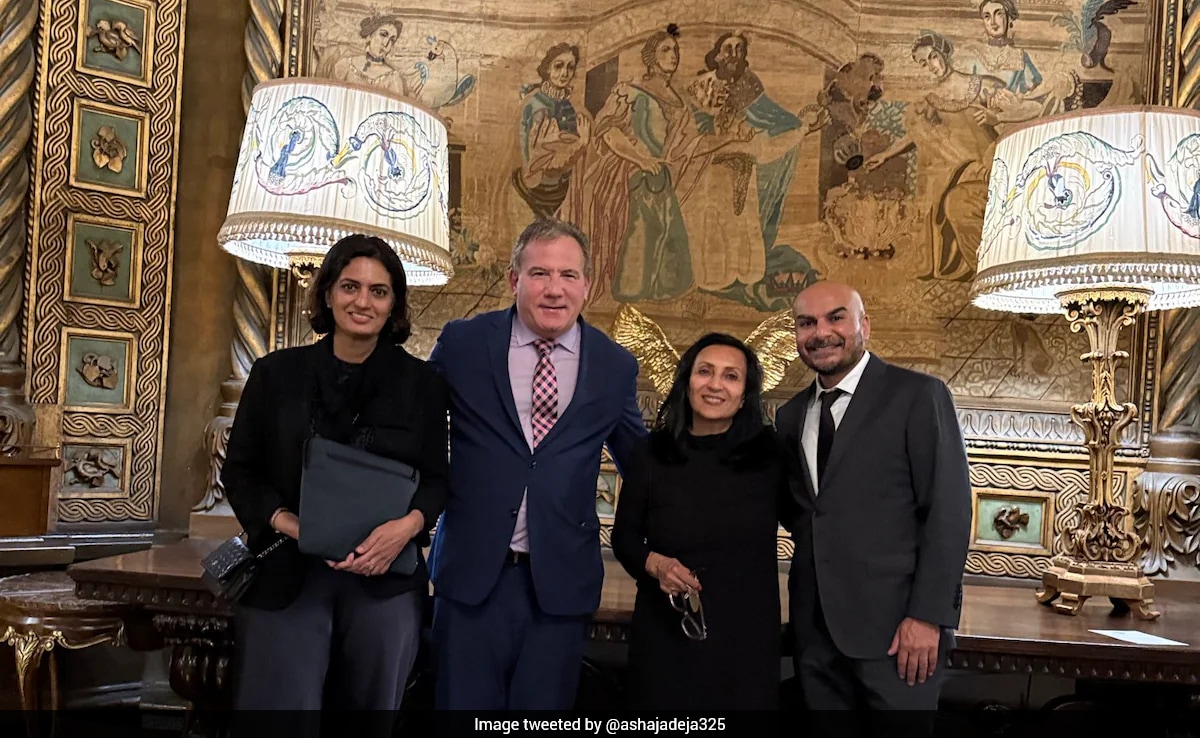
The recent private meeting between Donald Trump and a select group of high-net-worth investors at Mar-a-Lago was not merely a social call or a campaign fundraiser. It served as a high-stakes demonstration of the "shadow cabinet" effect that increasingly defines modern geopolitical influence. Among those present was a prominent Indian-origin investor whose subsequent accounts have pulled back the curtain on how private capital and executive power intersect just moments before global military escalations.
This gathering took place in the tense window immediately preceding the joint US-Israel operations against Iranian targets. While the official lines of communication between the White House and the Pentagon were humming with activity, a parallel conversation was happening in a gilded dining room in Palm Beach. The significance of this meeting lies in the proximity of private interests to the decision-making apparatus of a man who, despite being out of office at the time of the initial reporting, maintains a gravitational pull over the current administration's foreign policy constraints and the future of global markets.
The Investor Access Loop
For the Indian-origin investor and his peers, the value of a two-hour sit-down with Trump is not found in the appetizers. The real currency is the perception of early-stage intelligence. In the world of high-stakes venture capital and global equity, the ability to gauge the temperament of the next potential Commander-in-Chief regarding Middle Eastern stability is worth more than any standard market analysis.
Trump’s approach to these meetings is transactional but strategic. He provides a sense of "insider" status to donors and influencers, while they provide the financial and ideological scaffolding for his return to power. This creates a feedback loop where private investors become unofficial conduits for diplomatic signaling. When an investor walks out of Mar-a-Lago and shares details about the mood or the topics discussed—specifically regarding Iran—it sends ripples through the Bombay Stock Exchange and Wall Street alike.
Decoding the Iran Strike Context
The timing of this interaction cannot be dismissed as a coincidence. The geopolitical architecture of the Middle East is currently being reshaped by a hardline stance against Iranian proxies. By hosting influential figures from the Indian diaspora, Trump is speaking to a demographic that holds immense sway over the technological and financial bridges between the East and West. India’s own complex relationship with Iran—balancing energy needs with a strategic partnership with Israel—makes this specific investor group a critical audience.
During the session, the dialogue reportedly touched on the necessity of "strength" and the perceived vacuum in American leadership. These are not just campaign talking points. They are signals to the market that a shift toward more aggressive interventionism is not just possible but planned. For the investor, the takeaway was clear: the era of cautious containment is ending, and the era of "maximum pressure" is being updated for a new cycle of conflict.
The Friction Between Public and Private Interests
There is a fundamental tension in these private briefings. Official statecraft is supposed to be conducted through secure channels, monitored by the State Department and the National Security Council. When a former president—and current candidate—engages in detailed geopolitical discussions with private citizens, it creates a "gray zone" of diplomacy.
- Market Volatility: Rumors from these meetings can trigger preemptive selling or buying in energy sectors before any official policy is announced.
- Diplomatic Confusion: Foreign governments, including Tehran and New Delhi, are forced to parse whether these private comments represent a coming reality or mere bravado.
- The Shadow Cabinet: This structure allows for the testing of radical policy shifts without the immediate backlash of a formal press release.
This isn't about traditional lobbying. It is about the commodification of proximity. The Indian-origin investor’s presence highlights the globalized nature of this proximity. It is no longer just about domestic policy; it is about how a Florida-based power center can influence the capital flows of Mumbai and the defensive posture of Tel Aviv.
The Indian Angle and Strategic Alignment
India has spent decades walking a tightrope in the Middle East. However, the rise of a billionaire class in India that is increasingly aligned with the American right-wing’s economic nationalism has changed the math. These investors see a Trumpian foreign policy as a way to clear the path for the India-Middle East-Europe Economic Corridor (IMEC), a project that inherently requires the sidelining of Iranian influence.
By engaging with these individuals, Trump is effectively building a global coalition of private interests that will support a hardline stance. The investor who shared his experience at Mar-a-Lago is a symptom of this broader trend. He represents a bridge between the "Make America Great Again" philosophy and the "Viksit Bharat" (Developed India) ambition. Both ideologies rely on a strongman approach to regional security and an unapologetic pursuit of national economic interests.
The Reality of the Mar-a-Lago Influence
Critics often dismiss these meetings as ego-stroking sessions. That is a mistake. In the lead-up to the US-Israel action against Iran, every word spoken in that room was analyzed by participants for clues on how to hedge their bets. If the former president indicates that he supports—or would have initiated—even harsher strikes, it emboldens the current Israeli leadership to push the envelope further, knowing they have a safety net in the American political landscape regardless of the next election's outcome.
The investor described the atmosphere as one of "absolute certainty." In the volatile world of international relations, certainty is a rare and dangerous commodity. When it is manufactured in a private club rather than a situation room, the risk of miscalculation grows. Yet, for the participants, this risk is the very thing that provides the opportunity for outsized returns.
Beyond the Photo Op
We have moved past the era where these meetings were just about campaign contributions. They are now essential nodes in a decentralized intelligence network. The investor isn't just a donor; he is a sensor. He is there to report back to his own networks, creating a ripple effect that shapes the narrative of the conflict before the first missile is even launched.
The strikes on Iran were the physical manifestation of a policy shift that had already been discussed, dissected, and cheered on in the dining rooms of the elite. This is the new reality of the 21st-century power structure. Information is no longer held by the few; it is shared with the "right" few. As the smoke clears in the Middle East, the focus remains on these private sanctuaries where the next decade's wars and wealth are mapped out over dinner.
The next time a private citizen shares a "behind the scenes" look at a meeting with a high-level political figure, look past the anecdotes about the decor or the personality. Look at the timing. Look at the markets. Look at the borders that moved shortly after the coffee was served.
Watch the flow of venture capital into defense tech companies in the weeks following these "social" visits.


