The dust of ancient oceans
High above the red plains of the Gediz Vallis, the wind does not howl so much as it sighs. It is a thin, freezing breath that carries the scent of oxidized iron and the ghosts of water that vanished billions of years ago. There is no one there to hear it. No birds. No rustling leaves. Just the rhythmic, metallic crunch of six aluminum wheels biting into the Martian regalia.
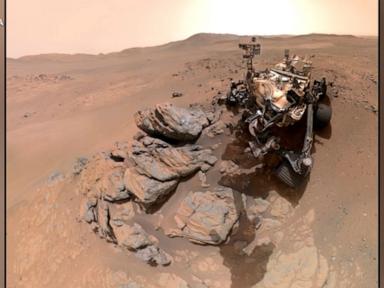
Curiosity is a machine, a hunk of titanium and wires roughly the size of an SUV, but we have a habit of treating it like a scout we sent over the ridge who never came home. We track its "health." We worry about its "joints." We celebrate its "birthdays" with a solitary song hummed by its own vibration motors. Recently, this mechanical wanderer stopped in its tracks, turned its robotic arm toward its own scarred face, and took a picture. Discover more on a related subject: this related article.
The media calls it a selfie. That word feels too small for what is actually happening.
A selfie on Earth is an act of vanity or a digital breadcrumb left to prove we were at a brunch or a concert. On Mars, a selfie is a diagnostic miracle and a profound act of cosmic record-keeping. When Curiosity holds up its Mars Hand Lens Imager (MAHLI), it isn't looking for its best angle. It is documenting the erosion of its skin and the grit in its gears, showing us exactly what it costs to live on a world that wants to grind everything down to powder. More reporting by TechCrunch highlights comparable views on the subject.
A mechanical witness to deep time
The image is breathtaking, not because of the lighting—which is a flat, alien copper—but because of the context. Behind the rover lies the vast expanse of Gale Crater. In the distance, the sharp peaks of Mount Sharp rise like the jagged teeth of a forgotten god.
Think about the physics required to produce that single frame.
The rover is 140 million miles away. To get that photo to your smartphone, the data had to be bundled into packets, beamed from the rover’s high-gain antenna to an orbiter screaming across the Martian sky at thousands of miles per hour, relayed across the void of space to a massive dish in the California desert, and finally processed by a team of engineers who haven't slept properly since the landing in 2012.
The image itself is a mosaic. Curiosity can’t capture its whole body in one go; the arm isn't long enough. Instead, it takes dozens of individual photos, moving its "hand" with the precision of a surgeon. Then, through a bit of mathematical wizardry, the arm is stitched out of the final product. It looks as though an invisible photographer is standing there in the dirt, snapping a portrait of a traveler taking a well-deserved break.
But there is no photographer. There is only the machine and the silence.
The toll of the journey
If you look closely at the "selfie," the story becomes less about exploration and more about endurance. You can see the holes in the wheels.
When Curiosity landed, those wheels were pristine, gleaming silver. Now, they are mangled. The Martian terrain is covered in "ventifacts"—rocks sharpened by eons of windblown sand into literal knives. Every mile Curiosity travels is a fight. The rover is literally limping across the crater, its tread torn by the very ground it seeks to understand.
This is the invisible stake of the mission. We are watching a slow-motion breakdown. Every photo Curiosity sends back might be one of its last. The nuclear heart of the machine, a Multi-Mission Radioisotope Thermoelectric Generator, is slowly decaying. The heat it produces is dropping. The power available to move those heavy limbs is trickling away, watt by watt.
$$P(t) = P_0 e^{-\lambda t}$$
That equation is the ticking clock. $P_0$ is the power at the start, and $\lambda$ is the decay constant of the Plutonium-238 fueling the craft. We are watching a sunset that lasts decades.
Why we keep looking back
Why do we care about a robot taking a picture of itself?
It’s because Curiosity is our proxy. Humans are biological entities optimized for a very specific atmospheric pressure and a very narrow temperature range. We cannot go to Gale Crater. Not yet. Our blood would boil, and our lungs would collapse in the thin CO2 atmosphere. So, we build these steel avatars to go where we cannot.
When the rover looks at itself, we are looking at ourselves. We see our ingenuity, our persistence, and our desperate need to be noticed by a universe that seems largely indifferent to our existence. There is something heartbreakingly human about a machine stopping in the middle of a billion-year-old desert to make sure it’s still all there.
Consider the "chemistry" of the shot. Curiosity isn't just looking; it's tasting. Nearby, it has been drilling into the "White Cliffs" of the Gediz Vallis, searching for sulfur and minerals that prove water once flowed here in torrents. The selfie is the "before" photo in a long line of experiments. It’s the scientist taking a breath before diving back into the work of uncovering how a planet dies.
The bridge between worlds
The data transfer alone is a feat of endurance. The Deep Space Network (DSN) is the only reason we see these images. Imagine trying to download a high-definition movie using a router located in another city, while you are moving in a car and the router is on a plane. That is the daily reality for the JPL team.
They work on "Mars time." Because a Martian day (a sol) is about 40 minutes longer than an Earth day, the engineers’ schedules shift forward every single day. They live in a permanent state of jet lag, their bodies tied to the rotation of a planet they will never step foot on. When they see that selfie hit their monitors, it isn't just "content." It is a confirmation that their "child" survived another night of sub-zero temperatures.
The rover's eyes—the Mastcam—are more than just lenses. They are calibrated to see the world in ways we can't, filtering light to highlight different mineral compositions. But in these selfies, the team often processes the color to look "natural," or how a human would see it if we were standing there.
It is an act of empathy. We want to believe that if we were there, the sky really would be that dusty salmon color. We want to believe the shadows would fall just that way.
A legacy in the red dirt
One day, Curiosity will stop moving. The gears will seize. The last of the plutonium will cool. The wind will slowly begin the work of burying the rover in the very dust it spent its life analyzing.
In a thousand years, or ten thousand, a human explorer might walk across the Gediz Vallis. They will see a strange, angular mound of rusted metal half-submerged in a dune. They will brush away the sand and find the cameras, the wheels, and the drill bits.
They will find the spot where the rover stood when it took this picture.
They will look at the same peaks of Mount Sharp and realize that for a brief window in the 21st century, a small group of primates on a blue planet sent a piece of their curiosity across the dark to say, "I was here."
The selfie isn't about the rover. It’s about the fact that we were brave enough to send it.
The wind continues to sigh across the crater. The rover turns its head back to the path ahead. There is more drilling to do. There are more hills to climb. The sun is setting, casting a long, thin shadow of the machine toward the east—a dark finger pointing toward a home it will never see again, but whose face it keeps perfectly preserved in a gallery of digital stars.