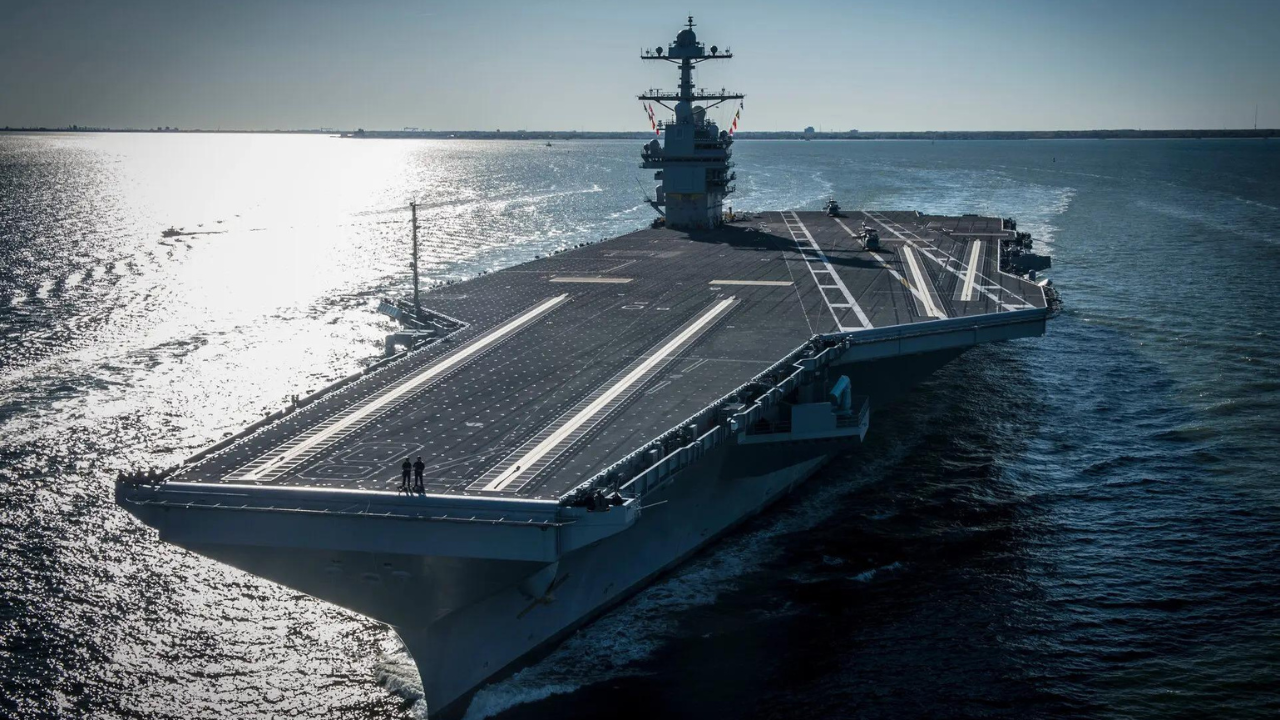
The withdrawal of the USS Gerald R. Ford (CVN 78) from the Eastern Mediterranean following the escalation of regional tensions in late 2023 was not a failure of intent, but a manifestation of the structural limits of modern maritime hegemony. While public discourse focuses on political optics, the operational reality is defined by a triad of constraints: technological maturation debt, the physics of sortie generation, and the mathematical vulnerability of concentrated high-value assets against asymmetric "anti-access/area denial" (A2/AD) networks. To understand why the world's most advanced warship departed a combat zone during a crisis, one must analyze the interplay between its revolutionary internal systems and the external evolution of Iranian-backed saturation strike capabilities.
The Sortie Generation Rate Paradox
The fundamental metric of an aircraft carrier’s lethality is the Sortie Generation Rate (SGR)—the number of aircraft launches and recoveries achievable within a 24-hour window. The Ford-class was engineered to exceed the Nimitz-class SGR by 33%, targeting 160 sorties per day in sustained operations and 270 in "surge" conditions. This theoretical leap relies on two primary technologies: the Electromagnetic Aircraft Launch System (EMALS) and the Advanced Arresting Gear (AAG).
EMALS replaces traditional steam catapults with linear induction motors. While this allows for a wider range of aircraft weights and reduces airframe stress, its reliability remains a critical bottleneck. The "Mean Cycles Between Critical Failure" (MCBCF) for EMALS has historically struggled to meet the Navy's threshold of 4,166 cycles. When EMALS or AAG experiences a software or hardware fault, the impact is systemic. Unlike steam systems, which have independent architectures for each catapult, the Ford’s power conversion electronics are interconnected. A major fault in the shared energy storage system can degrade the entire flight deck's capacity. In a high-threat environment like the Persian Gulf or the Levant, a 15% reduction in SGR isn't just a technical delay; it is a degradation of the Combat Air Patrol (CAP) density required to intercept incoming cruise missiles or swarming drones.
The Physics of the Dual Band Radar and Target Discrimination
The USS Gerald R. Ford was originally designed with the Dual Band Radar (DBR), combining X-band and S-band capabilities to handle both horizon-tracking and volume search. However, the integration of these two disparate frequencies into a single suite created significant electromagnetic interference and power consumption challenges. The DBR’s complexity reflects the broader difficulty of "sensor fusion" in a cluttered littoral environment.
In the Eastern Mediterranean, the radar environment is saturated with civilian maritime traffic, land-based signals, and atmospheric interference. The "probability of detection" for low-RCS (Radar Cross Section) targets, such as the Iranian-designed Noor or Gader anti-ship missiles, decreases as the distance to the coastline shrinks. The decision to cycle the Ford out of the region aligns with the tactical necessity of preventing "sensor saturation." If an adversary can overwhelm the radar’s processing logic with a mix of cheap drones and high-speed missiles, the carrier's Aegis-linked escorts are forced into a "winchester" state—depleting their limited supply of interceptor missiles against low-value targets.
The Advanced Weapons Elevator and Internal Logistics
Logistical throughput determines a carrier's "staying power." The Ford utilizes 11 Advanced Weapons Elevators (AWE) powered by electromagnetic motors rather than cables and pulleys. The AWEs are designed to move 24,000 pounds of ordnance at 150 feet per minute, a significant improvement over the 10,500 pounds at 100 feet per minute on Nimitz hulls.
However, the delayed certification of these elevators during the Ford’s early deployment phases highlighted a vulnerability in the ship’s "internal supply chain." If the elevators fail to move ordnance from the magazines to the flight deck at the predicted rate, the SGR drops regardless of how well the catapults are functioning. In a prolonged conflict with Iranian proxies, where the carrier must provide continuous Close Air Support (CAS) and deep-strike capabilities, any friction in the internal movement of munitions creates a "strike gap." This gap provides the adversary with windows of opportunity to maneuver or reload their own mobile launchers.
The Geometry of the A2/AD Threat Envelope
The deployment of the Ford into the Eastern Mediterranean placed it within the theoretical "kill web" of diverse missile systems. Iran’s development of the Khalije Fars (a supersonic anti-ship ballistic missile) and the integration of Russian-made P-800 Oniks missiles by regional actors has fundamentally altered the risk-to-reward ratio for supercarrier operations.
The "cost-exchange ratio" is heavily skewed against the carrier. An SM-6 interceptor costs approximately $4 million; a Houthi-deployed or Iranian-supplied suicide drone costs between $20,000 and $50,000. To defend a $13 billion asset, the US Navy must maintain a perfect defensive record, whereas the adversary only needs a single successful "lethal hit" to achieve a strategic victory—even if the hit does not sink the ship. A damaged Ford-class carrier requiring a return to Newport News for specialized repairs would be a catastrophic blow to US naval readiness worldwide, as the dry dock infrastructure for these 100,000-ton vessels is extremely limited.
The Personnel and Maintenance Fatigue Function
The Ford's departure was also dictated by the "Human Capital Depreciation" factor. The ship’s deployment was extended multiple times, pushing the crew and the machinery past their scheduled maintenance intervals. The Ford-class is designed with a smaller crew (approximately 600 fewer than a Nimitz) through increased automation. While this reduces life-cycle costs, it increases the "per-capita cognitive load" during high-intensity operations.
Automation replaces manual labor but requires higher-tier technical maintenance. When systems like the plasma arc waste destruction or the new reverse osmosis desalinization plants fail, the limited crew size means there is less "redundancy in labor" to perform manual workarounds. The operational pause was a mandatory reset to prevent a "cascading system failure" where deferred maintenance on the propulsion plant or flight deck systems would lead to a long-term loss of availability.
Strategic Allocation of Maritime Force
The US Navy currently operates 11 supercarriers, but the "Rule of Three" dictates that for every one ship on station, one is in training and one is in deep maintenance. At the height of the 2023 crisis, the US had two carriers in the region (the Ford and the Eisenhower). Maintaining this posture indefinitely creates a "readiness vacuum" in the Indo-Pacific theater.
The strategic pivot to the Pacific requires the presence of CVNs to deter peer competitors. Keeping the Ford in a "static" defensive posture in the Mediterranean to counter non-state actors or regional powers like Iran was an inefficient use of a platform designed for "high-end" peer conflict. The transition from the Ford to smaller, more distributed surface groups and the USS Dwight D. Eisenhower (CVN 69) represented a shift toward a more sustainable "attrition-based" defensive posture.
The Erosion of Near-Coast Sanctuary
The primary takeaway from the Ford’s deployment is the end of the "littoral sanctuary." Historically, US carriers could operate with impunity within 200 nautical miles of a hostile coast. The proliferation of long-range drones, sub-surface unmanned vehicles (UUVs), and anti-ship ballistic missiles has pushed the "stand-off distance" further out to sea.
This distance directly impacts the effectiveness of the Carrier Air Wing (CVW). If the carrier must stay 500 miles offshore to remain outside the high-threat A2/AD bubble, the F/A-18E/F Super Hornets require extensive aerial refueling to reach their targets. This increases the demand on the MQ-25 Stingray (the Navy’s new unmanned tanker) and reduces the total number of "bombs on target" per sortie. The Ford’s departure was a tactical admission that, in its current configuration, the risks of operating in confined waters against a sophisticated missile-dense adversary may outweigh the benefits of its concentrated fire-power.
The US Navy must now prioritize the "Distributed Maritime Operations" (DMO) concept. This involves de-emphasizing the carrier as a singular point of failure and instead integrating it as a command-and-control hub for a network of smaller, unmanned, and expendable platforms. Future deployment cycles will likely see Ford-class ships operating further from shore, utilizing their massive electrical generation capacity (three times that of a Nimitz) to power future directed-energy weapons (lasers) capable of flipping the cost-exchange ratio back in favor of the defense. The strategic play is no longer about "being there" at all times; it is about maintaining the technical integrity of the platform until the moment of decisive engagement.