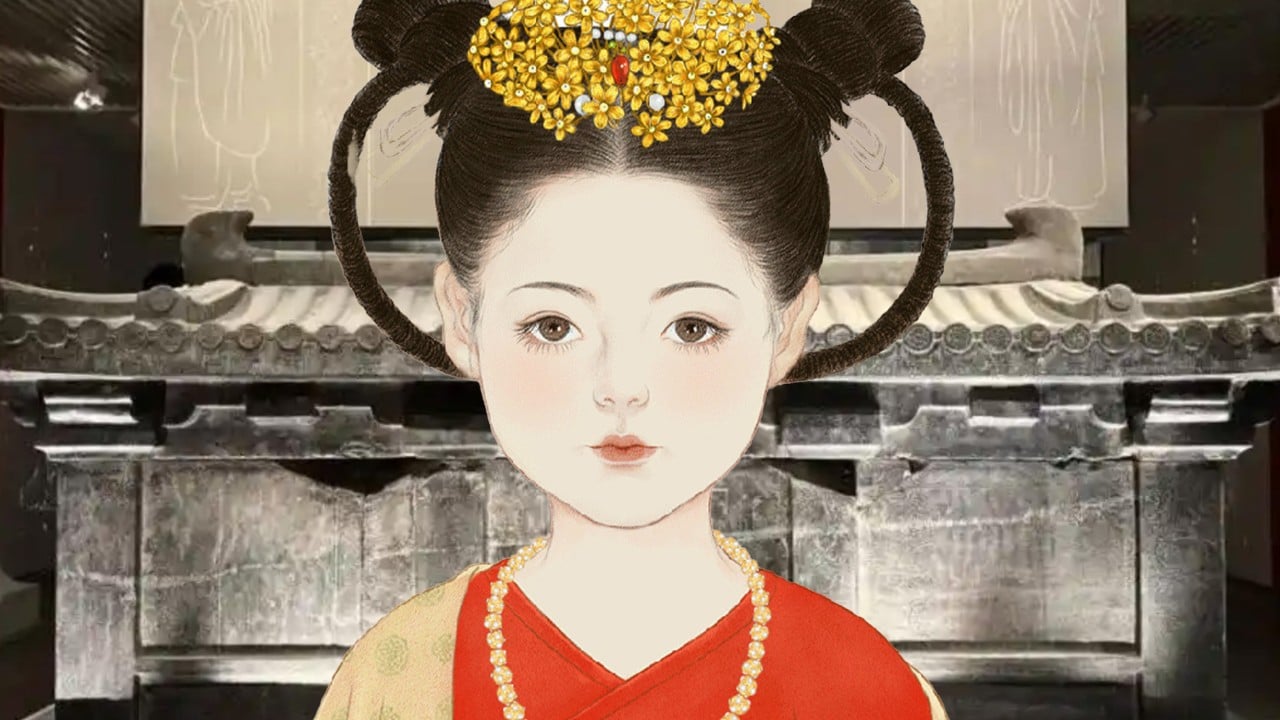
Archaeology usually brings up images of dusty bones and broken pots, but the 1957 discovery in Xi’an felt different. It was intimate. When researchers stumbled upon the tomb of Li Jingxun, they weren't just looking at a burial site from the Sui Dynasty. They were looking at a heartbreak frozen in time. A nine-year-old girl, buried 1,400 years ago, rested inside a stone sarcophagus carved to look like a palatial home. It's the most lavish child’s grave ever found in China.
People call her the most pampered child in Chinese history. While that sounds like a headline meant for clicks, the evidence back it up. Her family didn't just bury her; they tried to build her a permanent, golden afterworld. You see, Li Jingxun wasn't just any kid. She was the granddaughter of Empress Yang Lihua. In a world where child mortality was a brutal reality, her death clearly shattered the highest levels of the Sui imperial court.
A House of Stone for an Eternal Sleep
Most high-ranking tombs from this era follow a predictable pattern. You get a sturdy coffin, some pottery, maybe some coins. Li Jingxun’s setup was an entirely different beast. Her coffin was a meticulously detailed miniature palace.
Think about the craftsmanship required for this. The sarcophagus features intricate carvings of pillars, doors, and windows. It even has tiny stone locks. The inscription on the lid reads "Open and You Die," a stark warning to grave robbers that actually worked. Because the tomb remained sealed for over a millennium, we have a pristine look at what extreme wealth looked like in 608 AD.
It wasn't just about the box. Inside, she was surrounded by over 230 items. We're talking gold, silver, jade, and rare glass from the West. This wasn't a standard burial. It was an aggressive attempt by a grieving grandmother to ensure the girl lacked nothing in the next life. If she couldn't grow up in the palace, the palace would come to her.
The Necklace That Rewrites Trade History
If you want to understand why this find matters beyond the "sad story" factor, look at her jewelry. Specifically, the gold necklace found around her neck.
This piece is stunning. It’s made of 28 gold beads, inlaid with pearls and deep blue lapis lazuli. The centerpiece is a large, glowing red carnelian. Here’s the kicker: the craftsmanship isn't Chinese. Experts have traced the style and the stones to the Sasanian Empire (modern-day Iran) and parts of Pakistan or Afghanistan.
It tells us that even 1,400 years ago, the Silk Road was a high-speed lane for luxury. A little girl in Xi’an was wearing the finest craftsmanship the Middle East had to offer. It wasn't just a trinket. It was a status symbol that signaled her family's reach across the known world. She wore the wealth of continents.
Why the Imperial Family Went Overboard
You might wonder why a nine-year-old got a burial that rivaled emperors. The answer lies in the messy politics and personal tragedies of the Sui Dynasty.
Li Jingxun’s grandmother, Yang Lihua, was a powerhouse. She had been an Empress and then a Queen Mother. She lost her husband and her political standing shifted as dynasties rose and fell. Li Jingxun was likely her favorite, a bright spot in a life defined by cold political maneuvering. When the girl died of an illness in the Fenghuang Palace, the Empress snapped.
She demanded a burial that broke all the rules. Usually, Chinese tradition dictates that children receive modest burials because they haven't "earned" their place in the ancestral hierarchy. Yang Lihua ignored that. She used her massive influence to ensure her granddaughter was treated as a fully realized royal. This wasn't just "pampering." It was a grandmother's final, desperate act of love and a defiance of tradition.
The Ghost of the Sui Dynasty
The Sui Dynasty didn't last long—only about 37 years. It’s often overshadowed by the Tang Dynasty that followed. But Li Jingxun’s tomb gives us a snapshot of this transitional period. It was a time of massive ambition. They built the Grand Canal. They rebuilt the Great Wall. And they produced art that was sophisticated, experimental, and incredibly expensive.
Looking at the items in her tomb—the white porcelain jars, the tiny gold cups, the jade hairpins—you see a culture at its peak. The porcelain found here is some of the earliest high-quality white ware ever discovered. It predates the famous "true" porcelain of later centuries, showing that Sui craftsmen were already mastering techniques that would later make China famous worldwide.
Lessons from the Xi an Excavation
When we look at Li Jingxun today, it’s easy to get lost in the gold. But the real value is the human element. We see a family that couldn't say goodbye. We see a trade network that brought gems from thousands of miles away to the neck of a child.
If you're ever in Xi’an, you can see these treasures at the National Museum of China. They aren't just artifacts. They’re a reminder that 1,400 years ago, people felt the same grief and the same desire to protect their kids that we do today. They just had a lot more gold to express it.
Don't just read about the history. Go look at the craftsmanship of the Sasanian necklace or the detail on that stone palace. It changes how you view the "Dark Ages" of the East. There was nothing dark about it. It was glittering, complex, and deeply emotional.
Start your deep dive by looking into the Sui Dynasty’s connection to the Silk Road. Most people skip the Sui and go straight to the Tang, but that's a mistake. The foundation of China’s golden age was laid in the very palaces Li Jingxun called home. Check out the excavation reports from the Xi'an Institute of Cultural Relics and Archaeology if you want the raw data. It’s a rabbit hole worth falling down.

.jpeg?width=1200&auto=webp&trim=37%2C0%2C37%2C0)