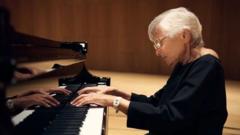
The air in the room didn't just carry the scent of old wood and piano wax. It carried a lineage. When Ruth Slenczynska sat at a Steinway, she wasn't just a centenarian with brittle bones and a lifetime of accolades. She was a living bridge. To see her play was to witness a physical connection to a vanished world, a direct line stretching back through the decades to a giant of the Romantic era.
Now, that bridge has finally folded into the river of history. Ruth Slenczynska has died at the age of 101.
She was the last surviving pupil of Sergei Rachmaninoff. When she closed her eyes for the final time, the last person on Earth who could describe the specific, terrifying, and brilliant weight of Rachmaninoff’s hand on a shoulder—or the precise way he demanded a rubato—went with her. We often talk about the death of a celebrity as the end of an era. With Ruth, it is the death of a physical memory.
The Child Who Was Not Allowed to Be a Child
To understand the woman, you have to understand the crucible. Ruth didn't just "start" piano. She was forged in it. Her father, Josef Slenczynski, was a violinist who saw in his daughter a vessel for the greatness he never quite gripped. By the age of three, Ruth was practicing nine hours a day.
There is a specific kind of silence that exists in the home of a child prodigy. It isn't peaceful. It is high-tension, vibrating with the fear of a missed note or a collapsed wrist. While other children in the 1920s were playing with hoops and sticks in the dirt, Ruth was memorizing the works of Bach and Beethoven. Her childhood was a series of black and white keys, a rhythmic prison that she eventually turned into a sanctuary.
By the age of six, she made her debut in Berlin. By eight, she was playing Town Hall in New York City. The critics didn't just call her good; they called her a miracle. But miracles are often the result of grueling, invisible labor. She was a tiny girl carrying the weight of a family’s ambition and the expectations of a global audience.
A Giant in the Room
Then came the meeting that would define her legacy. Imagine a small, porcelain-faced girl entering a room to face a man who looked like a weary monk and played like a thunderstorm. Sergei Rachmaninoff was a man of immense physical presence—towering height and hands that could famously span a twelfth on the keyboard.
He didn't take many students. He didn't have the patience for mediocrity. Yet, he saw something in Ruth. Or perhaps he saw a reflection of the same haunting discipline that governed his own life.
When they sat together, the technicalities of music faded into something more primal. Rachmaninoff didn't just teach her where to put her fingers. He taught her how to breathe through the wood of the instrument. He showed her how to make a piano mourn. There is a story, perhaps apocryphal but emotionally true, that he once gave her a Faberge egg—a delicate, beautiful thing that mirrored her own precarious position in the world of high art.
To learn from Rachmaninoff was to learn from the last of the titans. He was the end of the Russian Romantic tradition, a man displaced by revolution and haunted by the ghost of Tchaikovsky. Through Ruth, that haunting was passed down. She became the keeper of his secrets: the way he leaned into a chord, the way he treated silence as a note in itself.
The Burnout and the Rebirth
The problem with being a miracle is that eventually, the world expects you to walk on water every single day. By the age of 15, the pressure fractured. Ruth walked away.
She didn't just take a break; she stopped. She sought a life that didn't involve the relentless judgment of the concert hall. She went to college, got married, and tried to be a person instead of a phenomenon. This is the part of the story that often gets skipped in the dry obituaries, but it is the most human. It is the moment the puppet cuts the strings.
For years, the piano sat silent. But music like hers isn't a hobby; it’s a nervous system. You can’t simply switch it off. In the 1950s, she returned. But she didn't return as the child prodigy pushed by a demanding father. She returned as a woman who had chosen the music for herself.
The playing was different now. It was deeper. The technical perfection was still there, but it was layered with the grit of lived experience. She wrote books. She taught. She became a professor at Southern Illinois University Edwardsville, pouring her knowledge into generations of students who likely had no idea they were receiving lessons filtered through the hands of a Russian master who had been dead for half a century.
The Century Mark
Time is a relentless editor. It thins the ranks of our heroes until only a few sentinels remain. As the years ticked toward a hundred, Ruth became more than a pianist. She became a living artifact.
At 97, she recorded a new album. Think about that. Most people at 97 are struggling to remember their own phone numbers. Ruth was in the studio, navigating the complexities of Chopin and Debussy with a clarity that defied biology. Her fingers, though knotted with age, still found the center of the key with an unerring, soulful precision.
There was a video that went viral a few years ago. It showed her at the piano, her face a map of a century’s worth of joy and sorrow. She wasn't just playing the music; she was listening to it. You could see her head tilt, her eyes go distant, as if she were hearing a voice from 1930 whispering the tempo in her ear.
When she turned 100, the world celebrated her longevity. But Ruth didn't seem interested in just being old. She wanted to be useful. She wanted to ensure that the "Rachmaninoff sound"—that lush, dark, unapologetic emotion—didn't die with her. She taught until the very end, her voice a soft rasp, her eyes lighting up only when a student finally understood the tension between two dissonant notes.
The Final Chord
There is a concept in physics called "entanglement," where two particles remain connected across vast distances. Ruth Slenczynska was entangled with the 19th century. She carried its etiquette, its rigorous standards, and its belief that beauty was a matter of life and death.
Her passing isn't just the death of a 101-year-old woman. It is the final closing of a door. We have the recordings, of course. We have the grainy footage and the digital files that will preserve her notes forever. But we no longer have the touch.
We no longer have the person who knew the warmth of the man who wrote the Rach 3. We no longer have the witness who saw the world before it was electrified, before it was digital, before it forgot how to sit still for an hour and listen to a single person tell a story with ten fingers and a box of wires.
In the end, Ruth Slenczynska didn't just survive. She endured. She outplayed the critics, outlived the skeptics, and outlasted the very era that created her.
The piano in her room is closed now. The lid is heavy, the mahogany cool to the touch. Somewhere, in a space between the notes, a tall, somber Russian man is waiting. He is checking his watch, nodding slowly, and finally, after a hundred years, gesturing for his favorite pupil to take her place at the bench beside him.
The lesson is finally over. The music, however, is just beginning to echo in the silence she left behind.