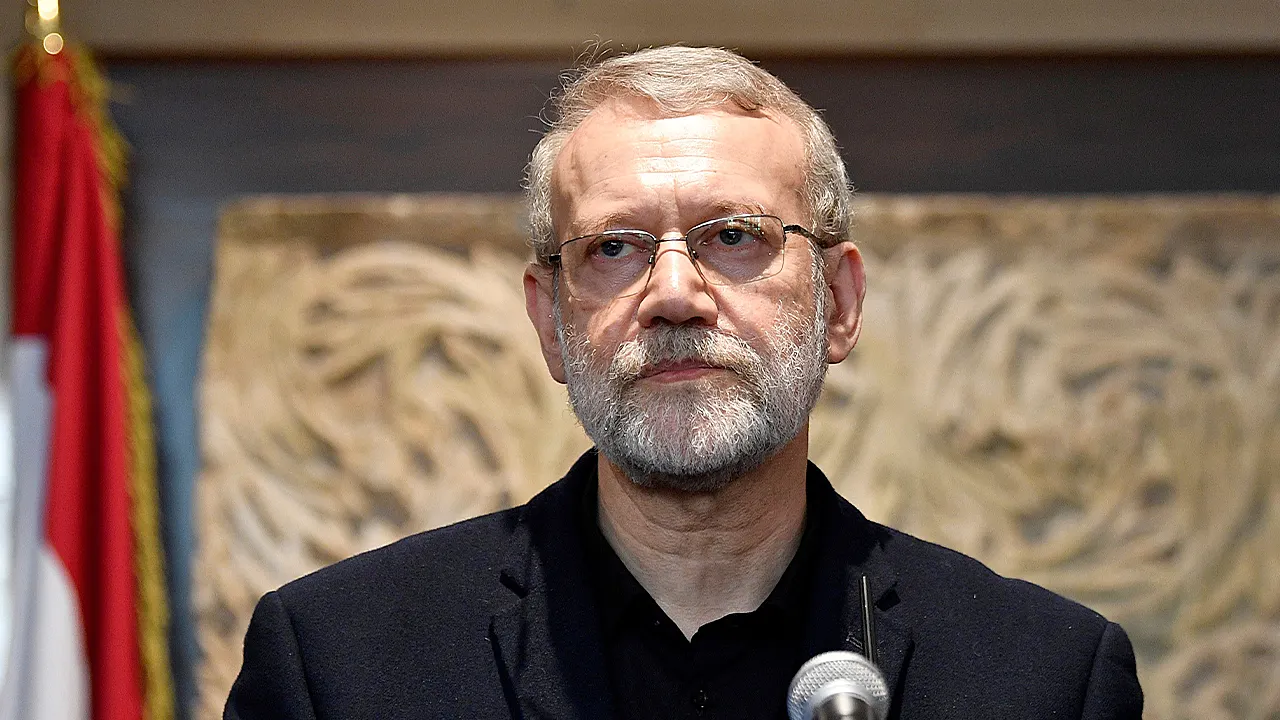
The assassination of Ali Larijani on March 17, 2026, by an Israeli airstrike in Tehran does not merely eliminate a high-ranking official; it removes the primary architect of the Islamic Republic’s modern "flexible resistance" strategy. While standard reportage focuses on his biographical milestones, a structural analysis reveals Larijani as the critical node connecting three disparate power centers: the clerical establishment, the Islamic Revolutionary Guard Corps (IRGC), and the pragmatic bureaucratic class. His death creates a functional vacuum in the regime's "calibration mechanism"—the ability to balance ideological escalation with survivalist diplomacy.
The Tri-Node Power Framework
Larijani’s influence was not derived from a single office but from a unique position at the intersection of three institutional pillars. This trifecta allowed him to operate as a de facto head of state following the death of Ali Khamenei on February 28, 2026.
- Clerical Pedigree and Legal Legitimacy: As the son of Grand Ayatollah Mirza Hashem Amoli and son-in-law of Ayatollah Morteza Motahari, Larijani possessed "inherited revolutionary capital." This allowed him to navigate the Qom-Tehran clerical axis with an authority that non-clerical military figures lacked.
- Military-Industrial Integration: His tenure as a brigadier general in the IRGC during the Iran-Iraq War and his subsequent role in founding the Jahad-e-Khodkafai (Self-Sufficiency Organization) embedded him within the regime’s missile development and internal security apparatus.
- Bureaucratic Continuity: Serving 12 years as Speaker of the Majles (Parliament) and two distinct terms as Secretary of the Supreme National Security Council (SNSC), Larijani mastered the mechanics of the "Deep State." He was the only figure capable of translating the Supreme Leader's ideological decrees into actionable legislative and security policy.
The Cost Function of Tactical Pragmatism
Larijani’s career was defined by a specific logic: Calculated De-escalation. Unlike the "scorched earth" hardliners, Larijani viewed diplomacy as a weapon of war. This philosophy, often termed "Pragmatic Principlism," operated on a specific cost-benefit function where the preservation of the system (Nezam) always outweighed the purity of the ideology.
- The Nuclear Lever: During his time as chief nuclear negotiator (2005–2007) and his later support for the 2015 JCPOA, Larijani utilized the nuclear program as a "hedging asset." He understood that the threat of enrichment was more valuable than the weapon itself, using it to extract economic concessions while maintaining the technical infrastructure for rapid breakout.
- Media as Kinetic Control: As head of the Islamic Republic of Iran Broadcasting (IRIB) for a decade, he shifted state media from simple propaganda to a sophisticated psychological operations tool. The introduction of programs featuring forced confessions was a deliberate application of "informational deterrence" designed to fragment domestic opposition before it could reach a critical mass.
Internal Security and the Bottleneck of 2026
The January 2026 crackdowns marked a terminal shift in Larijani’s strategy. Historically seen as a bridge to the West, Larijani’s transition into a "Wartime Secretary" of the SNSC removed the regime’s last remaining internal "soft power" option.
The suppression of the January protests, which resulted in thousands of casualties, was not a breakdown of his pragmatism but a realization of its limits. When the survival of the Nezam was threatened by internal kinetic force, Larijani discarded the "diplomatic mask" in favor of absolute IRGC-led consolidation. This shift created a strategic bottleneck: by centralizing all decision-making under the SNSC to bypass the paralyzed presidency, the regime became entirely dependent on Larijani’s personal ability to coordinate multiple fronts.
Strategic Attrition and the Successor Crisis
The death of Larijani alongside his son, Morteza, and key aides like Alireza Bayat, triggers an immediate "Coordination Failure" within the Iranian leadership. The current conflict environment is characterized by high-velocity intelligence gaps.
- Intelligence Vulnerability: The precision of the strike confirms a catastrophic breach in the inner sanctum of the Iranian security state. If Larijani, the man responsible for the regime's counter-intelligence protocols, could be localized and eliminated, the operational security of the remaining leadership is effectively zero.
- The Mojtaba Khamenei Isolation: With Ali Khamenei deceased, the new Supreme Leader, Mojtaba Khamenei, loses his most experienced "Regent." Larijani was the only figure who understood the "informal networks" through which the elder Khamenei exercised power. Without Larijani, Mojtaba is forced to rely entirely on the IRGC, transforming the Islamic Republic from a clerical-military hybrid into a pure military autocracy.
The removal of Ali Larijani is the removal of the Iranian system's "governor"—the component that prevents the engine from over-revving into self-destruction. In the immediate term, expect an erratic, non-calibrated response from Tehran as the remaining factions compete for the vacuum he leaves behind. The probability of a negotiated "off-ramp" in the current war has effectively dropped to near-zero, as the regime's most capable negotiator is no longer on the board.
Would you like me to analyze the projected impact of this leadership vacuum on the IRGC's command structure in the Levant?