The automotive industry is currently littered with the remains of over-hyped promises and missed deadlines. For decades, legacy manufacturers have attempted to convince the public that the next "big thing" is just around the corner, only to be met with the cold reality of hardware limitations and software bugs. Kia, a brand once known primarily for budget-friendly hatchbacks, is now attempting to leapfrog its way into the high-stakes world of robotics and artificial intelligence.
At the core of this gamble is a two-pronged attack: the deployment of Atlas humanoid robots in American manufacturing by 2029 and the launch of its first Software-Defined Vehicle (SDV) by 2027. While these announcements sound like a script from a science fiction film, the financial and logistical pressure driving them is very real. Kia is no longer just competing with Ford or Toyota. It is in a desperate sprint to match the vertical integration of Tesla and the software prowess of Silicon Valley.
The Manufacturing Gamble in Georgia
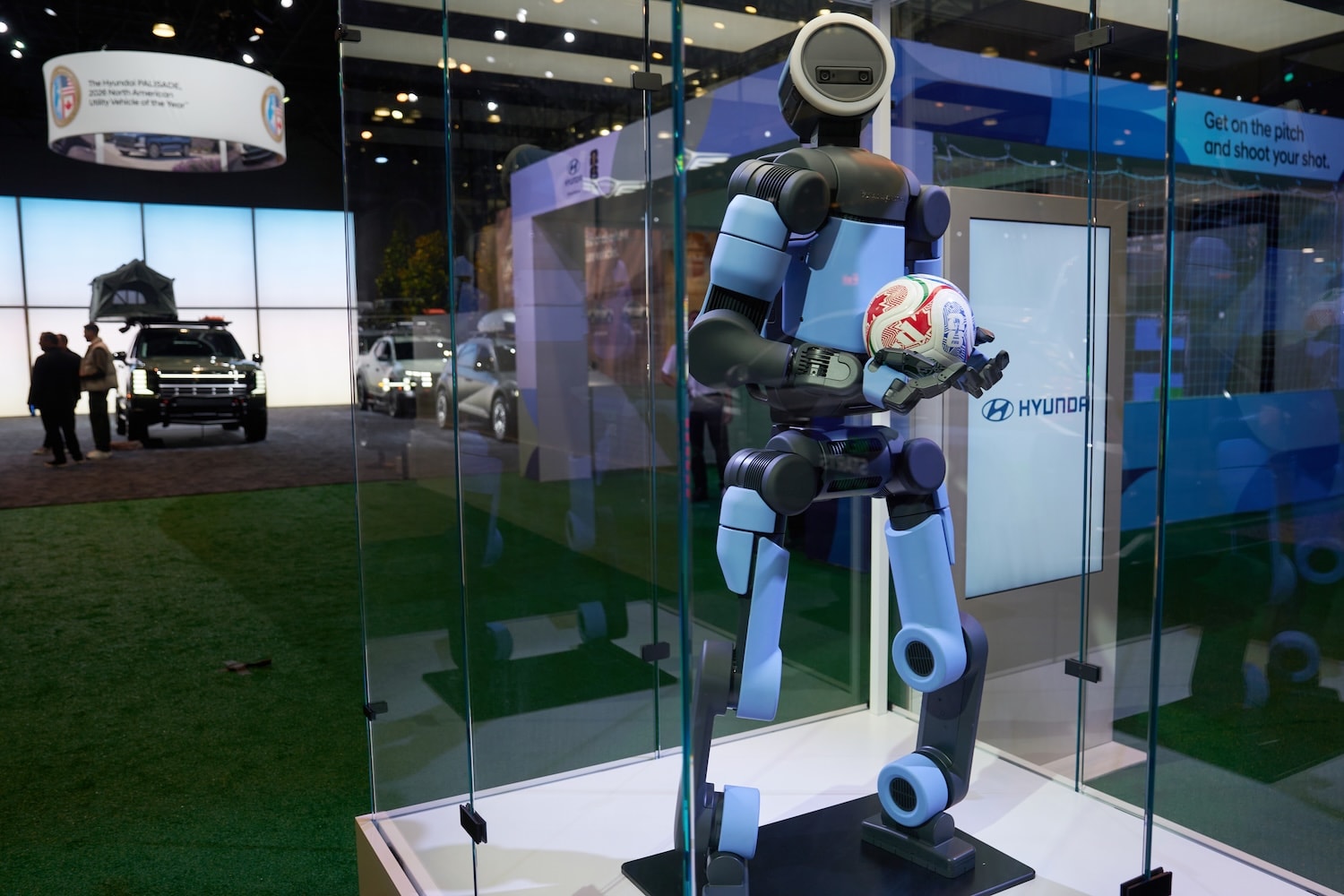
The choice of the United States as the staging ground for Kia’s robotic revolution is a calculated move. In April 2026, the company confirmed that the Atlas humanoid, developed by Boston Dynamics, will enter the production lines of the Kia AutoLand Georgia plant in 2029. This follows an earlier deployment at the Hyundai Motor Group Metaplant America (HMGMA) in 2028.
This is not about replacing every human worker overnight. That is a fantasy. Instead, Kia is targeting specific "dull, dirty, and dangerous" tasks that have traditionally been difficult for fixed robotic arms to handle.
- Sequencing Tasks: Atlas is being trained to handle parts that require a human-like range of motion and the ability to navigate a dynamic floor.
- Risk Mitigation: By using humanoids for high-risk ergonomic maneuvers, Kia aims to reduce workplace injuries that drive up insurance and operational costs.
- Physical AI: The real breakthrough isn't the metal frame of the robot, but the "Physical AI" being developed in collaboration with Boston Dynamics and Google DeepMind.
However, the 2029 timeline is aggressive. Integrating a bipedal robot into a live automotive assembly line requires more than just good balance. It requires a level of perceptual robustness and real-time decision-making that the industry has yet to prove at scale. If Atlas trips over a discarded bolt or fails to recognize a human worker's subtle gesture, the entire production line stops. In a factory where every second is worth thousands of dollars, these "learning moments" are incredibly expensive.
The Software-Defined Delay
While robots are the headline-grabbers, the success of Kia’s 2030 strategy hinges on software. The company has set a hard target for 2027 to debut its first true Software-Defined Vehicle (SDV).
An SDV is essentially a computer that happens to have wheels. In a traditional car, functions like braking, climate control, and infotainment are handled by dozens of isolated Electronic Control Units (ECUs) from different suppliers. In an SDV, these functions are centralized into a single, powerful "brain" using an architecture Kia calls CODA (Computing & I/O Domain-based Architecture).
The transition hasn't been smooth. Kia recently pushed back its SDV roadmap, acknowledging that building a proprietary operating system is vastly more difficult than building a chassis. To fix this, the company has undergone a massive leadership shake-up, hiring veterans from Nvidia and Tesla to steer the ship.
The Autonomous Progression
| Feature | Target Date | Capability |
|---|---|---|
| Level 2+ | Late 2027 | Hands-off highway driving with supervision. |
| Level 2++ | Early 2029 | Urban autonomous navigation and "Data Flywheel" learning. |
| Level 4 | 2030+ | Fully autonomous Robotaxis in partnership with Motional. |
The move to Level 2++ is particularly significant. It marks the point where the car begins to "learn" from its environment, feeding data back to Kia’s servers to improve performance across the entire fleet via Over-The-Air (OTA) updates.
The PBV Strategy and the End of the "Car"
Kia is also betting that the very definition of a vehicle is changing. Their Platform Beyond Vehicle (PBV) initiative is a move away from the "one-size-fits-all" SUV toward modular, task-specific electric vans.
The PV5, PV7, and PV9 models, scheduled for sequential launches between 2025 and 2029, are designed to be "blank slates." A single chassis could be a delivery van in the morning and a mobile office in the afternoon. This modularity is meant to capture the burgeoning $288 billion last-mile delivery market.
By integrating these vehicles with robots like Stretch (for unloading) and Spot (for surveillance), Kia is attempting to sell an entire ecosystem rather than just a piece of hardware. It is a bold, expensive, and incredibly risky vision.
The company has increased its investment to 41.4 trillion won (approximately $28 billion) through 2029 to fund this pivot. This massive capital expenditure comes at a time when global EV demand is fluctuating and competition from Chinese manufacturers is intensifying. Kia is essentially betting its future on the hope that it can become a technology company before the tech companies can become car manufacturers.
The 2029 deadline for Atlas in Georgia isn't just a milestone. It is a desperate line in the sand. If Kia cannot make these robots and software systems work in harmony, they risk becoming a high-priced hardware supplier in a world dominated by those who own the code.
Success requires moving beyond the "car company" mindset and embracing the brutal efficiency of a software house. There is no middle ground. The factory of 2029 will either be a marvel of automated synergy or a very expensive monument to corporate overreach.