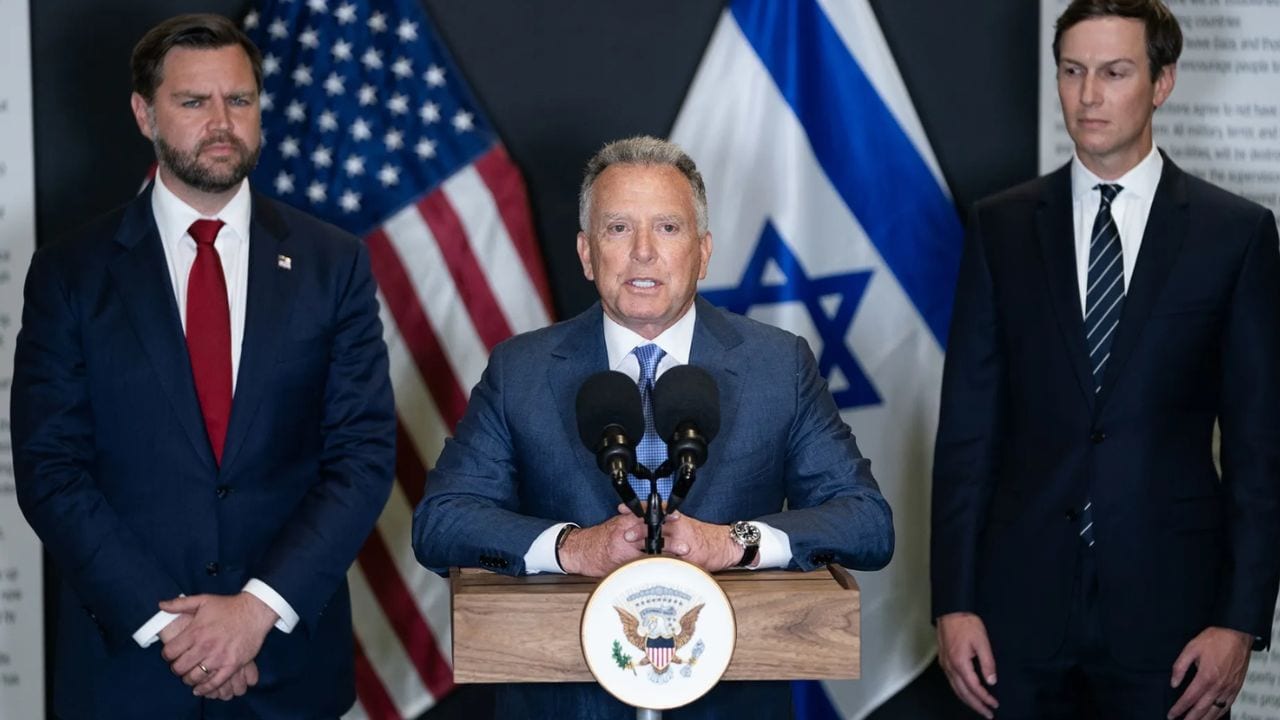
The air in Islamabad during the shoulder season is heavy, a thick curtain of humidity and diesel exhaust that clings to the skin like a damp wool coat. Inside the secure corridors of the capital’s diplomatic enclave, the atmosphere is even tighter. Security details check their watches. Translators adjust their headsets. This isn't just another summit. This is a collision of three distinct worlds—real estate, high finance, and the raw machinery of the American executive branch—descending on a single table to discuss the enigma of Iran.
J.D. Vance, Steve Witkoff, and Jared Kushner do not, at first glance, belong in the same sentence, let alone the same high-stakes negotiation. Vance represents the populist pulse, the man who rose from the hollows of Ohio to the heartbeat of Washington. Witkoff is the quintessential New York builder, a man used to seeing the skeleton of a skyscraper where others see only dirt. Kushner is the architect of the Abraham Accords, the silent operator who spent years weaving a new web of alliances across the Middle East. Together, they represent a shift in how the world works. Diplomacy is no longer just the work of career bureaucrats in dusty offices. It has become an extension of the boardroom.
The Weight of the Chair
Consider for a moment the sheer pressure of that room. It is one thing to debate foreign policy on a television screen in Virginia. It is quite another to sit across from regional power brokers in Pakistan while the shadow of Tehran looms over the map. Iran is not a line item on a budget. It is a complex, ancient civilization with a modern appetite for regional dominance, currently squeezed by sanctions and internal strife.
Vance sits there with the burden of the American worker on his shoulders. For him, every decision made regarding the Middle East eventually trickles down to the gas pump in Middletown or the manufacturing plant in the Rust Belt. He isn't there to speak the flowery language of the State Department. He is there to ensure that American blood and treasure aren't spilled in another "forever war," while simultaneously projecting the kind of strength that prevents one from starting.
Contrast that with Witkoff. Why is a real estate mogul at a table discussing Iranian nuclear capabilities and regional proxy wars? Because Witkoff understands the one thing that transcends language: value. He knows how to read a person’s true bottom line. In a world where diplomacy often fails because of ego, Witkoff looks at the deal. He looks at the leverage. He treats the geopolitical map like a distressed asset that needs a turnaround specialist.
The Invisible Architect
Then there is Jared Kushner. He has walked these halls before, albeit in different contexts. To understand his role in Islamabad, you have to look back at the Abraham Accords. Critics said it was impossible to bypass the traditional roadblocks of Middle Eastern peace. Kushner ignored the roadblocks and built a new highway.
In Islamabad, Kushner is the bridge. He understands the delicate ego of the region. He knows that in this part of the world, a "no" rarely means never, and a "yes" is only the beginning of the real conversation. He isn't interested in the status quo. He is interested in the recalibration.
Imagine the conversation. The Pakistani hosts, navigating their own precarious tightrope between Washington and Beijing, look at this American trio. They see a Vice President-elect, a billionaire developer, and a seasoned private-sector envoy. It is a terrifyingly pragmatic lineup. There is no room for the usual platitudes.
The stakes are invisible but absolute. If this group can find a way to de-escalate the tension with Iran through the Pakistani backchannel, the entire global economy shifts. Oil prices stabilize. Shipping lanes in the Red Sea open up. The threat of a broader regional conflict, which has been simmering like a pot left too long on the flame, begins to cool.
The Language of the Deal
Most people think of international relations as a series of formal treaties signed with fountain pens. The reality is much grittier. It’s about the coffee. It’s about the tone of voice used when the cameras are turned off. It’s about the "what if" scenarios whispered in the corners of a mahogany-paneled room.
Pakistan serves as the perfect, if uncomfortable, host for this theater. Islamabad has always been the crossroads. It is the place where the West meets the deep, complex currents of Central and South Asia. By choosing this location, the American delegation is signaling that they are willing to step outside the traditional Western bubble. They are meeting the problem where it lives.
But the real challenge isn't just talking to Iran; it’s talking to the ghost of the last forty years. Every time an American official sits down to discuss Iran, they are haunted by the 1979 revolution, the hostage crisis, the failed nuclear deals, and the endless cycle of rhetoric. Vance, Witkoff, and Kushner are attempting to cut through that ghost. They are treating the Iran problem not as a historical grievance, but as a modern logistical and economic hurdle that needs to be cleared.
The Human Cost of Calculation
What does this mean for the person reading this in a coffee shop in Des Moines or a flat in London? It feels distant. It feels like a chess game played by giants.
But the "invisible stakes" are your savings account. They are the price of the plastic in your phone and the stability of the world your children will inherit. When these three men walk into that room, they aren't just representing a political party. They are representing a new theory of power: that the world can be managed through a combination of populist mandate, business acumen, and unconventional diplomacy.
It is a gamble.
The traditionalists in the foreign policy establishment are likely horrified. They prefer the slow, rhythmic dance of the "interagency process." They like their white papers and their three-year timelines. They don't like builders and populist firebrands taking the lead on the most sensitive file in the world.
Yet, the old way hasn't exactly produced a peaceful Middle East. The old way resulted in decades of stalemate.
The Silence After the Meeting
As the meetings in Islamabad conclude, there won't be a grand parade. There might not even be a joint communique that says anything of substance. That’s not how these things work. The real results will manifest in the things that don't happen.
A missile that isn't fired.
A sanction that is quietly eased in exchange for a specific concession.
A trade route that remains peaceful.
The men in the room know that the world is watching, but more importantly, they know that the clock is ticking. Iran is moving closer to a nuclear threshold every day. The regional proxies are restless. The global economy is fragile.
Vance looks at the data. Witkoff looks at the leverage. Kushner looks at the map.
They exit the building into the heavy, humid Islamabad night. The motorcade idles, a line of black SUVs against the backdrop of a city that has seen a thousand empires come and go. They aren't looking for a "win" for the history books yet. They are looking for a crack in the wall—a single point of entry where a deal can be hammered home, piece by piece, until the structure of the world changes.
Behind them, the lights of the capital flicker. In the distance, the Margalla Hills stand silent, indifferent to the men and their missions, waiting to see if this new, strange alchemy of business and politics can actually turn the tide of history.