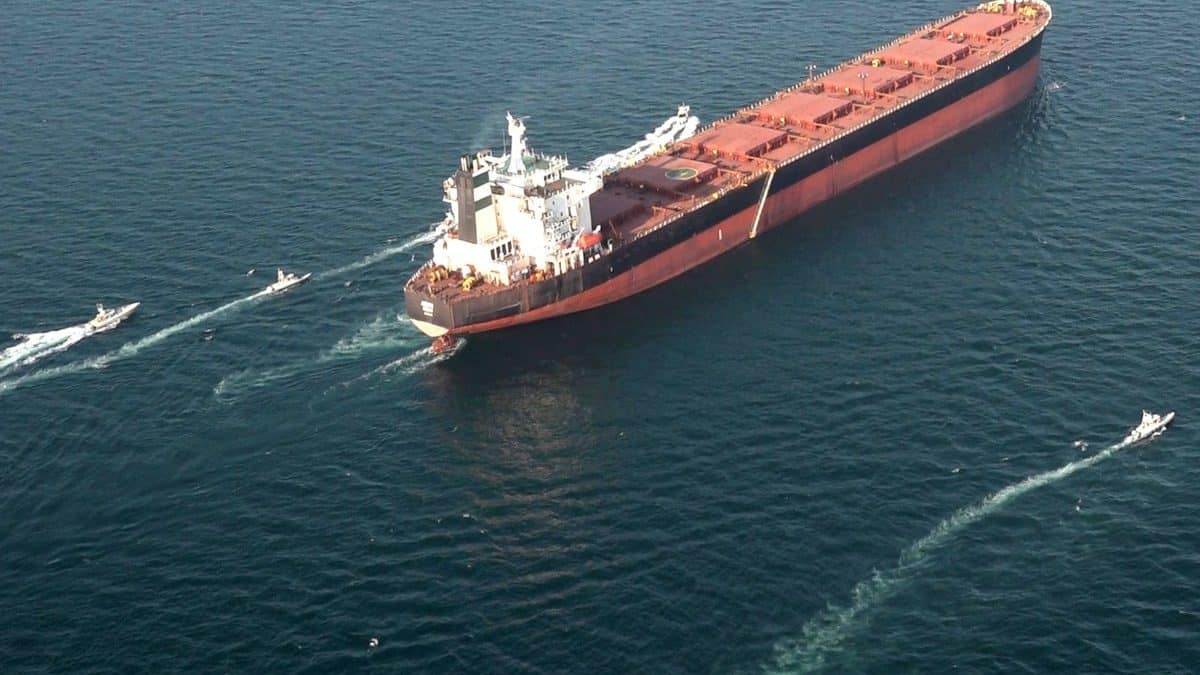
The steel hull of a VLCC supertanker is roughly three football fields long, but in the Strait of Hormuz, it feels like a toy in a bathtub.
If you stand on the bridge of one of these behemoths, you aren't just looking at water. You are looking at the carotid artery of the global economy. One fifth of the world’s daily oil consumption pulses through this twenty-one-mile-wide chokepoint. It is a place where the air smells of salt and heavy fuel oil, and where the silence of the horizon is frequently shattered by the crackle of a radio.
Recently, that radio has been carrying a specific, pointed message from Tehran.
The Iranian government has signaled a stance that is part diplomatic gambit and part schoolyard dare. They are "waiting," they say. They are waiting for the United States to commit to escorting its commercial vessels through these contested waters. It sounds like a logistical detail. It is actually a high-stakes game of chicken played with three-hundred-thousand-ton chess pieces.
The Shadow on the Water
To understand why this matters to a person filling their car in Ohio or a factory manager in Shenzhen, you have to look at the "Tanker War" mentality currently gripping the Persian Gulf.
Consider a hypothetical captain—let's call him Elias. Elias has spent thirty years at sea. He knows the currents of the Indian Ocean and the fickle winds of the North Sea. But when his charts bring him toward the Musandam Peninsula, his pulse changes. He isn't worried about the weather. He is worried about the fast-attack craft. These small, maneuverable boats belonging to the Islamic Revolutionary Guard Corps (IRGC) often buzz around massive tankers like hornets around a slow-moving bull.
When Iran says they are waiting for the U.S. to provide escorts, they are highlighting a vacuum of perceived authority. They are pointing at the gray zone.
By demanding—or "expecting"—the U.S. Navy to physically shield every merchant hull, Iran creates a binary choice for Washington. Either the U.S. commits massive, expensive naval resources to a permanent convoy system, which looks like an escalation, or they don't, which Iran interprets as a lack of resolve or a tacit admission that these waters are under Iranian influence.
The Math of Anxiety
There is a cold, hard arithmetic to this tension.
The Strait of Hormuz is not just a geographical feature; it is a price multiplier. Every time a headline hits about a "waiting" Iranian Navy or a seized vessel, the "war risk" insurance premiums for shipping companies spike. These aren't small fees. We are talking about hundreds of thousands of dollars added to the cost of a single voyage.
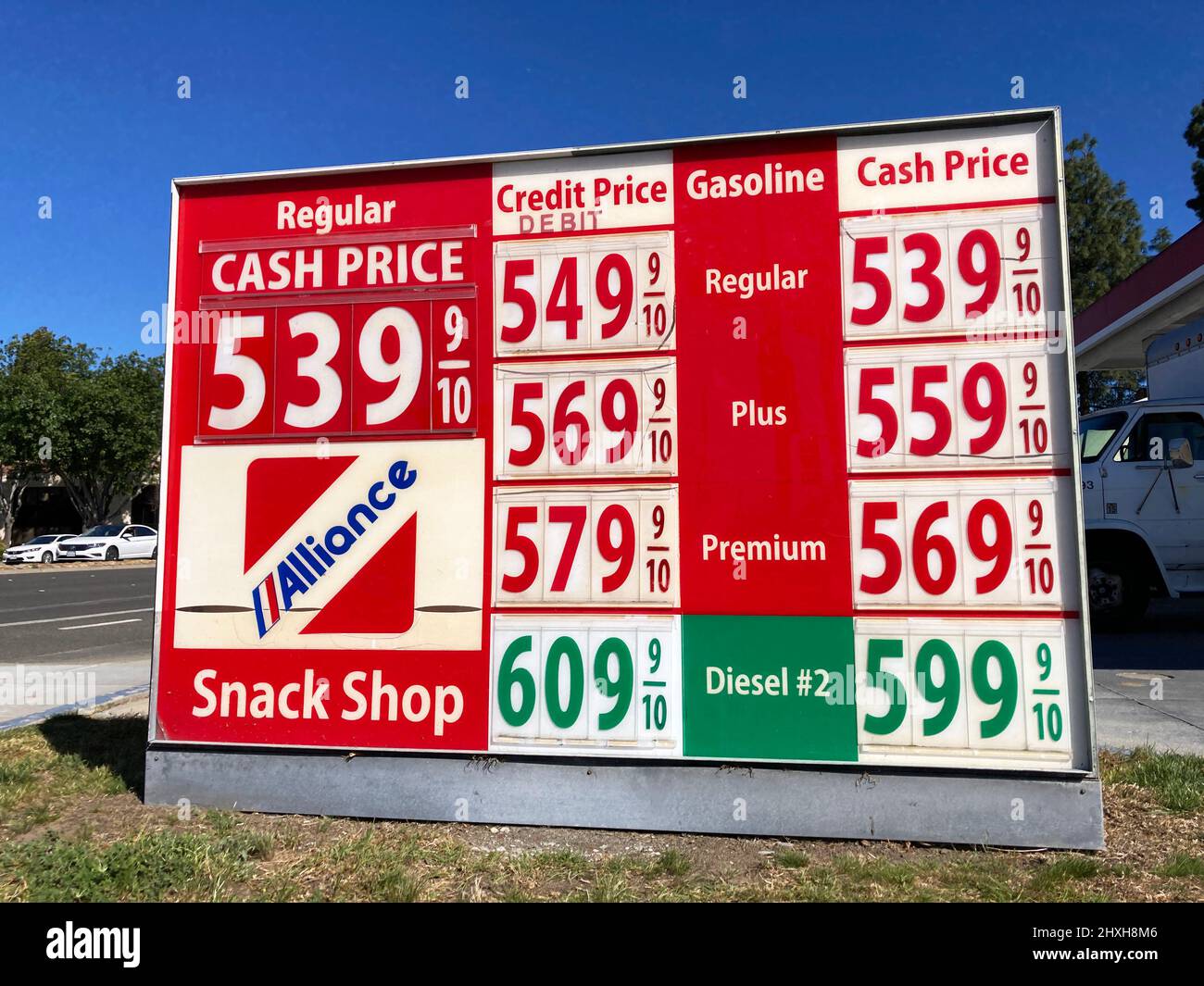
Those costs do not vanish into the seawater. They migrate. They move from the shipping company to the refinery, from the refinery to the distributor, and eventually, they land on your receipt at the pump or in the price of a plastic toy shipped halfway across the world.
Iran’s strategic communication is designed to keep this anxiety simmering. By framing the U.S. presence as a requirement for "safe passage," Tehran subtly shifts the burden of stability. They are essentially saying: "We aren't the ones making this dangerous; the lack of your warships is."
It is a masterful bit of rhetorical inversion.
The Ghost of 1988
History doesn't repeat, but it certainly echoes in the Gulf.
In the late 1980s, during the Iran-Iraq War, the "Tanker War" saw hundreds of merchant ships attacked. The U.S. eventually launched Operation Earnest Will, the largest convoy operation since World War II. They re-flagged Kuwaiti tankers as American ships so the Navy could legally protect them.
Today’s "waiting" game is a ghost of that era.
But the world has changed. In 1988, the U.S. was the undisputed guarantor of global maritime commons. Today, the geopolitical board is cluttered. China is the primary customer for the oil flowing through the Strait. India’s energy security depends on it. When Iran calls for U.S. escorts, they are poking at a nerve: Does the United States still want to be the world's policeman at its own expense, for the benefit of everyone else’s energy prices?
The Human Toll of High-Level Posturing
While diplomats in Tehran and Washington trade barbs, the men and women on the ships live in a state of suspended animation.
Imagine the engine room of a Suezmax tanker. It is 110 degrees Fahrenheit. The vibration is constant, a deep thrum that you feel in your teeth. The crew isn't thinking about "regional hegemony" or "strategic deterrence." They are looking at the radar. They are wondering if the fast boat approaching at forty knots is a patrol looking for a bribe, a legitimate inspection, or the beginning of an international incident that will see them detained in Bandar Abbas for six months.
The psychological pressure is a weapon in itself.
By maintaining this posture of "waiting," Iran ensures that the tension remains a permanent feature of the landscape. It forces the U.S. 5th Fleet, based in Bahrain, to remain on a hair-trigger. It turns every routine transit into a potential spark for a conflagration that no one—not even the protagonists—actually wants.
The Illusion of Control
We often talk about the "global community" as if it’s a managed entity. The reality in the Strait of Hormuz is far more fragile. It is a system built on the assumption of "innocent passage."
Iran’s current rhetoric chips away at that assumption.
If passage is only "safe" when an Arleigh Burke-class destroyer is riding shotgun, then the concept of international waters begins to dissolve. It becomes a series of fortified corridors.
The U.S. response has generally been to emphasize "multilateral" maritime security—trying to get a coalition of nations to share the burden. But coalitions are slow. They require committees and consensus. A "waiting" adversary is fast. They only have to wait for one mistake, one moment of hesitation, or one ship that wanders slightly out of the shipping lane into territorial waters.
The Ripples in the Sand
There is a peculiar stillness in the Gulf just before dawn. The water is like mercury. If you are on a ship, you can see the lights of the Iranian coast to the north and the jagged mountains of Oman to the south.
In this narrow space, the margin for error is measured in yards.
The Iranian statement isn't just a news update. It is a barometer of a world where the old rules are being tested to their breaking point. It is an invitation to a dance that has no clear ending.
The U.S. has not taken the bait of a full-scale convoy system yet. They prefer the "over the horizon" approach, watching from the sky and with sensors, ready to intervene but trying not to provide the very target Tehran is looking for.
But as long as the "waiting" continues, the shadow remains over the water.
The stakes are not just barrels of crude or the price of a gallon of gas. The stakes are the fundamental idea that the world’s oceans belong to everyone, and that a merchant ship can sail from point A to point B without becoming a pawn in a game of empires.
Until that certainty returns, every sailor entering those waters will keep one eye on the radar and one hand on the rail, watching for a shape in the haze that shouldn't be there.
The ocean is vast, but in the Strait of Hormuz, the world has never felt smaller, or more crowded.