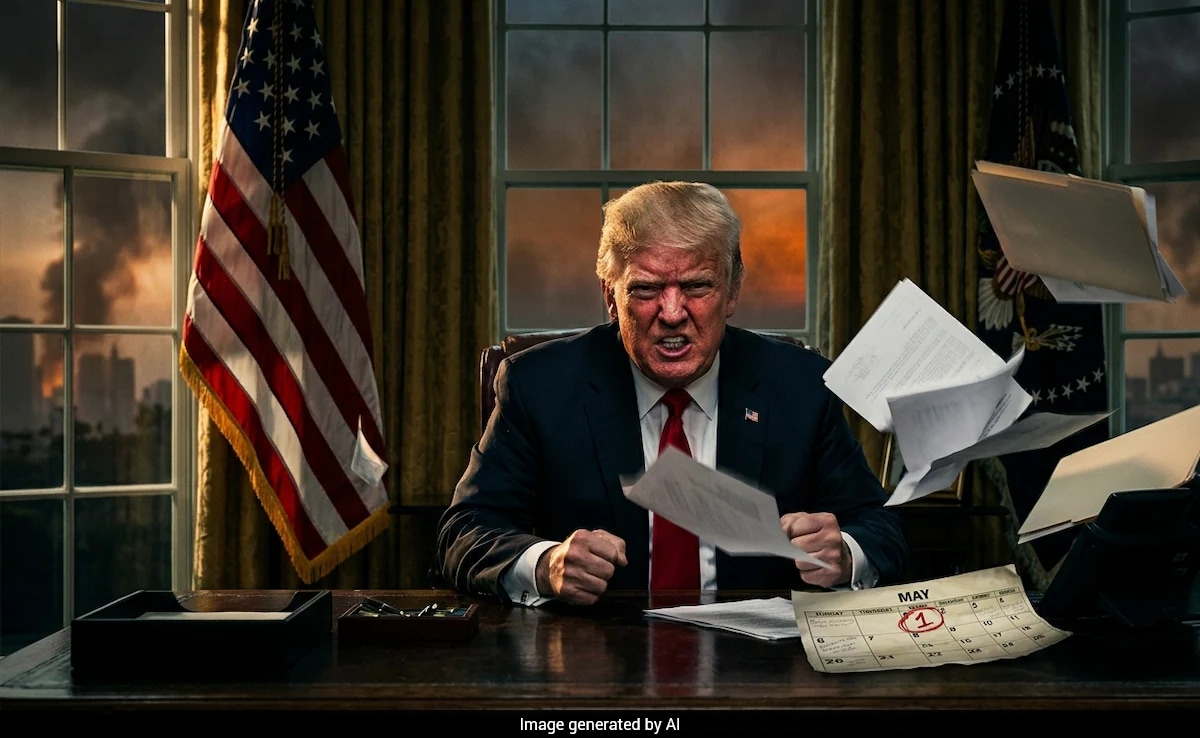
A single piece of paper sits on a mahogany desk in the Oval Office, its edges crisp, its weight negligible. To the casual observer, it is just a resolution. To the crew of a guided-missile destroyer idling in the Strait of Hormuz, that paper is the difference between a routine patrol and a firestorm.
This is the reality of the War Powers Resolution. It is not a dusty artifact of the Nixon era; it is a ticking clock, a sixty-day countdown that stands between the executive branch's impulse and the legislative branch's restraint. When tensions with Iran spike, this clock starts to hum. We often talk about geopolitics in terms of "red lines" and "strategic pivots," but the human truth is far more mechanical. It is about a deadline that most Americans will never see, yet one that dictates whether their sons and daughters are sent into a conflict that hasn't been officially declared. Building on this idea, you can also read: Operational Architecture of Balikatan 2026 and the Strategic Logic of Integrated Deterrence.
The Ghost of 1973
The 1973 War Powers Resolution was born from the scars of Vietnam. It was a desperate attempt by a bruised Congress to reclaim the power to declare war—a power the Constitution explicitly gave them, but which the presidency had slowly, quietly stolen.
The mechanism is simple. If a President sends U.S. forces into "hostilities" or situations where hostilities are "imminent," they have 48 hours to tell Congress why. Then, the clock starts. They have sixty days to get a formal authorization for the use of military force (AUMF) or a declaration of war. If they don't get it, they have thirty more days to pack up and come home. Analysts at The New York Times have shared their thoughts on this matter.
It sounds airtight. It feels like a safety catch on a loaded gun. But in the high-stakes poker game of Middle Eastern diplomacy, the catch is often bypassed by a clever flick of the wrist.
Consider a hypothetical young officer named Elias. He is twenty-four, stationed on a carrier, and his entire world is defined by the three hundred feet of steel beneath his boots. Elias doesn't care about the constitutional nuances of the 1970s. He cares about the "inbound" alerts. When a President decides to launch a strike against an Iranian drone facility or a naval asset, Elias is the one who feels the deck vibrate. If that strike happens without Congressional approval, Elias is living inside a legal gray area. He is a soldier in a war that, on paper, does not exist.
The Semantic Escape Hatch
How does a leader ignore a sixty-day deadline? They don't break the law; they redefine the language.
The executive branch has become masterful at arguing that certain actions do not constitute "hostilities." Imagine a surgeon claiming they didn't perform "surgery" because they only used a laser instead of a scalpel. This is the legal gymnastics used to keep the clock from ever starting. If a drone strike is "limited," "defensive," or "short-term," the White House lawyers argue that the War Powers Resolution simply doesn't apply.
We saw this play out in the recent past when the administration targeted high-ranking Iranian figures. The justification shifted like desert sand. First, it was an "imminent threat." Then, it was "deterrence." By the time the sixty-day mark approached, the argument had evolved into a claim that the President’s Article II powers as Commander-in-Chief are essentially absolute when it comes to national defense.
The danger here isn't just a legal technicality. It is the erosion of the collective "we." When the country goes to war through a Congressional declaration, there is a debate. There is a vote. There is a record of who stood for what. When a President bypasses the clock, they are removing the public from the decision-making process. They are making a choice for 330 million people behind closed doors, using a dictionary they wrote themselves.
The Weight of the Sixty Days
Imagine the pressure inside the halls of the Capitol as the fiftieth day approaches.
The air is thick with the scent of cheap coffee and expensive cologne. Legislators are caught in a vise. If they vote to stop the President, they are accused of abandoning the troops in the field—troops like Elias. If they vote to authorize the conflict, they are handing over a blank check for a war that could last a decade.
The sixty-day window was designed to be a cooling-off period. It was meant to force the executive to prove their case to the people's representatives. Instead, it has become a game of chicken. Presidents know that once the first shot is fired, it is politically suicidal for Congress to cut off funding or demand a retreat. The "clock" becomes a suggestion rather than a command.
But for the families in small towns across the Midwest or the suburbs of Virginia, the clock is different. For them, sixty days is two months of checking the news every hour. It is two months of wondering if the "limited strike" they heard about on the radio will spiral into a regional conflagration.
The Power of the Purse vs. The Power of the Sword
History shows us that the only thing more powerful than a President's command is a Congress that refuses to pay for it. Yet, this is the lever no one wants to pull.
The War Powers Resolution is often criticized as being "unconstitutional" by the executive branch and "toothless" by the legislative branch. This tension creates a vacuum where uncertainty thrives. In that vacuum, Iranian hardliners find justification for their own escalations. They see a divided American government and calculate that they can push the envelope because the President’s hands are tied—or they see an unchecked President and calculate that they must strike first before the "limited engagement" becomes an invasion.
Miscalculation is the mother of all wars. When the rules of engagement are murky, everyone is guessing.
The sixty-day clock is supposed to provide clarity. It is supposed to say: This is how long you have to justify the cost of blood and treasure. When the President ignores it, they aren't just ignoring a law; they are ignoring the principle that no single person should have the power to commit a nation to death.
The Human Cost of Legal Loopholes
Let’s go back to Elias.
If the sixty-day clock runs out and nothing changes, Elias stays on that carrier. He stays in the line of fire. He continues to launch sorties or monitor radar screens, while three thousand miles away, lawyers argue about whether the word "hostilities" includes cyber-attacks or proxy skirmishes.
The human element is the casualty of this legal warfare. We get so wrapped up in the "could he ignore it" part of the headline that we forget the "why it matters" part. It matters because the Constitution was designed to be slow. It was designed to be frustrating. It was designed to prevent a single, impulsive ego from setting the world on fire.
When we allow the sixty-day clock to be treated as a mere suggestion, we are admitting that the system is broken. We are saying that the speed of modern warfare has outpaced the speed of democracy.
The reality of a conflict with Iran is not a series of clean, surgical strikes. It is a messy, grinding, unpredictable nightmare that would stretch far beyond any sixty-day window. If a President can ignore the clock on day sixty-one, what stops them on day six hundred?
The silence in the aftermath of a bypassed resolution is the loudest sound in Washington. It is the sound of a precedent being set. It is the sound of the guardrails being ground into dust.
As the sun sets over the Persian Gulf, the sailors on deck watch the horizon. They aren't looking for legal precedents. They are looking for incoming fire. They deserve to know that if they are there, they are there because the entire country, through its elected representatives, decided it was necessary. Anything less isn't just a violation of a 1973 resolution; it’s a betrayal of the people wearing the uniform.
The clock is ticking. It has always been ticking. The question is whether anyone is still listening to the sound.