The U.S. Treasury’s latest round of sanctions against the Sinaloa Cartel targets an international network of money launderers and chemical suppliers, but the move exposes a much deeper systemic failure. While the government freezes bank accounts and blacklists front companies, the fundamental infrastructure of the drug trade remains untouched. This isn’t just a law enforcement problem. It’s a supply chain mastery that rivals the world’s most efficient Fortune 500 companies. The Sinaloa Cartel has evolved beyond a simple gang of smugglers; they are now a global conglomerate that exploits the friction points of international trade to move fentanyl and meth with industrial precision.
The recent sanctions focus on a specific node of the organization—those responsible for procuring precursor chemicals and cleaning the resulting cash. However, treating these networks as isolated criminal cells ignores the reality that they are deeply embedded in the legitimate global economy. They use the same shipping lanes, the same legal shell company structures, and the same digital payment rails as every other international business.
The Mirage of Financial Crippling
Sanctions are the preferred weapon of the Treasury Department because they are clean and immediate. By adding a name to the Specially Designated Nationals (SDN) list, the U.S. effectively excommunicates that individual or business from the global dollar-based financial system. It sounds devastating on paper. In practice, it’s often a game of corporate Whac-A-Mole.
The Sinaloa Cartel operates with a redundancy that would make a server farm jealous. When one money laundering cell is "burned" by a Treasury designation, three others are already operational, often under the names of distant relatives or low-level associates who haven't yet popped up on the radar of the Office of Foreign Assets Control (OFAC). These networks rely on smurfing—the practice of breaking down massive amounts of cash into tiny deposits that fall below reporting thresholds—and the use of trade-based money laundering.
Trade-based money laundering is particularly difficult to stop. A cartel-controlled company in Culiacán might buy a shipment of electronics or textiles from a legitimate supplier in China. The "payment" for these goods is made using drug proceeds already sitting in an overseas account. The goods are then sold in Mexico for "clean" pesos. On the books, it looks like a standard import-export business. To the Treasury, it looks like a needle in a haystack of millions of daily global transactions.
The Chemical Arbitrage
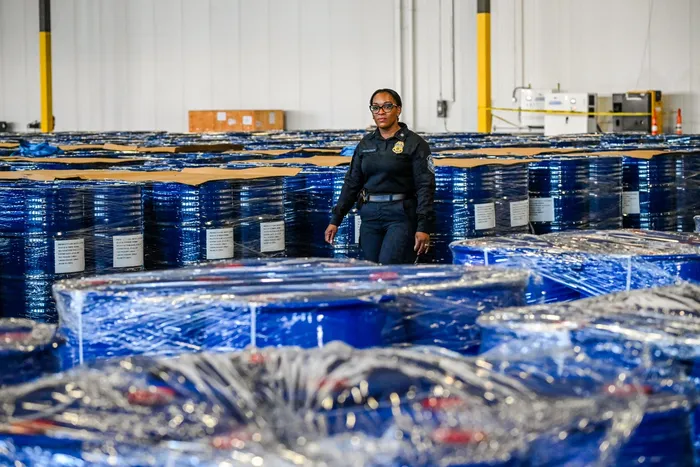
Fentanyl changed the math of the drug war. Unlike cocaine, which requires vast fields of coca and favorable weather, fentanyl is purely a product of laboratory efficiency. The Sinaloa Cartel has mastered the art of sourcing "dual-use" chemicals—substances that have perfectly legal applications in the pesticide or pharmaceutical industries but can be diverted into synthetic drug production with one or two chemical steps.
The recent sanctions target Chinese suppliers who ship these precursors to Mexico. The bottleneck here isn't a lack of regulation; it's the sheer volume of global chemical trade. Tens of thousands of shipping containers move through ports like Manzanillo and Lázaro Cárdenas every week. Expecting customs agents to inspect every barrel of "industrial solvent" for potential fentanyl precursors is a logistical impossibility.
The cartel’s chemists are also increasingly sophisticated. They aren't just following recipes; they are innovating. When a specific precursor is banned or heavily monitored, they switch to a different "pre-precursor" that hasn't been regulated yet. This constant evolution of the chemical blueprint means that by the time a substance is added to a global watch list, the cartel has already moved on to a new formula.
The Myth of the Kingpin
There is a persistent obsession in Western media and policy circles with the "Kingpin" strategy. The idea is that if you cut off the head of the snake—capturing a figure like "El Mayo" Zambada or the sons of "El Chapo"—the entire organization will wither. History proves the opposite.
The Sinaloa Cartel is not a rigid hierarchy; it is a horizontal federation of various factions that share a brand name and logistics network. Removing a top-tier leader doesn't stop the flow of drugs. It simply triggers a period of internal realignment or "succession management," often accompanied by a spike in violence, followed by a return to business as usual. The middle management of the cartel—the logistics coordinators, the chemical brokers, and the financial fixers—are the ones who keep the engine running. These are the individuals the Treasury is now trying to target, but they are far more numerous and replaceable than the charismatic bosses on the "Most Wanted" posters.
Sovereignty and the Mexican Stasis
No amount of U.S. sanctions can succeed without a partner in Mexico City that is willing and able to dismantle the cartel's domestic infrastructure. Currently, that partnership is strained. The Mexican government’s "Abrazos, no balazos" (Hugs, not bullets) policy has largely moved away from high-stakes confrontations with cartel leadership.
The cartel’s power in Mexico is not just military; it is social and political. In many regions, they are the primary employer, the provider of social services, and the de facto local government. They have successfully co-opted local police and municipal officials through a combination of plata o plomo (silver or lead). When the U.S. Treasury sanctions a Mexican business, that business might lose its ability to deal in U.S. dollars, but it doesn't necessarily lose its local standing or its ability to operate within the Mexican economy using pesos or cryptocurrency.
The Crypto Pivot
While traditional money laundering still accounts for the bulk of cartel finances, cryptocurrency has provided a new, high-speed lane for value transfer. Tether (USDT), a stablecoin pegged to the U.S. dollar, has become a favorite tool for international criminal syndicates. It offers the stability of the dollar with the anonymity and speed of the blockchain.
Cartels use crypto to pay their Asian chemical suppliers instantly, bypassing the delays and scrutiny of the SWIFT banking system. These transactions leave a digital trail, but following that trail across multiple jurisdictions and "tumbling" services—which mix clean and dirty coins—is a nightmare for investigators. The decentralized nature of these assets means there is no central "bank" for the Treasury to threaten with sanctions. You can sanction a wallet address, but the owner can generate a new one in seconds.
The Failure of Demand-Side Denial
Every time a new sanctions package is announced, it is framed as a victory. But the metric that truly matters—the price and purity of fentanyl on American streets—rarely budges. As long as the demand in the United States remains at record highs, the Sinaloa Cartel will find a way to meet it. The profit margins are simply too high for any sanction to act as a meaningful deterrent.
A kilogram of fentanyl precursors might cost a few thousand dollars in China. Once processed into millions of pills, that same kilogram can generate millions of dollars in revenue in the U.S. market. The "risk premium" created by law enforcement and sanctions is just a cost of doing business, easily absorbed by the astronomical returns. We are trying to use 20th-century financial tools to fight a 21st-century decentralized network that views the law as a mere variable in its profit-and-loss statement.
The Shadow Economy of Enablers
Behind every cartel transaction is a professional class of enablers. These are the lawyers who set up the shell companies, the accountants who balance the double books, and the bankers who look the other way for a fee. Many of these individuals live in "clean" jurisdictions and maintain an aura of respectability.
The Treasury has begun to target some of these facilitators, but the legal framework in many tax havens makes it incredibly easy to hide the true "beneficial owner" of a company. Without a global, transparent registry of corporate ownership, the cartel’s financial footprint will remain obscured by layers of legal fiction. The sanctions often hit the "front man," while the actual architects of the financial structures remain shielded by attorney-client privilege and opaque offshore laws.
The Logistics of Death
To understand the Sinaloa Cartel, you have to view them as a logistics firm. They have mastered the "Last Mile" problem of drug delivery. Once the fentanyl crosses the border—usually through legal ports of entry in passenger vehicles or commercial trucks—it enters a highly fragmented distribution network.
This network is intentionally designed to be "lossy." The cartel expects a certain percentage of its shipments to be seized. They factor this into their pricing. A seizure of 50,000 pills at a border crossing makes for a great press release for the DEA, but to the Sinaloa Cartel, it’s just inventory shrinkage, no different from a retail store dealing with shoplifting. The sheer volume of traffic ensures that the vast majority of product reaches its destination.
The Dead End of Current Policy
The U.S. government’s reliance on sanctions is a symptom of a lack of better options. It is a way to "do something" in the face of a crisis that kills over 100,000 Americans annually. But sanctions are a reactive tool being used against a proactive enemy. The Sinaloa Cartel has already anticipated the next five moves. They have already diversified their portfolios into legal industries like avocados, logging, and mining, which provide even more cover for their illicit activities.
We are witnessing the limits of financial warfare. When an organization has the wealth of a small nation and the ruthlessness of a paramilitary force, a "Keep Out" sign from the Treasury Department isn't an endgame. It's just a redirection.
The real threat isn't just the drugs themselves, but the way the cartel's money is slowly hollowing out legitimate institutions. When cartel cash enters the real estate market or the banking system, it doesn't just sit there; it buys influence. It corrupts the very systems we use to track it. The "international drug network" isn't a separate entity from the global economy. It is a malignant growth within it, sharing the same veins and arteries.
Until the focus shifts from blacklisting names to fundamentally changing the cost-benefit analysis of the drug trade—through massive demand reduction and a total overhaul of global corporate transparency—these sanctions will remain little more than a scorecard in a game the cartels are currently winning. The infrastructure is too resilient, the money is too fast, and the borders are too porous for anything less than a complete reimagining of the conflict. The pipeline is invisible because we are looking for a physical pipe, when in reality, the pipe is the system itself.