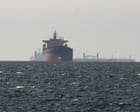
A single, rusted steel hull sits deep in the water, carrying two million barrels of crude oil. It moves at the pace of a brisk walk. To the crew on the bridge, the Strait of Hormuz looks like any other stretch of turquoise sea, save for the jagged, limestone cliffs of the Musandam Peninsula looming like teeth to the north. But this is not just water. It is a throat. Through this twenty-one-mile-wide pinch point flows one-fifth of the world’s liquid energy. If that throat constricts, the lights go out in factories in Germany, the price of bread rises in Cairo, and a commuter in London suddenly finds their morning drive costs twice as much as it did yesterday.
The British government is currently locked in quiet, high-stakes negotiations to determine who, exactly, will stand guard at this throat.
The Weight of the Horizon
Imagine a young merchant sailor named Elias. He isn't a soldier. He’s a twenty-four-year-old from a coastal town who took this job to pay off a mortgage or see the world. As his tanker approaches the Strait, the atmosphere on the bridge shifts. The radar screen, usually a rhythmic pulse of predictable dots, becomes a source of dread. Small, fast-moving craft—often unmarked, often swarming—frequently shadow these massive vessels.
For Elias, the geopolitical "discussions" happening in climate-controlled rooms in Whitehall aren't abstract policy points. They are the difference between a routine watch and a hostage situation. When the UK Ministry of Defence signals that it remains in talks over escorting ships, they are talking about sending Type 23 frigates or Type 45 destroyers to act as a physical shield.
These warships represent a paradox of modern power. They are billion-pound machines designed for high-intensity conflict, yet their primary mission here is psychological. Their presence says: Do not touch this ship. It is a visual promise of protection in a stretch of water where international law often feels as fluid as the tides.
The Economics of Anxiety
We often think of global trade as a series of spreadsheets and stock tickers. It is actually a system built entirely on trust and insurance. The moment a region like the Strait of Hormuz is deemed "unstable," the cost of doing business spikes. Insurance underwriters in the City of London begin to adjust their "war risk" premiums.
Consider the math. If the risk of seizure or attack increases by even a fraction of a percentage, the cost to insure a single voyage can jump by hundreds of thousands of dollars. The shipping companies don't just eat that cost. They pass it to the refinery. The refinery passes it to the distributor. The distributor passes it to you at the pump.
This is why the UK’s hesitation—or rather, its deliberate "ongoing consultation"—is so fraught. To commit to a permanent escort mission is an admission that the world is no longer safe for "free" trade. It is an expensive, exhausting commitment of resources. The Royal Navy is smaller than it has been in centuries. Stretching its fleet to cover every vulnerable tanker is a logistical nightmare.
But the alternative is worse. If the UK stays its hand, it signals that the world’s most vital maritime artery is effectively up for grabs.
The Invisible Chessboard
The Strait is not just a geographical chokepoint; it is a laboratory for "gray zone" warfare. This isn't the kind of war where fleets exchange broadsides. It’s a war of harassment, of mysterious limpet mines attached to hulls under the cover of darkness, and of electronic interference that makes a ship’s GPS believe it is ten miles away from its actual location.
When British officials discuss "multi-national frameworks" and "coordinated responses," they are trying to solve a puzzle. They want to protect British-flagged vessels without accidentally sparking a regional conflagration. It’s a tightrope walk over a sea of oil.
A naval officer once described the sensation of patrolling the Strait as "waiting for a glass to break." You spend hours, days, weeks in a state of hyper-vigilance, watching the grainy thermal feeds of small boats zigzagging toward your convoy. You have to decide in seconds: is that a fishing boat or a boarding party?
The Fragility of the Flow
We live in an age where we expect goods to appear on our doorsteps with the click of a button. We have forgotten the physical reality of the world. We have forgotten that our entire way of life depends on the safe passage of steel boxes through narrow gaps in the earth’s crust.
The UK’s ongoing talks aren't just about ships. They are about the survival of an idea—the idea that the oceans belong to everyone and that commerce should be shielded from the whims of regional powers.
Behind the dry headlines about "escort duties" and "strategic coordination" lies a much deeper tension. It is the realization that the peace we took for granted for decades was never the natural state of things. It was a managed condition.
As the sun sets over the Persian Gulf, Elias stands on the wing of the bridge. He looks out at the dark silhouette of a Royal Navy destroyer a mile to his port side. Its lights are dimmed. It looks like a ghost. He doesn't know the specifics of the talks in London. He doesn't know which budget subcommittee is debating the fuel costs of the escort mission. He only knows that as long as that grey shape is there, he might actually get to go home.
The water remains calm, for now. But beneath the surface, the currents are pulling harder than ever, and the line between a routine voyage and a global crisis is as thin as the wake behind a ship.
Would you like me to look into the specific naval assets the UK currently has deployed in the region to see how they compare to the required escort capacity?