The viral quote attributed to Socrates regarding the hierarchy of minds—claiming that the strong discuss ideas while the weak discuss people—is a staple of modern social media motivation. It offers a tidy, comforting framework for understanding why public conversation feels so increasingly shallow. However, the true crisis of modern discourse isn't just that we are talking about people; it is that we have lost the ability to distinguish between a person, an event, and the underlying architecture of an idea. By categorizing our thoughts into these three rigid tiers, we often miss the reality that they are inextricably linked.
Intellectual rigor is dying because we treat these categories as silos. We look at the gossip industry and the obsession with celebrity scandal as a low-level distraction, which it often is. Yet, the broader failure lies in our inability to trace the path from a specific event or a specific person back to the structural concepts that govern our lives. True investigative depth requires moving beyond the "who" and the "what" to reach the "why," but the modern attention economy is designed to keep us trapped in the basement of human curiosity.
The Misattributed Mandate
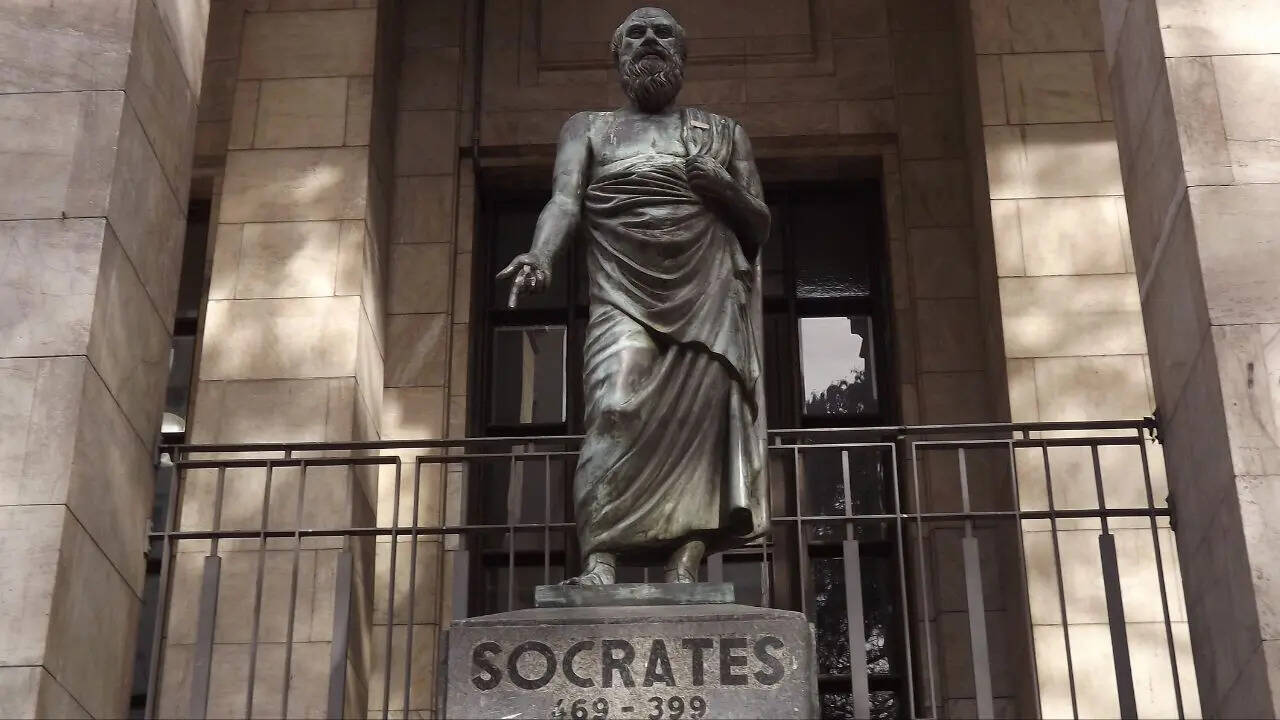
Before deconstructing the merit of the "ideas versus people" framework, we have to address the irony of its origin. There is no historical evidence that Socrates ever uttered those words. Most scholars point to a similar sentiment expressed by Henry Thomas Buckle, a 19th-century historian, or even Eleanor Roosevelt. The fact that the internet consistently attaches the quote to a Greek philosopher proves the very point the quote tries to make: we are more interested in the "person" (the branding of Socrates) than the "idea" (the historical accuracy of the statement).
This misattribution serves as a perfect case study for the current state of information consumption. We prioritize the aesthetic of wisdom over the labor of verification. When we share a meme about "strong minds," we are engaging in a performative act of intellectualism. We want to be seen as the type of person who values ideas, even if we haven't spent five minutes actually interrogating the concept at hand. This is the "people" tier of thinking disguised as the "idea" tier.
Why We Are Hardwired for the Bottom Tier
The human brain did not evolve to contemplate the intricacies of monetary policy or the ethics of artificial intelligence in a vacuum. It evolved to track social hierarchies and navigate tribal dynamics. Discussing "people" was a survival mechanism for thousands of years. Knowing who was untrustworthy, who was rising in power, and who was forming alliances was the primary way our ancestors stayed alive.
The problem arises when this biological instinct is hijacked by a 24-hour news cycle and algorithmic feeds. We are now fed a constant stream of "people" stories—not because they are important, but because they trigger the most primitive parts of our cognition.
- The dopamine hit of outrage: Seeing a "villain" get comeuppance provides a neurological reward.
- The safety of the tribe: Agreeing that a specific person is "bad" reinforces our standing within our own social group.
- The ease of consumption: It takes far less caloric energy to judge a politician’s personal life than to read a 50-page white paper on their proposed infrastructure bill.
By staying at the level of the individual, we avoid the discomfort of complex thought. We treat systemic failures as personal failings. If a corporation pollutes a river, we hunt for a CEO to blame. While accountability is necessary, focusing solely on the individual obscures the regulatory gaps and economic incentives that allowed the pollution to happen in the first place.
The Event Trap
The middle ground—discussing "events"—is where most of our professional media lives. This is the realm of the "breaking news" alert. It provides a veneer of substance because it deals with facts and occurrences. A bridge collapses; a stock price drops; a law is passed. These are the "whats" of the world.
However, the "event" tier is often just as shallow as the "people" tier if it lacks context. We have become a society of event-trackers. we watch the scoreboard without ever learning the rules of the game. This creates a reactive populace that is perpetually surprised by the inevitable.
When we only discuss events, we are constantly in a state of defense. We react to the crisis of the day, then move on to the next one without ever identifying the patterns. This is "average" thinking because it requires no foresight and no synthesis. It is data without wisdom. To move from the average to the strong, one must look at the event and ask: "What system produced this outcome?"
The Architecture of an Idea
To discuss "ideas" is to look at the blueprints of society. It is the most difficult form of conversation because ideas are invisible. You cannot see "capitalism," "justice," or "meritocracy." You can only see the people they affect and the events they trigger.
Strong minds are those that can look at a specific person or a specific event and see the underlying ideology at work. They don't just talk about a specific instance of censorship; they talk about the tension between individual liberty and collective safety. They don't just talk about a billionaire’s latest tweet; they talk about the changing nature of public squares in a digital age.
The danger of the "idea" tier, however, is the risk of becoming untethered from reality. Intellectualism can easily turn into a high-brow form of escapism. If your discussion of ideas never touches the ground—if it never accounts for the people it impacts or the events it causes—it becomes a hollow academic exercise.
The Weaponization of Small Talk
In professional environments, the "people" tier is often used as a weapon. Office politics is the art of keeping a workforce focused on personalities so they don't question the "ideas" behind the management structure. When employees are busy discussing who got the promotion or who said what at the holiday party, they aren't discussing the equity of the pay scale or the long-term viability of the company's mission.
This is a deliberate distraction. If you can keep people focused on the "who," they will never have the energy to tackle the "how." This is true in corporate boardrooms and it is true in national politics. Political campaigns are almost entirely focused on character assassination and personal gaffes because those are the easiest things for the public to digest.
How to Elevate the Conversation
Breaking out of the "weak" and "average" tiers requires a conscious effort to reframe every piece of information you encounter. It is a muscle that must be trained. When you hear a piece of gossip, you must force yourself to look for the event it describes, and then the idea behind that event.
The Reframing Method
If the topic is "Person X is a hypocrite," the event is "Person X did something that contradicts their stated values." The idea is "The psychological difficulty of maintaining ideological purity in a complex world."
If the topic is "The price of gas went up," the event is "Market fluctuations in the energy sector." The idea is "The geopolitical vulnerability of a fossil-fuel-dependent economy."
This shift doesn't mean we stop talking about people or events. It means we stop using them as the end point of the conversation. They should be the entry point.
The Cost of Intellectual Laziness
The stakes of this shift are not merely social; they are existential. We are facing challenges—climate shifts, economic instability, the ethical boundaries of technology—that cannot be solved at the level of the individual. You cannot "cancel" your way out of a systemic crisis. You cannot "event-track" your way to a stable future.
We have built a world where the loudest voices are the ones that stay in the basement of human thought. The algorithms that govern our digital lives are programmed to reward the "weak" mind because it is the most predictable. Outrage is easier to monetize than nuance.
If we continue to let our discourse be defined by the "who" and the "what," we will remain a reactive, fragmented society. The strength of a mind is not measured by its ability to ignore the world of people and events, but by its ability to see through them to the ideas that are actually driving the ship.
We must stop mistaking the players for the game. Stop focusing on the actors and start studying the script. The next time you find yourself deep in a discussion about a person's failings or a singular event, pause and look for the idea hiding in the shadows. That is where the power lies. That is where the change happens.