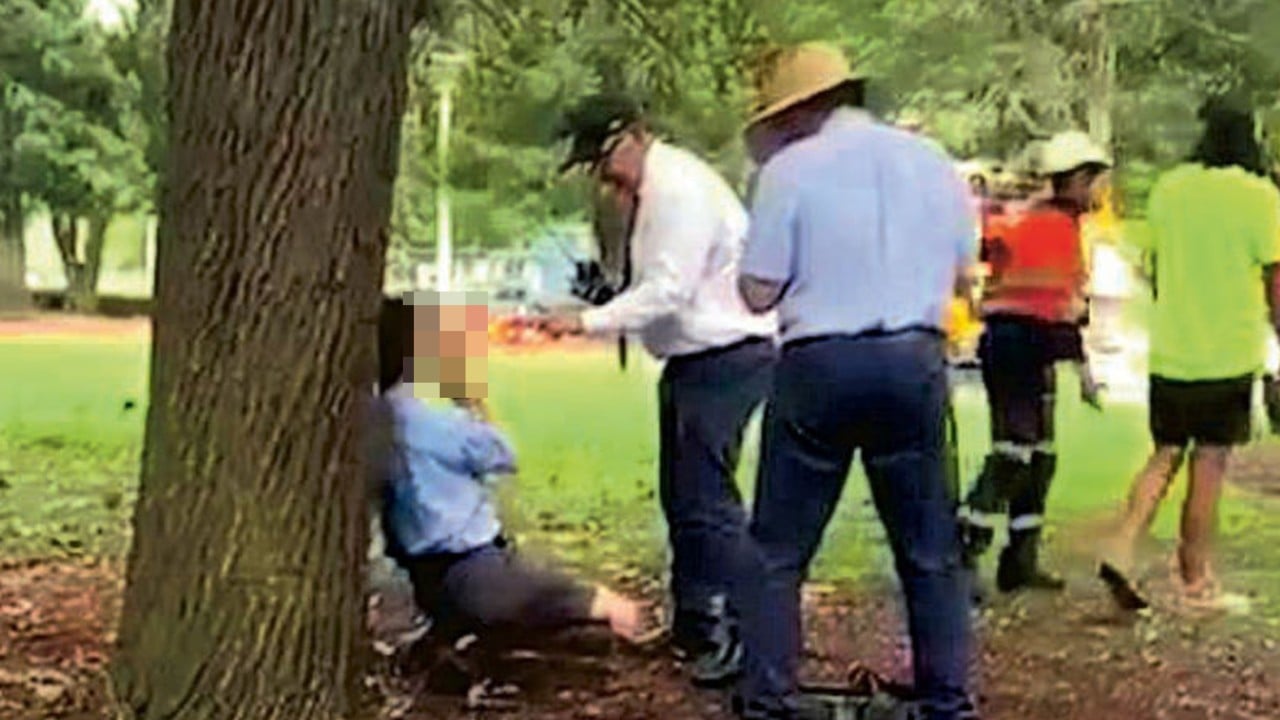
The arrest of a Chinese University of Hong Kong (CUHK) professor for infiltrating Australian secondary schools under the guise of a student represents a catastrophic failure of both individual professional ethics and institutional vetting protocols. This incident transcends simple criminal voyeurism; it exposes a specific intersection of high-functioning behavioral pathology and the systemic blind spots within international academic mobility. Analyzing this case requires a deconstruction of the predator's "access strategy," the failure of cross-border credentialing, and the specific psychological profiles associated with such high-risk deception.
The Triad of Institutional Vulnerability
The ability of a middle-aged academic to successfully pose as a minor within a structured educational environment relies on a "Triad of Vulnerability" that exists in many Western public institutions.
- The Halo Effect of Academic Credentialing: Higher education professionals often enjoy a "presumption of integrity." Because the subject held a professorship at a prestigious institution (CUHK), his presence in an educational context—even one outside his primary field—was likely met with less scrutiny than a member of the general public.
- Operational Gaps in Visitor Management: Despite stringent Child Safe Standards in Australian jurisdictions, visitor management systems often prioritize administrative compliance over active behavioral monitoring. If the subject possessed forged or misleading identification that bypassed the initial digital checkpoint, the system defaulted to a state of "trusted access."
- The Cultural Camouflage Factor: In diverse urban environments, international visitors often benefit from a "cultural distance" that masks behavioral anomalies. What might be flagged as suspicious behavior in a local resident is often dismissed as a cultural misunderstanding or a linguistic barrier in an international academic, providing the subject with the necessary social friction to operate undetected.
The Mechanics of the Infiltration Strategy
The subject did not merely enter a school; he engineered a persona designed to exploit the specific psychological landscape of a secondary school environment. This is defined as Tactical Infantilization. By adopting the dress, mannerisms, and physical markers of a student, the subject sought to disappear into the "background noise" of the institution.
From a strategic standpoint, this infiltration follows a three-stage progression:
Phase I: Acquisition of Physical Proxies
To pass as a student, the subject required "legitimizing artifacts." This includes specific school uniforms, bags, and identification. The acquisition of these items suggests a premeditated logistics chain. It indicates that the breach was not a crime of opportunity but a calculated operation requiring reconnaissance of the target school’s branding and vendor requirements.
Phase II: Behavioral Synchrony
Successful infiltration requires the subject to mimic the behavioral rhythms of the target population. This includes adhering to bell schedules, congregating in student-only areas (such as cafeterias or locker rooms), and adopting a non-threatening, submissive posture characteristic of a subordinate in a hierarchy. The cognitive dissonance required for a PhD-level professor to maintain this charade suggests a high degree of dissociative capability.
Phase III: The Documentation Cycle
The reported "taking of photos" serves as the primary objective of the breach. In forensic psychology, this is often categorized under the Substitution Mechanism, where the digital capture of the subject serves as a permanent proxy for the prohibited interaction. The risk-to-reward ratio in this phase is the most skewed, as the act of photography is the moment of highest visibility and potential detection.
Quantifying the Damage to Academic Diplomacy
The repercussions of this event extend far beyond the immediate criminal charges in Australia. It creates a "Contagion of Distrust" that impacts the broader framework of international academic exchange between Hong Kong and the West.
- The Credibility Tax: Every future visiting scholar from the affected department or university will now face a heightened level of scrutiny, effectively a "tax" on their time and reputation.
- Legal Liability Re-alignment: Institutions may move from a "Declaration of Good Standing" model to a "Verified Background" model, significantly increasing the administrative overhead for short-term fellowships and research sabbaticals.
- The Insurance Ripple: Professional indemnity and liability insurance for universities often include clauses regarding the conduct of staff while abroad. A high-profile arrest for a moral turpitude crime can lead to premium hikes or the introduction of "Conduct Exclusion" riders that leave universities financially exposed.
The Psychological Profile of High-Functioning Deception
The subject’s background as a professor at CUHK suggests an individual with high cognitive function and the ability to navigate complex social systems. When such individuals engage in "low-status" crimes like schoolboy impersonation, it points toward a Compensatory Power Dynamic.
In his professional life, the subject held significant authority and status. The clandestine adoption of a "powerless" student persona suggests a psychological need to experience the world from a perspective of invisibility or subversion. This is not a lapse in judgment; it is a structured manifestation of a paraphilic or obsessive-compulsive drive that utilizes the subject’s high intelligence to bypass social safeguards.
Structural Failures in Cross-Border Vetting
The primary bottleneck in preventing such incidents is the lack of a Global Registry of Professional Misconduct. Currently, a professor can be under investigation in one jurisdiction while maintaining active, "clean" status in another.
- Information Silos: Hong Kong and Australian law enforcement/educational databases are not integrated.
- Privacy Protection as a Shield: Privacy laws designed to protect individuals are frequently leveraged by bad actors to prevent the sharing of "soft intelligence" (e.g., reports of odd behavior that did not reach the level of a criminal charge).
- Institutional Silence: Universities often prefer "quiet resignations" to public scandals. If there were prior red flags at CUHK, the desire to protect the university’s brand may have prevented those warnings from entering the public record, effectively facilitating the subject’s ability to travel and offend elsewhere.
Strategic Response Protocols for Educational Institutions
To mitigate the risk of similar infiltrations, institutions must move toward a Zero-Trust Physical Architecture.
- Biometric Verification for Non-Standard Entrants: Any individual who is not a full-time student or regular staff member must undergo multi-factor authentication, including biometric scans compared against a localized "denied access" list.
- Behavioral Detection Training: Staff should be trained in Non-Verbal Leakage Identification. Even the most skilled impersonator will display "micro-tells" of age, authority, and cognitive load that differ from the baseline behavior of a genuine adolescent.
- Standardized International Reporting: Organizations like the Association of Pacific Rim Universities (APRU) must establish a centralized ethics clearinghouse. This would allow for the confidential flagging of individuals who have demonstrated behavioral risks, bypassing the lag time of formal criminal proceedings.
The suspension of the professor by CUHK is a reactive measure, but the systemic problem remains. The vulnerability lies in the assumption that intellectual achievement correlates with moral stability. Until the academic community adopts a data-driven, risk-managed approach to staff conduct—treating it with the same rigor as laboratory safety or financial auditing—the "Academic Halo" will continue to be exploited by those with the intelligence to mask their pathologies.
The next strategic move for school districts and universities is the integration of AI-driven Gait and Proportionality Analysis in surveillance feeds. Such technology can flag individuals whose physical proportions or walking patterns do not match the age-demographic of a student body, providing a non-human, objective layer of security that bypasses the "Cultural Camouflage" and "Halo Effect" that allowed this breach to occur.