The bottleneck in general-purpose robotics is not mechanical dexterity but the translation of tacit human knowledge into executable machine code. South Korean innovators are currently attacking this friction point by bypassing traditional programming and instead treating human expertise as a high-density data source to be harvested. This process, known as Imitation Learning (IL) or Behavioral Cloning (BC), requires a fundamental shift from "teaching" robots via code to "recording" humans via sensor-integrated workflows. To understand the viability of this approach, one must analyze the architecture of data acquisition, the conversion of physical intuition into digital weights, and the economic hurdles of scaling expert-driven AI brains.
The Three Pillars of Robotic Skill Acquisition
Traditional industrial robots operate on hardcoded coordinates—a method sufficient for repetitive tasks in controlled environments but incapable of handling the entropy of a kitchen or a logistics hub. Moving beyond this requires a transition to three distinct layers of intelligence:
- Kinesthetic Mapping: The physical recording of human limb movement, joint angles, and velocity. This provides the spatial foundation but lacks the "why" behind the movement.
- Haptic Feedback Integration: Capturing the pressure and resistance encountered by a human hand. Without force-sensing data, a robot cannot differentiate between picking up a glass bottle and crushing an egg.
- Visual Contextualization: Mapping the environmental state—lighting, object orientation, and obstacles—to the specific actions taken.
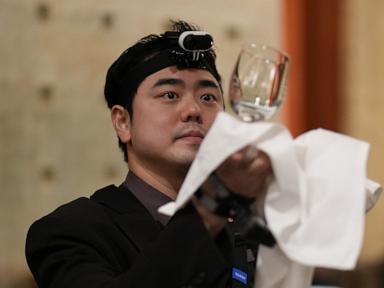
The current Korean startup model focuses on high-fidelity capture at the intersection of these three pillars. By utilizing wearable sensors or teleoperation rigs, they transform a master craftsman’s "feel" for a task into a multi-dimensional dataset.
The Cost Function of Human Data
Data is the primary capital expenditure in AI-driven robotics. Unlike Large Language Models (LLMs) that scrape the internet for pennies, robotic training data requires physical "on-site" generation. The cost of this data is determined by a specific efficiency formula:
$$C = (W_e \times T_d) + (S_o \times R_f)$$
Where:
- $C$: Total Cost of Skill Acquisition.
- $W_e$: Hourly wage of the expert.
- $T_d$: Time spent demonstrating the task.
- $S_o$: Hardware overhead (sensors, rigs, compute).
- $R_f$: Refinement factor (the number of iterations required to achieve 99.9% reliability).
The Korean strategic advantage lies in reducing $T_d$ and $R_f$ through superior sensor density. If a sensor rig can capture the nuances of a task in 50 demonstrations rather than 5,000, the economic viability of "Robot-as-a-Service" (RaaS) shifts from a theoretical luxury to a viable industrial replacement.
Teleoperation vs Direct Capture
The methodology of capturing "robot brains" generally splits into two technical paths:
Passive Capture (Exoskeletons and Vision)
Humans perform the task naturally while wearing sensors.
- Strength: Captures the most authentic human movement.
- Weakness: The "Correspondence Problem." Human anatomy (bones, muscles, degrees of freedom) does not map perfectly to robot actuators. A human wrist can move in ways a standard six-axis cobot cannot, leading to "illegal" or impossible commands in the robot's logic.
Active Teleoperation (The Digital Twin Approach)
The human operates the robot remotely using VR or haptic controllers.
- Strength: Solves the Correspondence Problem. The data captured is already within the robot’s physical constraints.
- Weakness: Latency and "haptic disconnect." The human operator moves slower and more cautiously because they are not feeling the immediate physical feedback of the object, resulting in data that is "stiff" and less efficient than natural human motion.
South Korean firms are currently favoring a hybrid model: using vision-based capture to build the broad logic of the task, followed by high-frequency teleoperation to "clean" the data at the edges of the action space.
Overcoming the Generalization Gap
A robot that learns to flip a pancake in a specific pan in a specific light is useless if the pan changes. This is the "Generalization Gap." To bridge this, the captured data must undergo Data Augmentation and Domain Randomization.
- Synthetic Perturbation: Digitally altering the captured data—changing the color of the object, the lighting, or adding "noise" to the coordinates—to force the AI to identify the core invariant (the object) rather than the environment.
- Recursive Self-Play: Once a human provides the "seed" data, the robot practices in a simulation (a digital twin) millions of times, exploring variations the human didn't demonstrate.
This creates a "Brain" that is 10% human intuition and 90% machine-simulated refinement.
The Structural Bottleneck of Edge Cases
The primary risk in the South Korean "skill capture" model is the long tail of edge cases. In a laboratory, a robot may achieve 95% success. However, in an industrial setting, a 5% failure rate is catastrophic.
Human intuition is most valuable not in the "success path" (the 90% of the time things go right), but in the Recovery Logic (what to do when the object slips). Capturing "recovery data" is significantly harder because experts rarely fail during demonstrations. To solve this, developers must intentionally force "failed states" and have the human demonstrate the correction. This "Negative Data" is the most expensive and most critical component of a robust robotic brain.
Strategic Allocation of Skill Capture
The market will not be won by the company with the most robots, but by the company that identifies which human skills are most "compressibility-friendly."
- Low Value/High Complexity: Tasks with high environmental variability and low economic output (e.g., folding laundry).
- High Value/Moderate Complexity: Tasks with high repeatability but requiring high precision (e.g., polishing semiconductor components, surgical prep, precision assembly).
The focus on South Korean manufacturing sectors—electronics and automotive—suggests a strategy of targeting high-value, moderate-complexity tasks where the ROI on expensive human data is immediate.
Comparative Advantage in the Global Robotics Race
While US firms (like Tesla or Figure) focus on end-to-end neural networks trained on massive, unstructured video data, the Korean approach is more surgical. They are betting that structured, high-fidelity demonstration is a faster path to deployment than unstructured mass-data ingestion.
The US model requires massive compute and "foundation models" (the GPT-4 equivalent for robots). The Korean model requires specialized hardware and "expert-in-the-loop" systems. The former scales better but takes longer to reach industrial reliability; the latter is deployable today but requires a higher upfront investment in human-centric data capture.
The Labor-Capital Paradox
A profound irony exists in this technological shift: the more "skilled" the human worker, the more valuable they are as a data source for their own replacement. This creates a temporary but intense demand for master craftsmen to act as "data trainers."
The strategic play for firms in this space is not just the AI model, but the Proprietary Data Vault. In a world where AI architectures are increasingly commoditized (Transformers, Diffusion models), the only defensible moat is the ownership of the high-fidelity haptic and kinesthetic data captured from human experts.
Investment should be diverted away from proprietary "black box" algorithms and toward the hardware-software interface used for capture. The winner of this race will be the entity that creates the "Standard Interface for Skill Digitization," effectively becoming the Microsoft Windows of human-to-robot translation. Success depends on achieving a sub-millimeter capture precision with a latency lower than 5ms, ensuring that every micro-adjustment of a human muscle is translated into a usable data point for the neural network.
The immediate tactical move for stakeholders is the acquisition of task-specific datasets in "dirty, dangerous, or dull" (3D) industries where human labor is scarce but the task logic is consistent. The data captured today from a single South Korean welding master may soon power 10,000 robots across the globe, effectively decoupling human skill from the human body.