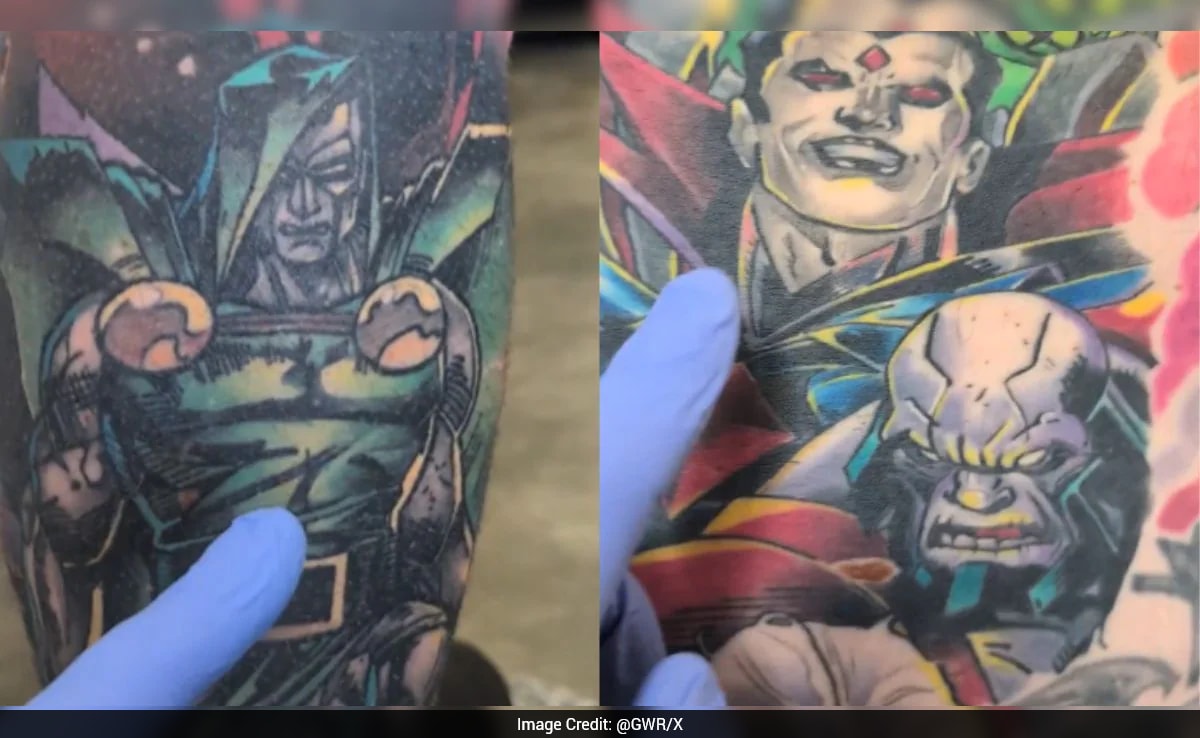
Rick Scoot is not just a fan of the Marvel Cinematic Universe. He is a walking, breathing archive of it. While most enthusiasts express their devotion through shelf-stable figurines or opening-night IMAX tickets, the 52-year-old from Blackpool has committed his entire epidermis to the cause. Scoot recently secured a world record for the most tattoos of characters from a single animated series—specifically Marvel—with 63 distinct portraits etched into his skin.
This is not a story about a record. It is a story about the intersection of corporate mythology, physical endurance, and the psychology of extreme fandom. To understand why a man would spend hundreds of hours under the needle and thousands of pounds on permanent ink, you have to look past the vibrant colors of Iron Man and Captain America. You have to look at what happens when the lines between personal identity and intellectual property vanish entirely.
The Physical Toll of a Living Gallery
Tattooing is trauma. On a biological level, the process involves a needle puncturing the skin between 50 and 3,000 times per minute. Each puncture deposits ink into the dermis, triggering an immune response where macrophages attempt to "eat" the foreign pigment. When they fail, the ink stays, and the art becomes permanent.
Scoot’s journey to 63 tattoos was not a sprint. It was a decades-long marathon of inflammation and healing. To achieve the level of detail required for a world record, the artist—in this case, the talented professionals at various North West studios—must manage the skin’s saturation limits. There is only so much trauma a single limb or torso can take before the skin "rejects" the ink or becomes overworked, leading to scarring that ruins the portrait's clarity.
The Geography of the Skin
The human body offers a finite amount of "prime real estate" for detailed portraiture. Scoot’s collection includes:
- The Back: Typically used for large-scale murals due to the flat surface area.
- The Limbs: Where most of the 63 characters reside, requiring the artist to wrap designs around muscles without distorting the character’s face.
- The Gaps: The most difficult part of achieving a record is the "filler"—the background art that connects disparate heroes into a cohesive sleeve or bodysuit.
The pain threshold varies wildly across these zones. While the outer arm is a walk in the park, the "ditch" of the elbow or the sensitive skin of the inner thigh represents a different level of psychological testing. Scoot’s record is as much a testament to his pain tolerance as it is to his love for Stan Lee’s creations.
The Financial Architecture of the Bodysuit
Let’s talk about the math that the headlines usually ignore. High-end color realism—the style required to make a Marvel character look like it jumped off the screen—is expensive.
A top-tier tattoo artist in the UK charges anywhere from £80 to £150 per hour. A single, detailed portrait of Spider-Man or Thanos can take six to ten hours depending on the scale and complexity. Multiply that by 63. Even with "mate’s rates" or bulk booking discounts, we are looking at a total investment that likely exceeds £10,000 to £15,000.
This is not "disposable income" for most people. It is a prioritized capital expenditure. For collectors like Scoot, the body becomes a museum. Unlike a car or a house, this investment cannot be sold, leveraged, or liquidated. It is the ultimate sunk cost. It is also a commitment to maintenance. Color ink, particularly reds and yellows common in superhero costumes, fades faster than black and grey. To keep a record-breaking collection looking "world-class," the wearer must commit to lifelong "touch-ups" and a strict regimen of sunblock. UV rays are the natural enemy of the tattoo; they break down the pigment particles, turning a crisp Wolverine into a blurry yellow smudge over the course of a decade.
The Brand as Biological Identity
There is a deeper sociological shift happening here. In the past, tattoos were marks of rebellion or tribal belonging. Today, they are increasingly used to signal alignment with global media franchises.
When Rick Scoot puts 63 Marvel characters on his body, he is essentially becoming a brand ambassador for Disney, the parent company of Marvel. This represents a fascinating evolution in consumer behavior. We have moved past wearing the t-shirt. We have moved past buying the Blu-ray. We are now in an era of biological branding, where individuals use corporate intellectual property to define their own sense of self.
The Psychology of the Collection
Why 63? Why not stop at 20?
The "collector’s itch" is a recognized psychological phenomenon. Once a set is started, the brain seeks completion. For a Marvel fan, the "set" is effectively infinite, given the thousands of characters in the comic book archives. The world record acts as an artificial finish line—a way to turn a hobby into a legacy.
However, there is a risk involved. Fashions change. Cinematic universes reboot. Today’s blockbuster is tomorrow’s "remember that?" trivia question. By anchoring his identity so firmly to a specific era of entertainment, Scoot has made himself a living time capsule.
The Technical Challenge for the Artist
We must credit the unnamed architects of this record. Tattooing a human is not like painting on a canvas. The canvas moves. It bleeds. It swells.
To fit 63 characters on one body without the whole thing looking like a cluttered mess requires immense compositional skill. The artist has to consider:
- Light Sources: If Iron Man is lit from the left, but Thor is lit from the right, the sleeve will look disjointed.
- Color Theory: Using complementary colors in the backgrounds to make the primary characters pop.
- Longevity: Knowing which details will hold up over twenty years and which will turn into "mud."
Many artists refuse to do "micro-tattoos" because the lines eventually spread. To get 63 characters into a limited space, the scale must be precise. If the faces are too small, they will lose their features as the skin ages. Scoot’s record is a high-wire act of dermatological physics.
The Counter-Argument: Is This Art or Advertisement?
Critics of "fandom tattooing" often argue that it lacks the soul of traditional Japanese or American Traditional work. They see it as a billboard for a multi-billion dollar corporation.
But that is a narrow view. For the wearer, these characters often represent more than just a movie. They represent a period of their life, a set of moral values (the "hero's journey"), or a connection to a community. Scoot isn't just carrying a Disney logo; he's carrying a narrative of resilience and justice that resonates with his personal history.
The "record" itself is a strange beast. Guinness World Records has become a marketing machine in its own right, often criticized for creating hyper-specific categories just to generate headlines. Does having 63 Marvel tattoos make Scoot a "better" fan than someone with one? No. But it makes him a more visible one. It gives him a platform in a world that often ignores the middle-aged working class.
The Reality of Living with a Record
Life after the record isn't all flashbulbs and interviews. There is the daily reality of being "the tattoo guy."
In Blackpool, a seaside town known for its vibrant and sometimes eccentric characters, Scoot might blend in more than he would in a London law firm. Yet, there is a social burden to this much ink. He becomes a public object. People feel entitled to touch his skin, to count the characters, to ask him "what happens when you get old?"
The answer to that last question is simple: he will be an old man with some very interesting stories and a lot of faded ink. The skin sags for everyone, tattooed or not. At least Scoot will have a map of his passions to look at in the mirror.
The Next Frontier of Extreme Tattooing
Scoot’s record is currently safe, but the nature of these feats is that they invite challengers. Somewhere, someone is likely planning a 64-character sleeve. This arms race of ink is pushing the boundaries of what the human body can endure and what tattoo artists can execute.
We are seeing a move toward augmented reality tattoos, where a phone app can "read" the ink and play a video or sound file. Imagine Scoot’s arm coming to life with the sound of Avengers' themes or the "thwip" of Spider-Man's webs. The line between the digital and the biological continues to blur.
For now, Rick Scoot stands as the peak of this specific mountain. He has surrendered his body to the myths of our age. Whether you see it as an impressive feat of endurance or a baffling display of consumerism, you cannot deny the sheer commitment involved. It takes a certain kind of steel to sit in a chair and let a needle tear your skin for the sake of a record. It takes even more to do it 63 times.
The ink is dry, the record is in the books, and the "Incredible Hulk" on Scoot’s arm remains a permanent fixture of his reality. He has transformed himself into something more than a man; he is a walking storyboard, a human franchise, and a reminder that for some, "fandom" is not just something you watch—it is something you become.
If you are considering your own journey toward a world record, start with the "why" before you ever touch the needle. A record is a lonely thing once the cameras leave. You have to be comfortable living in that skin for the next forty years. Scoot seems to be. He has turned his body into a fortress of heroes, and in an increasingly uncertain world, perhaps that’s a comfort only a true believer can understand.
Keep your skin hydrated. Use SPF 50. If you’re going to be a masterpiece, you might as well be a well-preserved one.