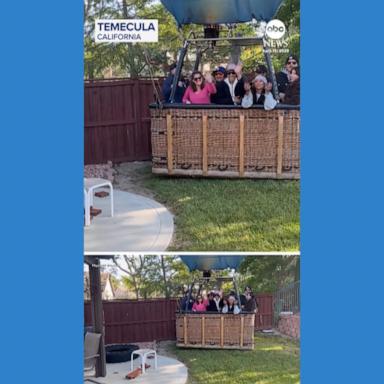
You’re sitting on your patio, sipping coffee, and suddenly the sky turns orange. Not from the sunset, but from a massive nylon envelope descending directly toward your flower beds. Most people would panic. They’d assume the pilot lost control or that a tragedy is unfolding in real-time. But here’s the truth about hot air balloon emergency landings that the clickbait news won’t tell you. They happen all the time, and they're usually just part of the job.
Earlier this week, a family in a quiet suburban neighborhood got the shock of their lives when a commercial balloon touched down right behind their swing set. The footage went viral. Neighbors scrambled with their phones. Local news stations blasted "Emergency Landing" across the ticker. While it looks terrifying from the ground, the reality inside the basket is often much more calculated.
The Myth of the Out of Control Balloon
Balloons don't steer like Cessnas. You can’t just bank left to avoid a house. Pilots are entirely at the mercy of wind currents at different altitudes. If the wind dies down or shifts unexpectedly toward a residential zone, the pilot has to make a choice. They can either stay in the air and hope for a better clearing—risking a run-in with power lines—or they can put the bird down in the first safe, open space they see. Sometimes, that’s your backyard.
Federal Aviation Administration (FAA) regulations are pretty clear on this. Pilots are required to land with a certain amount of fuel reserve. If they see the fuel gauge dropping and no grassy fields in sight, a backyard is a perfectly legal and safe "alternate" landing site. It’s not a crash. It’s a precautionary landing.
Most pilots will tell you that landing in a tight spot is a badge of honor. It shows they’re paying attention. If you wait until you’re completely out of propane to look for a spot, you’re asking for trouble. By choosing a backyard early, the pilot keeps control of the descent rate. They use the burners to "feather" the landing, making it as soft as a kiss on the grass.
What Actually Happens During a Backyard Landing
The sound is what gets people first. The roar of the propane burner is deafening when it’s only thirty feet above your roof. It sounds like a jet engine in your garden. Then there’s the shadow. A standard commercial balloon can hold 100,000 cubic feet of air. That’s a lot of shade to suddenly cast over your pool.
Once the basket hits the ground, the pilot’s first priority isn't the homeowners. It’s the envelope. They have to "vent" the hot air quickly so the balloon doesn’t act like a giant sail and drag the basket across your fence. You’ll see a large panel at the top of the balloon open up. This is the parachute valve. It lets the heat out, and the fabric collapses.
- The pilot identifies a safe "LZ" (landing zone) free of power lines.
- The crew chief, following in a van, tries to get to the location as fast as possible.
- Passengers stay in the basket until the envelope is deflated to prevent the balloon from becoming light and taking off again.
- The pilot greets the homeowner—usually with a bottle of champagne.
That champagne tradition isn't just a gimmick. It dates back to 18th-century France. Early aeronauts used to carry bubbly to prove to frightened farmers that they were humans, not demons or aliens. Today, it’s a peace offering for the tire tracks on your lawn.
The Real Danger Isn't the Landing
If you ever see a balloon coming down near your house, don't run toward it immediately. The biggest threat isn't the basket hitting you. It's the power lines. These are a pilot's worst nightmare. Even a slight breeze can push a deflating envelope into a transformer, and that's when things get ugly.
If the balloon stays clear of the wires, the biggest "damage" is usually just some flattened grass. Most balloons weigh about as much as a small SUV when they land. They aren't going to crush your foundation. They might knock over a lawn gnome or scare the dog, but that’s about it.
I’ve talked to pilots who have landed on golf courses, school parking lots, and even in the middle of intersections. Every single one says the same thing. The public’s reaction is the hardest part to manage. You get twenty people running toward the basket with cameras, and suddenly the pilot has to manage a crowd while trying to secure a multi-ton aircraft.
Why We Should Stop Calling Them Emergencies
Language matters. When the media uses the word "emergency," it implies someone almost died. In the ballooning world, we call these "landings out." It just means you didn't land where you planned to.
Think about it like this. If you’re driving a car and you realize you’re low on gas, so you pull into a random gas station you’ve never been to, is that an emergency? No. It’s a detour. For a balloon, a backyard is just a very convenient, unplanned gas station.
The safety record for hot air balloons is actually stellar compared to other forms of general aviation. According to NTSB data, fatalities are incredibly rare. Most "accidents" are actually just hard landings where someone bumped their knee or twisted an ankle. When you see a video of a balloon in a backyard, you're looking at a pilot doing their job correctly under pressure.
How to Handle a Balloon Landing in Your Yard
If it happens to you, stay calm. Don't go outside and start screaming about trespassing. The pilot is likely more stressed than you are. They’re worried about their passengers, their equipment, and your property.
- Keep your distance until the pilot gives you a thumbs up.
- Watch for the "drop line." The pilot might throw a rope down for people on the ground to help stabilize the basket. Don't grab it unless they ask.
- Check for power lines. If you see the fabric touching a wire, stay far away and call the fire department.
- Be a good neighbor. Most pilots are happy to give you a quick look inside the basket or take a photo once the balloon is secure.
The next time you see a headline about a "terrifying" backyard landing, take a breath. Look at the trees. Is it windy? Is the sun going down? The pilot probably just made a smart, tactical decision to keep their passengers safe. It's a miracle of physics, a bit of 18th-century tradition, and a great story for the next block party.
Grab your phone, take the video, but don't call the evening news claiming the sky is falling. The sky is just fine. It just happened to bring a very large, colorful guest to your lawn. If you're lucky, you'll get a free glass of French sparkling wine out of the deal.