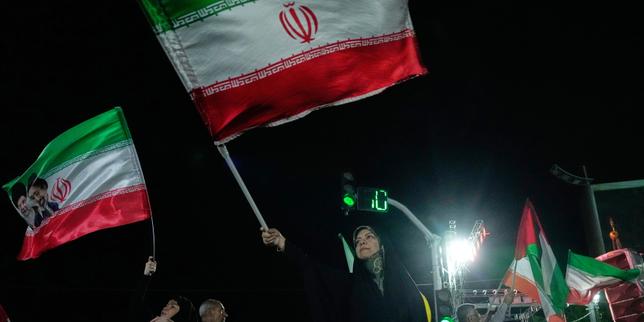
In the quiet, dust-choked alleys of south Tehran, the news of a political "win" doesn't travel through television screens or state-sanctioned radio broadcasts. It travels through the price of eggs. It travels through the nervous tap of a father’s fingers on a steering wheel as he calculates if he can afford another week of meat for his children. To the bureaucrats in the high-walled compounds of the North, the recent diplomatic maneuvers against Donald Trump might feel like a masterstroke. To the man in the street, it feels like a coat of fresh paint on a house whose foundation has already turned to sand.
The narrative coming out of the Islamic Republic is one of defiance. They point to the survival of their systems, the endurance of their trade routes, and their ability to outlast the "maximum pressure" of a volatile American administration. They claim a victory of will. But look closer at the frayed edges of the Iranian state. You won't see a triumphant power; you’ll see a regime that has traded its future for the sake of its pride.
The Mirage of Resistance
Consider a merchant named Abbas. He is a fictional composite, but his reality is shared by millions. Abbas remembers a time when the rial meant something. Now, he watches the digital boards in the exchange shops with the frantic energy of a gambler watching a losing hand. Every time Tehran claims a symbolic victory against Washington, the currency barely flinches. The "victory" doesn't lower his rent. It doesn't fix the rolling blackouts that kill the air conditioning in the brutal heat of July.
The regime has successfully navigated the labyrinth of international sanctions to keep its head above water. This is the fact that the state media obsesses over. They have built a "resistance economy" designed to withstand external shocks. Yet, this economy is a ghost. It functions on the black market, through shadow banking and back-alley oil shipments that sell at a steep discount to the few buyers willing to risk American ire.
When you sell your primary resource at fire-sale prices just to keep the lights on, you aren't winning. You are liquidating your country's inheritance to pay for the regime's survival. The state has mastered the art of not dying, but it has forgotten how to live.
The Demographic Time Bomb
The real tragedy isn't found in the halls of the United Nations. It is found in the "brain drain" that has become a national exodus. Iran’s greatest export isn't petroleum or pistachios anymore; it is its PhDs. The youth—the very people who should be building the infrastructure of 2030—are looking for the exits.
They see a leadership that is aging, insular, and increasingly disconnected from the digital reality of the 21st century. The regime’s victory over Trump was a tactical success in a theater of war that the Iranian youth no longer care to fight in. They don't want to "defeat the Great Satan." They want high-speed internet. They want a job that pays enough to buy a car before they turn forty. They want the freedom to wear what they choose without the looming shadow of the morality police.
The internal rot is psychological as much as it is financial. There is a profound sense of exhaustion. The revolutionary fervor that once fueled the streets has been replaced by a cynical, heavy-hearted pragmatism. People aren't rising up in mass revolution every day because they are tired. They are spent. But that silence shouldn't be mistaken for stability. It is the silence of a pressure cooker before the seal gives way.
The Cracks in the Monolith
Inside the corridors of power, the unity is an illusion. The Iranian leadership is currently grappling with a succession crisis that no amount of anti-Western rhetoric can solve. The Supreme Leader is an old man. Behind him, a swarm of hardliners, pragmatists, and military commanders are already sharpening their knives.
This is the invisible stake. The regime’s "victory" against external pressure has actually made the internal stakes more dangerous. Without a common enemy like Trump to rally against, the factions are turning inward. The Islamic Revolutionary Guard Corps (IRGC) has morphed from a military wing into a corporate conglomerate that owns everything from telecommunications to construction firms. They have a vested interest in the status quo because the status quo makes them rich.
But their wealth is extracted from a shrinking pie. The Iranian middle class is being systematically erased. When the teachers, the nurses, and the small business owners lose their stake in the system, the regime loses its buffers. It is left with only two tools: the propaganda machine and the baton.
A Strategy of Diminishing Returns
The geopolitical map tells a story of overextension. Tehran spends billions on its "Axis of Resistance"—supporting proxies in Lebanon, Yemen, Iraq, and Syria. On paper, this gives them a seat at every table in the Middle East. It makes them a regional heavyweight that cannot be ignored.
But back in the bread lines of Mashhad, the cost of that seat is becoming unbearable. The irony is bitter. Iran has successfully projected power abroad while losing its grip on the hearts of its people at home. They have won the battle for regional influence but are losing the war for national legitimacy.
The strategy was always to wait out the West. To endure. To stay in the game until the political winds in Washington changed. They did it. They outlasted the four years of the Trump presidency. Yet, the reward for their endurance is a country that is more isolated, more impoverished, and more divided than at any point since the 1979 revolution.
The Illusion of Choice
We often talk about Iran as if it were a single, coherent actor. We say, "Iran did this" or "Iran responded with that." This is a mistake. The "Iran" that claims victory is a narrow elite that has successfully insulated itself from the consequences of its own foreign policy. The other Iran—the ninety percent—is simply trying to survive the victory.
The regime’s survival is not synonymous with the country’s health. A patient can be kept alive on a ventilator for a long time, but you wouldn't say they are thriving. The Islamic Republic is currently on a geopolitical ventilator. It is breathing, yes. Its heart is beating, yes. But it cannot get out of bed. It cannot run. It cannot build.
The victory over Trump was a victory of the bunker. It was the success of a group of men who hid underground until the storm passed. But when they emerged, they found the landscape permanently altered. The water tables are drying up. The infrastructure is crumbling. The social contract is a shredded piece of paper.
The Long Shadow of the Past
History has a cruel way of repeating itself for those who refuse to learn. The Pahlavi dynasty looked invincible in the mid-1970s. It had the oil, the army, and the backing of a superpower. It too ignored the quiet murmurs in the bazaars and the growing resentment of a youth population that felt ignored. It too mistook silence for consent.
The current leadership believes their ideological foundation makes them immune to the fate of the Shah. They think their religious legitimacy provides a shield that the previous monarchy lacked. But legitimacy is a fickle thing. It requires more than just theological arguments; it requires the ability to provide a dignified life for your citizens.
When the state can no longer provide dignity, it loses its right to lead. No amount of "victory" over a foreign president can replace that lost domestic trust. The regime is currently walking a tightrope over an abyss of its own making, holding a trophy that is getting heavier by the second.
The Silent Tectonics
The world watches the headlines about uranium enrichment and drone capabilities. Those are the loud things. The quiet things are the ones that actually change the world. The quiet things are the falling birth rates, the rising rates of drug addiction, and the environmental collapse of the Iranian plateau.
The Great Salt Lake of Urmia is vanishing. Dust storms are swallowing cities that were once lush. These are the real enemies of the state. They cannot be sanctioned into submission. They cannot be intimidated by the IRGC. They are the physical manifestations of a government that has prioritized regional shadow wars over the basic stewardship of its own land.
The "victory" of the regime is a hollow shell because it addresses none of these existential threats. It is a political win in a world that is moving past such binaries. While the Mullahs celebrate their ability to withstand a billionaire from Queens, the very soil of Iran is slipping through their fingers.
Imagine the end of this play. It doesn't end with a bang or a cinematic revolution led by a single charismatic hero. It ends with the slow, grinding sound of a machine running out of oil. It ends with a state that has become so disconnected from its people that it essentially ceases to function, even as it continues to exist.
A victory that leaves you weaker, poorer, and more hated by your own children is not a victory. It is a slow-motion catastrophe. The Iranian regime has survived the storm, but it is standing on a sinking ship, waving a flag at an empty horizon, wondering why no one is cheering.



