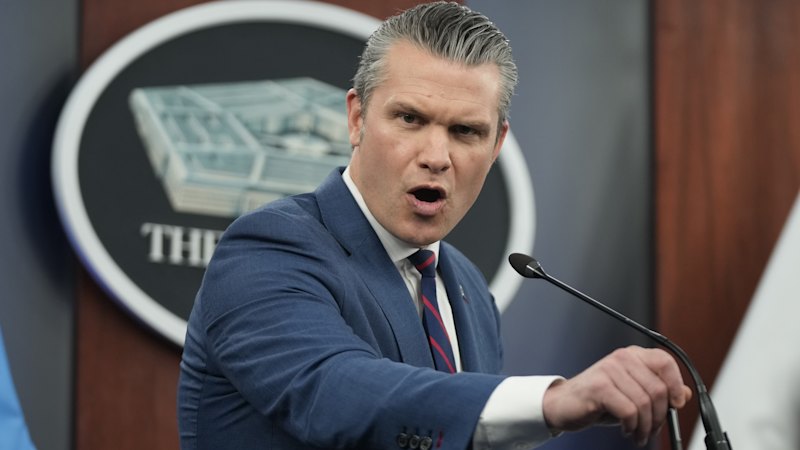
The air in the Pentagon briefing room often feels filtered, scrubbed of the grit and heat that defines an actual deployment. It is a place of acronyms and slide decks. But recently, a few words from Pete Hegseth, the man tapped to lead the Department of Defense, managed to pierce that sterile atmosphere. He spoke about the "quiet part" of military leadership, and in doing so, he touched a nerve that has been raw for nearly a generation of service members.
Think of a young lieutenant. We’ll call him Miller. Miller didn’t join the Army to navigate a labyrinth of social engineering or to act as a data point for a diversity study. He joined because he believed in a singular, brutal truth: his job was to win. He expected a culture of merit, a hierarchy built on who could shoot the straightest, lead the fastest, and think the clearest under fire. Instead, he found himself sitting through seminars that felt more like corporate HR retreats than preparation for combat.
This is the friction Hegseth exposed. When he suggested that the military has drifted from its core purpose, he wasn't just making a political point. He was voicing the frustration of the "Millers" across every branch.
The Weight of the "Quiet Part"
The controversy centers on a specific sentiment: the idea that the military’s primary focus should be lethality, period. To some, this sounds like common sense. To others, it sounds like a regression. But for the person wearing the boots, the distinction is everything.
Military effectiveness is a fragile thing. It relies on a concept called "unit cohesion." This isn't just about getting along. It is the invisible bond that makes a soldier crawl into a kill zone to drag a teammate to safety. It is forged in shared hardship and the absolute certainty that the person to your left and right earned their spot through nothing but competence.
When you introduce factors other than merit into the promotion or assignment process, that bond begins to fray. The "quiet part" Hegseth shouted is that if you prioritize social goals over combat readiness, you aren't just changing the culture. You are potentially increasing the body count.
A Departure from the Warrior Ethos
For decades, the American military was the ultimate meritocracy. It didn't matter where you came from or what your last name was; the "green suit" was the great equalizer. But the shift toward "wokeness"—a term often used as a blunt instrument but one that carries specific weight in this context—has changed the math.
Consider the physical standards. There is a reason the Infantry was historically a grueling, exclusionary club. Physics doesn't care about social progress. A 200-pound casualty in full body armor weighs the same regardless of who is trying to carry them. When standards are adjusted to ensure "equitable" outcomes, the message sent to the rank and file is clear: the mission is no longer the highest priority.
Hegseth’s background as a combat veteran gives his words a resonance that a career politician could never achieve. He knows what it looks like when a unit loses its edge. He has seen the difference between a team that is obsessed with being the best and a team that is distracted by bureaucratic box-checking.
The Invisible Stakes of Bureaucracy
The danger of a bloated administrative state within the military isn't just the waste of taxpayer dollars. It is the slow, agonizing death of the warrior spirit.
Imagine a sergeant who spends more time on mandatory "sensitivity" training than on the rifle range. Every hour spent in a classroom learning about microaggressions is an hour not spent practicing small-unit tactics or vehicle maintenance. Over a year, those hours add up. Over a decade, they create a leadership class that is better at navigating a spreadsheet than a battlefield.
This isn't a hypothetical problem. We see it in the recruiting crisis. Young men and women who are drawn to the "warrior" archetype—the ones who want to do hard things in difficult places—are looking at the current state of the military and choosing to stay home. They don't want to be part of a social experiment. They want to be part of a lethal force.
The Human Cost of a Softened Command
Leadership is about trust. When a commander stands before their troops, they need to know that every decision made by the higher-ups was designed to give them the best chance of success.
If that trust is broken—if the troops suspect their leaders are more interested in their post-service corporate board seats or political standing than in winning the next war—the entire structure collapses. Hegseth is signaling a return to a more primitive, and perhaps more honest, version of leadership. It is a version where the only metric that matters is the ability to close with and destroy the enemy.
Critics argue that this approach is divisive or exclusionary. They claim that a modern military must reflect the society it serves. But a military isn't a social club. It is a specialized tool. You don't ask a scalpel to be "representative" of the kitchen drawer; you ask it to be sharp.
The Tension of the New Guard
The pushback against Hegseth’s vision is intense because it threatens a massive institutional momentum. Thousands of jobs and millions of dollars are now tied to the very programs he wants to dismantle. This isn't just an ideological fight; it’s a structural one.
But for those on the ground, the debate feels far simpler. It’s about the guy in the foxhole. It’s about whether the officer leading the charge got there because they were the best, or because they fit a profile.
Hegseth isn't just saying the quiet part out loud; he’s screaming it. He is challenging the notion that the military can be everything to everyone and still be an effective fighting force. It is a gamble, certainly. It is a move that will alienate many in the traditional power centers of Washington.
Yet, in the barracks and on the flight decks, there is a different kind of energy. There is a sense of being seen. For the soldiers who have felt like an afterthought in their own institution, the "quiet part" sounds a lot like the truth.
The civilian world can afford the luxury of nuance and the slow grind of social evolution. The military exists in the world of the binary: you win or you lose. You live or you die. When the stakes are that high, there is no room for anything that doesn't contribute to the win.
The silence that used to surround these topics has been replaced by a roar. The question now is whether that roar will lead to a leaner, more focused force, or if the internal friction will leave the nation's defenses more fractured than ever.
The lieutenant looks at his training schedule. He sees the hours blocked out for "culture" and "awareness." He thinks of the mountains in a country he hasn't visited yet, and the weight of the pack he’ll have to carry. He wonders if the people in the tall buildings understand that when the shooting starts, the "quiet part" is the only thing that actually matters.
The mirror in the locker room reflects a face that is tired of the noise. It is a face waiting for a command that makes sense again.