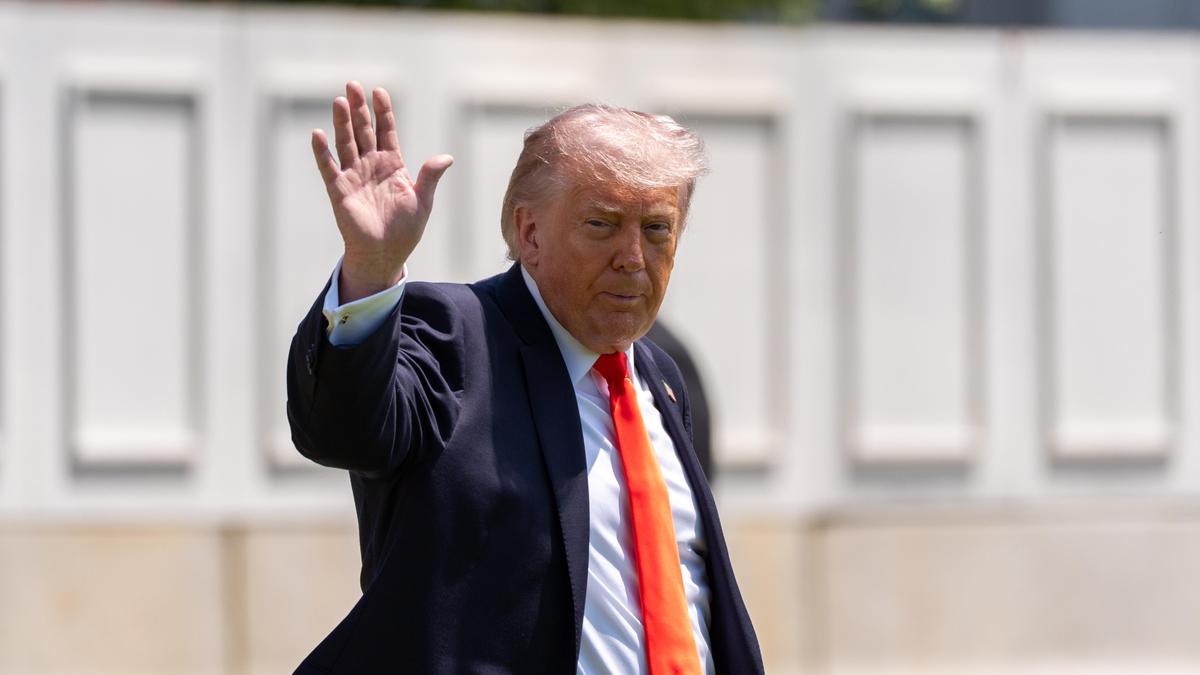
The latest peace proposal from Tehran arrived in Washington on a Thursday night via Pakistani intermediaries, only to be dismissed by Friday afternoon. President Donald Trump, speaking to reporters before departing for Florida, made it clear that the terms offered were insufficient to end a conflict that has already reshaped the global energy map. "At this moment I’m not satisfied with what they’re offering," Trump stated, adding that the Iranian leadership is "asking for things I can't agree to." This rejection signals that the current ceasefire is not a precursor to peace, but rather a tactical pause in a high-stakes war of attrition.
The standoff has moved beyond simple diplomacy into a "dual blockade" that has effectively severed the world's most vital energy artery. While the U.S. Navy maintains a blockade on all ships seeking to reach Iranian ports, Iran continues to hold the Strait of Hormuz in a chokehold. Despite the April ceasefire, commercial shipping through the strait has plummeted to 5% of its pre-war volume. The result is a global economy held hostage by a diplomatic impasse that neither side seems willing to break without total concession from the other. You might also find this similar coverage interesting: The Noose Tightens Around Bamako.
The Nuclear Zero Sum Game
The core of the disagreement remains Iran’s nuclear infrastructure. Since the start of Operation Epic Fury on February 28, the Trump administration has pursued a policy of "zero enrichment." This is not a return to the 2015 JCPOA standards; it is a demand for the complete dismantling of Iran's nuclear identity.
For the White House, any deal that leaves centrifuges spinning—even at low levels—is a non-starter. The administration’s perspective is grounded in the belief that previous agreements merely delayed an inevitable crisis. By contrast, the Iranian leadership, now overseen by Ayatollah Mojtaba Khamenei following the assassination of his father, views nuclear capability as a matter of national survival. In a statement released shortly after the latest proposal was rejected, the younger Khamenei vowed to protect the country’s "technological capacities" at all costs. As reported in latest reports by Reuters, the results are notable.
This is the fundamental "why" behind the failure of the Pakistan-mediated talks. Washington wants a surrender; Tehran is offering a compromise. In a conflict where the U.S. has already conducted decapitation strikes against senior Iranian leadership, the Islamic Republic sees little reason to give up its only remaining leverage without massive, immediate sanctions relief and security guarantees that the Trump administration is fundamentally unwilling to provide.
The Mirage of the 60 Day Deadline
Inside the halls of Congress, Friday marked a significant milestone: the 60-day deadline under the War Powers Resolution of 1973. Ordinarily, this would require the President to seek formal authorization for continued military action or begin a withdrawal. However, the administration has executed a legal maneuver to sidestep this requirement.
Senior officials argue that because no shots have been exchanged since the April 7 ceasefire began, the "hostilities" have technically terminated. Defense Secretary Pete Hegseth testified that the 60-day clock is effectively paused. This legal interpretation allows the administration to maintain its massive military buildup and the naval blockade without a vote from a divided Congress.
Critics argue this sets a dangerous precedent, essentially allowing a "forever war" to persist under the guise of a "terminated" conflict that still involves a total naval blockade. For the average American, the distinction is academic; the reality is reflected in oil prices that have hovered near $110 a barrel, a direct result of the Hormuz closure.
Disjointed Leadership and the Shadow of Larijani
Trump’s characterization of the Iranian leadership as "disjointed" is perhaps the most accurate assessment to come out of the White House this week. The Iranian political structure is in a state of profound shock. The assassination of Ali Larijani in March, who was seen as the pragmatic architect of potential backchannel deals, has left a vacuum.
The current negotiating team, led by Foreign Minister Abbas Araghchi, is caught between a desperate need to lift the blockade and the hardline demands of the Revolutionary Guard (IRGC). The IRGC, having lost significant naval assets to U.S. strikes, is doubling down on "asymmetric" control of the Strait of Hormuz using mines and drones. They view the blockade of the Persian Gulf as their only successful counter-offensive.
The Regional Toll of the Impasse
The conflict has moved far beyond the borders of the two primary combatants.
- Israel: Faces an estimated $50 billion in economic damage and remains on high alert for proxy strikes from a weakened but still active Hezbollah.
- The Gulf States: Nations like the UAE and Saudi Arabia are caught in a nightmare scenario where their primary export route is a war zone.
- The Global Market: The release of 400 million barrels of oil by IEA members has barely cushioned the blow.
The Toll System and the Strait
A particularly thorny issue in the rejected proposal was Iran's attempt to formalize a "toll" system for the Strait of Hormuz. Tehran proposed that "non-hostile" states could resume transit in exchange for fees, a move the U.S. Treasury Department immediately branded as a sanctionable offense.
By attempting to charge for passage, Iran is trying to turn a global commons into a private revenue stream to offset the $270 billion in direct economic damage it has sustained since February. The U.S. sees this as a blatant violation of international law. For Trump, agreeing to such a proposal would be a domestic political disaster, appearing as if the U.S. was "paying off" a regime it spent months trying to dismantle.
Maximum Pressure Meets Maximum Resistance
The Trump administration’s "Maximum Pressure 2.0" is more than just sanctions; it is a total economic and military isolation strategy. The recent Executive Order imposing tariffs on any country purchasing goods or services from Iran is designed to force China’s hand. China, which has continued to use the Strait through private arrangements with Tehran, now faces a choice between its Iranian energy ties and its access to the American market.
However, the "pressure" part of the equation has not yet produced the "collapse" predicted by some in the administration. While internal protests in Iran were the catalyst for the initial U.S. involvement, the external military strikes have, in some ways, allowed the regime to wrap itself in the flag of national defense.
The Reality of the Dual Blockade
We are currently witnessing a stalemate of the most expensive kind. The U.S. is spending billions to maintain an armada in the region, while the global economy loses billions more in transit delays and energy costs. The "peace" being discussed in Pakistan is a ghost.
Trump is betting that the Iranian economy will shatter before the American public loses patience with high gas prices. Tehran is betting that its ability to keep the Strait of Hormuz "closed for business" is a lever powerful enough to force the U.S. to accept something less than total nuclear surrender.
The rejection of the latest proposal confirms that neither side has reached its breaking point. The ceasefire remains in effect, but it is a fragile, hollow thing. In the absence of a deal that satisfies the White House's demand for a "zero-nuclear" Iran, the dual blockade will continue, the 60-day clock will remain "paused," and the world will remain one miscalculation away from a renewed eruption of full-scale combat.
The next move isn't likely to come from a diplomat’s briefcase. It will come from the reality of the counting house or the deck of a destroyer. Until one side feels the cost of the status quo is higher than the cost of concession, the peace proposals will continue to be delivered and dismissed within the same twenty-four-hour news cycle.