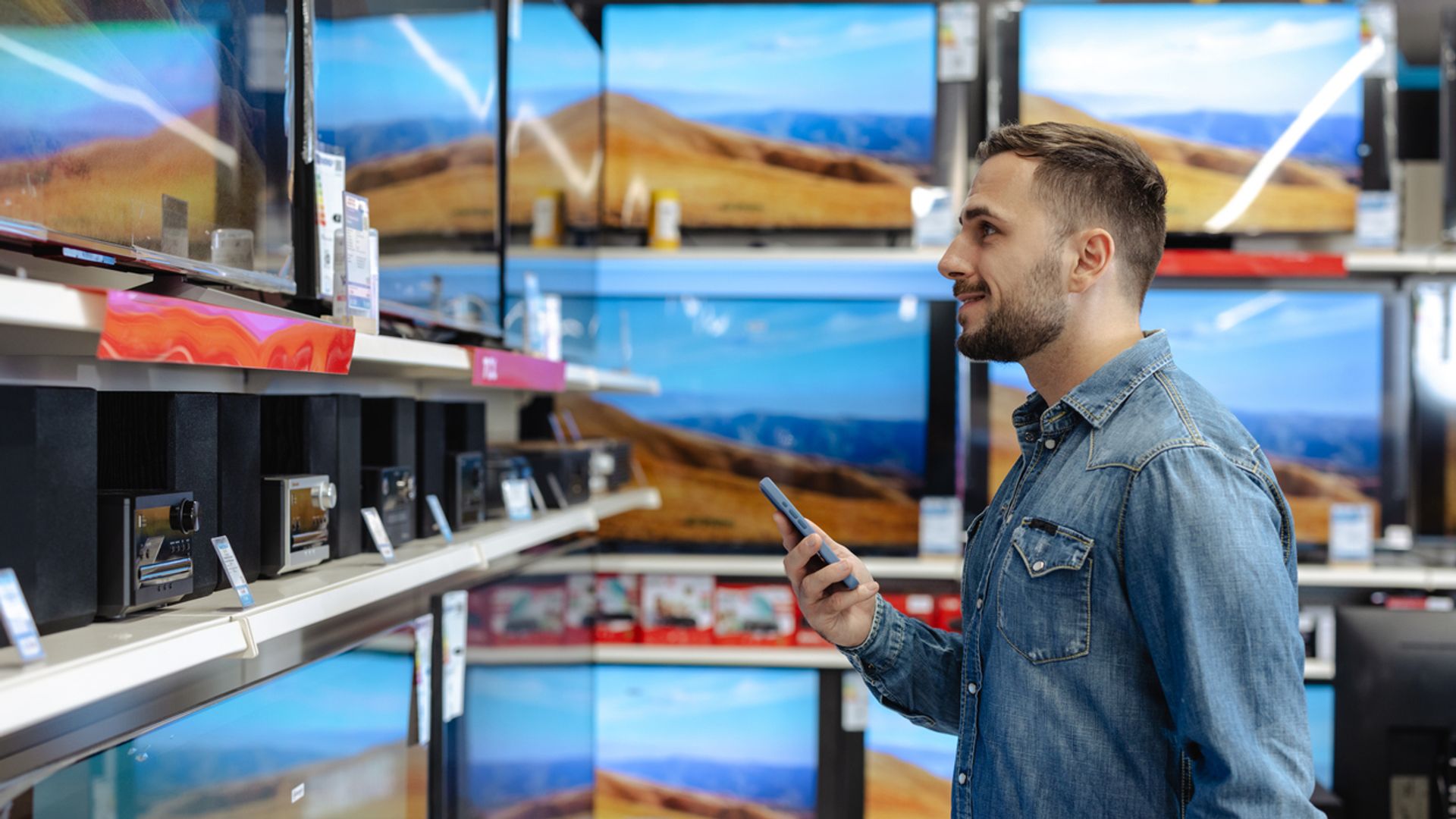
The salesman in the blue polo shirt had a specific kind of gleam in his eye, the sort usually reserved for selling beachfront property in a desert. He stood before a screen so vast it seemed to have its own gravitational pull. The picture was undeniably stunning. You could see the individual pores on a lizard’s nose and the microscopic jagged edges of a snowflake. "This," he whispered, as if letting me in on a state secret, "is 8K. It is four times the resolution of 4K. It is the future of your home."
I looked at the price tag. It cost more than my first car. I looked back at the lizard. It was beautiful, sure, but I found myself wondering why I needed to see a reptile's dermatological history in such agonizing detail while sitting on my sofa eating lukewarm takeout.
This is the trap. It is a meticulously laid snare of numbers, acronyms, and psychological pressure designed to make you feel like your current television—the one that served you perfectly well for the Super Bowl last month—is a flickering relic from the Victorian era. But the industry’s push for 8K is, for the vast majority of human beings, a magnificent lie.
The Biology of the Blind Spot
The human eye is an extraordinary piece of biological engineering, but it has hard limits. Evolution did not prepare us to distinguish between thirty-three million individual pixels from ten feet away while a Michael Bay explosion is happening. To truly see the benefit of an 8K resolution, you would either need a screen the size of a garage door or you would need to sit so close to the display that your nose would practically touch the glass.
Consider my friend Mark. Mark is a man who prides himself on having the best of everything. He bought an 8K flagship last year. He invited me over to watch a nature documentary, leaning in with expectant eyes, waiting for me to be transformed. I sat on his leather sectional, roughly eight feet from the screen. It looked great. But it didn't look four times better than the 4K set in his bedroom. It didn't even look twice as better. Because at that distance, the "extra" detail becomes a mathematical abstraction. His retinas simply couldn't resolve the data.
We are being sold a promise of clarity that our own nervous systems are physically incapable of collecting. The industry calls it "future-proofing." A more cynical person might call it a tax on the impatient.
The Content Desert
Even if you possessed the eyes of a hawk, you would still face the crushing reality of the content desert. Resolution is only as good as the signal you feed it. Currently, almost nothing is broadcast in 8K. Netflix, HBO, and Disney+ are still perfecting the art of delivering stable 4K streams without buffering. Your favorite sports are often still captured and broadcast in 1080p and then "upscaled" by your TV to fit the screen.
Buying an 8K TV today is like buying a Ferrari to drive exclusively through a school zone during a blizzard. You have all that horsepower, all that potential, and nowhere to let it run. The TV has to invent pixels to fill the gaps, using artificial intelligence to guess what a blade of grass should look like. It’s a sophisticated guess, but it’s still a guess.
The Secret Language of the Experts
If you want to know what actually matters, don't look at the marketing brochures. Look at what the people who design these systems put in their own living rooms. When you talk to colorists in Hollywood or engineers at the big panel manufacturers—off the record, away from the PR minders—they don't talk about pixel count. They talk about light.
They talk about OLED and QD-OLED.
They understand that a "perfect black" is worth more than a billion pixels. In a traditional LED TV, there is a backlight trying to shine through a shutter. It’s like trying to make a room pitch black while someone is holding a flashlight behind a curtain. There’s always a glow. But with OLED, every single pixel is its own light bulb. When it’s time for black, the pixel simply turns off. It dies.
The result is a depth that feels three-dimensional. When you watch a movie like Gravity on a high-end OLED, the vacuum of space isn't a muddy grey; it is an infinite, terrifying void. That contrast—the difference between the brightest white and the darkest black—is what the human brain perceives as "quality." Not the resolution.
The Motion Blur Betrayal
There is a specific kind of heartbreak that occurs when you bring home a three-thousand-dollar television, turn on a football game, and realize the ball looks like a caffeinated comet trailing a ghostly tail across the grass. This is the result of poor motion handling, and it is the "sneaky tactic" the big brands hope you won't notice in the showroom.
In the store, they play "slow-cinema" loops: slow-moving flowers, slow-drifting clouds, slow-swimming fish. Everything is fluid because nothing is moving fast. But life moves fast. To combat this, manufacturers use something called "Motion Smoothing" or the "Soap Opera Effect." It uses processing to manufacture fake frames of video to fill the gaps between the real ones.
It makes a cinematic masterpiece shot on film look like it was recorded on a handheld camcorder in a basement. It is the first thing every expert turns off the moment they take a TV out of the box. If you want a TV that handles movement well, you don't look for a higher resolution; you look for a native 120Hz refresh rate. You look for a processor that doesn't overthink the image until it becomes a digital soup.
The Brand Loyalty Trap
We often buy TVs based on the badges we grew up with. Sony, Samsung, LG. These giants dominate the shelf space, and for good reason—they make spectacular products. But the landscape has shifted. The "value" brands, the ones that used to make cheap, plasticky sets for dorm rooms, have caught up.
Companies like TCL and Hisense are now producing "Mini-LED" displays that rival the performance of the titans at a fraction of the cost. Mini-LED uses thousands of tiny lights to create "local dimming zones," allowing for brightness that can practically sear your retinas—perfect for a sun-drenched living room where an OLED might struggle against the glare.
The secret the premium brands don't want you to know is that they often buy their panels from each other. An expensive "Brand A" TV might be using a screen manufactured by "Brand B." You are often paying a massive premium for the plastic casing, the remote control, and the logo on the box.
The Sound of Silence
Imagine the scene: a high-stakes thriller. The protagonist is whispering a life-altering secret. The music swells. You lean in, straining to hear, but the dialogue sounds like it’s being muffled by a wet wool blanket. You turn the volume up to 40. Suddenly, an explosion happens, and your windows rattle, threatening to shatter.
This is the hidden tax of the "thinness" war. As televisions have become as thin as a smartphone, there is no longer any physical room for speakers. Sound requires the movement of air, and you can't move air with a speaker the size of a nickel.
Manufacturers know this. They design the TV with mediocre audio, fully expecting—perhaps even hoping—that you will be forced to buy a soundbar. When calculating your budget, the TV is only half the story. A five-hundred-dollar TV paired with a three-hundred-dollar sound system will almost always provide a more "cinematic" experience than a thousand-dollar TV using its own tinny, built-in speakers.
The Psychology of the Purchase
We are told that a bigger, brighter, sharper screen will make our lives better. We imagine the family gathered around, the shared gasps at a plot twist, the communal joy of a last-second goal. And those moments are real. But they don't depend on 8K.
The most important thing you can do before walking into a store is to measure your room. Not the wall—the distance between your eyes and the screen.
- If you sit 5-8 feet away, a 55-inch or 65-inch 4K TV is your sweet spot.
- If you sit 10 feet or more away, you might want to consider 75 or 85 inches.
- If you are considering 8K, ask yourself if you plan on sitting three feet from the screen. If the answer is no, take that extra money and spend it on a better sound system or a more comfortable sofa.
I walked out of that store without the 8K lizard TV. The salesman looked disappointed, as if I had just rejected a ticket to the future. I went home and watched an old black-and-white movie on my "outdated" 4K set. The shadows were deep. The dialogue was crisp through my external speakers. I didn't see the pores on anyone's nose, but I felt every ounce of the tension in the room.
The industry wants you to chase the horizon. They want you to believe that the next numerical jump—from 4 to 8, from 8 to 16—is the key to unlocking a better reality. But the magic isn't in the math. The magic is in the story, and a story doesn't need thirty-three million pixels to break your heart or make you laugh. It just needs to be seen clearly, in the right light, without the distraction of a marketing department shouting in your ear.
Next time you stand before the wall of glowing rectangles, turn your back on the specs for a moment. Close your eyes and think about the last time a movie truly moved you. I guarantee you weren't thinking about the resolution. You were lost in the dark, watching the light.
Would you like me to help you compare the specific technical specs of two TV models you're currently considering?