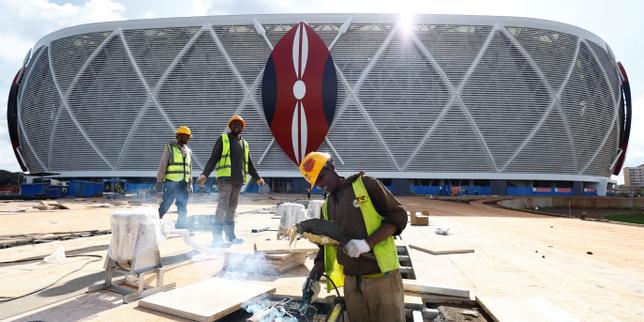
The dust in Namboole does not care about executive decrees. It rises in thick, red clouds, coating the plastic seats of a stadium that was supposed to be a cathedral of Ugandan pride. When the wind picks up across the Mandela National Stadium, it carries the scent of stalled progress—a mix of wet concrete, rusted iron, and the quiet, crushing anxiety of a deadline that refuses to slow down.
In 2027, the Africa Cup of Nations (AFCON) is scheduled to land in East Africa. For the first time in history, the "Pamoja" bid—a trinity of Kenya, Uganda, and Tanzania—promised to shift the center of the footballing universe toward the Great Lakes. It was a beautiful dream. It still is. But dreams require more than signatures on a bid document; they require cranes that move, budgets that aren't swallowed by bureaucracy, and a level of logistical alchemy that, right now, feels like magic.
Consider a young boy in Dar es Salaam named Juma. He is ten years old. He has never seen Mo Salah or Victor Osimhen in the flesh. To him, the AFCON 2027 announcement wasn't a policy shift; it was a promise that the world was finally coming to his front door. But if you walk the sites where these games are meant to happen, you see the gap between Juma’s hope and the hard, cold reality of construction milestones.
The Confederation of African Football (CAF) operates on a clock that does not respect "East African Time." Their inspectors don't look at intentions. They look at the grade of the turf, the diameter of the floodlight cables, and the proximity of Level 5 hospitals to the player tunnels. Right now, those inspectors are looking at their watches.
The Ghost of 1996
Kenya has been here before. In the mid-nineties, the country was handed the keys to the 1996 tournament. The excitement was electric. Then, the delays started. A missed deadline here, a funding gap there. Eventually, CAF pulled the plug, moving the tournament to South Africa. Kenya was left with a national scar and a "what if" that haunted a generation of fans.
History has a cruel way of repeating itself when the fundamentals remain unchanged. The current concerns aren't just whispers; they are screaming from the blueprints. While Tanzania has made strides with the Benjamin Mkapa Stadium, the overall regional readiness is a staggered line. Uganda and Kenya are sprinting, but they started the race with their shoelaces tied together.
The problem isn't a lack of passion. It’s the infrastructure of the soul versus the infrastructure of the soil. You can have a million fans ready to roar, but if the locker rooms don't have running water and the media centers lack high-speed fiber, the roar stays outside the gates. CAF requirements have evolved. They no longer accept "good enough." They demand "world-class," a standard that requires a total overhaul of how these nations approach public works.
The Invisible Stakes
We often talk about these tournaments in terms of GDP and tourism revenue. Those are the cold facts. The real stakes are invisible. They are found in the local hotels that have taken out loans to add extra wings, expecting a flood of fans from Dakar and Casablanca. They are in the eyes of the domestic players who believe a home tournament is their only ticket to a European scout's notebook.
If 2027 is moved—if the "Pamoja" dream is stripped away and handed to a "safe" backup like Morocco or Algeria—it won't just be a lost sporting event. It will be a psychological blow to a region trying to prove its modern mettle.
In Nairobi, the Talanta Sports City project is the centerpiece. It’s an ambitious, purpose-built stadium designed to bypass the aging issues of the Kasarani and Nyayo facilities. It is a bold bet. But construction is a physical manifestation of political will. When the money stalls in committee, the cement mixers stop turning. Every day the sun sets on an idle crane, the risk of a "Plan B" being activated by CAF grows.
The Logistics of a Dream
Logistics are the least sexy part of football, yet they are the only part that matters before the whistle blows. Imagine thirty thousand fans trying to move between Kampala and Nairobi. Consider the visa harmonies required, the border crossings, and the flight paths. The "Pamoja" bid implies "togetherness," but the physical reality of East African travel is often a lesson in patience.
The three nations are essentially trying to build a synchronized clock across three different time zones of political priority. Tanzania’s President Samia Suluhu Hassan has been a vocal champion, pushing the Mkapa Stadium renovations toward completion. Meanwhile, in Uganda, the focus has been a desperate scramble to get Namboole up to international standards after years of neglect. Kenya is juggling the renovation of its historic sites with the birth of a brand-new stadium.
It is a three-legged race where if one runner trips, the whole team hits the dirt.
The Inspector’s Ledger
When the CAF technical team arrives for their next inspection, they won't be moved by speeches. They carry clipboards that act as judge, jury, and executioner. They will check the pitch drainage. They will measure the lux of the lighting. They will ask for the signed contracts of the transport providers.
If the reports return with too much red ink, the narrative changes from "How do we host?" to "Who can save us?"
There is a specific kind of silence that falls over a stadium when a project is abandoned. It’s the sound of wind whistling through rebar. We saw it in various cities across Brazil after 2014, and in South Africa after 2010—white elephants that serve as monuments to poor planning. But East Africa’s risk is different. The risk isn't just having useless stadiums; it’s having no stadiums ready when the world arrives.
The pressure is mounting because the "ready" nations are already circling. Countries with turnkey infrastructure are always standing in the wings, ready to play the hero if the "Pamoja" nations falter. It is a predatory reality of global sports. If you can't host, someone else will, and they will take the revenue, the prestige, and the memories with them.
The Cost of Hesitation
Every week of delay adds a premium to the eventual cost. Materials become more expensive. Labor requires overtime. Shortcuts are taken. And shortcuts are exactly what CAF inspectors are trained to sniff out. A stadium that looks finished on television but has a failing electrical grid behind the walls is a liability CAF cannot afford.
Think back to Juma in Dar es Salaam. He doesn't understand the complexities of "sovereign debt ceilings" or "tendering disputes." He only knows that the posters are up and the radio says the giants are coming. For him, the delay isn't a statistic. It’s a slow-motion heartbreak.
The leaders of the "Pamoja" bid are currently in a room, somewhere, looking at spreadsheets that don't add up. They are facing the reality that the prestige of hosting is bought with the currency of relentless, boring, daily progress. It is bought by the bricklayer who stays an extra hour and the accountant who finds a way to release the funds before the weekend.
The red dust of Namboole is still rising. The cranes in Nairobi are still reaching upward, though perhaps not fast enough. The clock is not ticking; it is pounding.
In the end, the grass doesn't care about the bid. It only grows if the pipes are laid, the water is pumped, and the soil is prepared long before the first player steps off the bus. The tragedy of 2027 wouldn't be a lack of talent on the field, but the fact that the field itself remained a sketch on a piece of paper while the rest of the continent moved on to the next stadium.
The red dirt is waiting to be covered by green. The question is no longer if East Africa wants this, but if it can find the will to finish what it was so bold to start. The world is watching the horizon, waiting to see if the lights will actually turn on, or if we are all just sitting in the dark, waiting for a game that will never arrive.