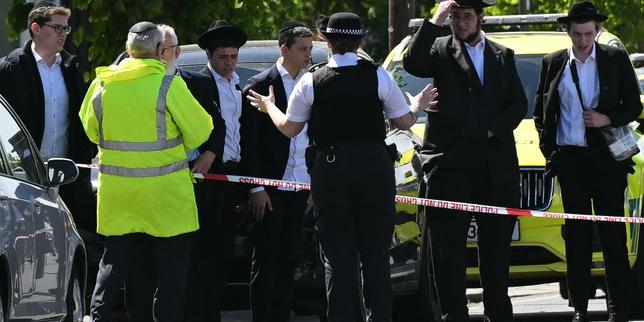
The headlines are predictable. They follow a script written decades ago. An attack occurs in Golders Green. The police make an arrest. The Crown Prosecution Service files a "attempted murder" charge. The community breathes a sigh of collective, albeit anxious, relief.
We are told the system is working. We are told that justice is being served because a man is in a cell.
This is a lie.
Charging a perpetrator after the blade has already swung isn't "justice" in any meaningful sense for a community living under a constant state of siege. It is high-level administrative bookkeeping. If we continue to view these incidents through the narrow lens of individual criminal prosecution, we are ignoring the structural rot that makes these attacks inevitable.
The Fallacy of the Isolated Actor
Most reporting on the Golders Green incident treats the assailant as a vacuum-sealed anomaly. The "lone wolf" narrative is the greatest gift ever given to lazy policy makers. It allows the state to treat the symptoms while ignoring the pathology.
When you label an attack as a singular criminal event, you ignore the infrastructure of radicalization that remains untouched. In my years analyzing urban security shifts, I’ve seen this pattern repeat:
- The incident occurs.
- The perpetrator is neutralized.
- The authorities issue a statement about "community cohesion."
- The underlying digital and social echo chambers that produced the actor are left to simmer.
Justice is not the incarceration of one man; it is the dismantling of the assembly line that produced him. By the time someone walks into a kosher shop with a weapon, the system has already failed. Attempted murder charges are a lagging indicator of a collapsed security strategy.
The Problem with Proportionality
Western legal systems are obsessed with proportionality. We wait for the crime to reach a specific threshold of violence before the heavy machinery of the law kicks in.
In Golders Green, the charge is "attempted murder." This is technically accurate but strategically useless. It focuses on the intent of the individual rather than the impact on the collective. An attack in the heart of a Jewish neighborhood is a message. It is a psychological operation designed to shrink the public square for a specific demographic.
The legal system treats this as a fight between Person A and Person B. It isn't. It is an assault on the concept of the open city. When we rely on standard criminal charges, we are effectively saying that the terrorized state of a whole neighborhood is a secondary concern to the specific mechanics of the physical assault.
The Security Theater of Golders Green
Walk through Golders Green or Stamford Hill today. You will see high fences, reinforced glass, and private security guards (CST) standing outside schools and synagogues.
We have normalized the idea that a specific segment of the population must live behind fortifications. The fact that an attack could still occur despite this hyper-vigilance proves that our current "defense-in-depth" model is broken.
The "lazy consensus" suggests more police patrols are the answer. They aren't. More boots on the ground provides a temporary dopamine hit of safety, but it doesn't change the risk calculus for a radicalized individual who views the police as just another target or a minor obstacle.
We are spending millions on reactive hardware—CCTV, bollards, and patrol cars—while spending pennies on the aggressive, preemptive disruption of the networks that fuel these crimes. We are building better shields instead of taking away the swords.
Stop Asking if it was a Hate Crime
The debate over whether to label an incident a "hate crime" or "terrorism" is a distraction for bureaucrats. It changes the sentencing guidelines, sure. It gives politicians a more potent talking point. But for the resident of Golders Green, the nomenclature is irrelevant.
The real question we should be asking is: Why is the barrier to entry for this type of violence so low?
In any other sector—aviation, medicine, engineering—a "near miss" triggers a total systemic audit. In urban security, a near-fatal stabbing triggers a press release and a court date. We treat these events as unavoidable weather patterns rather than predictable outcomes of a permissive environment for extremism.
The Uncomfortable Truth About Deterrence
We are told that harsh sentences for "attempted murder" act as a deterrent.
They don't.
For the individual motivated by ideological fervor, a life sentence is not a deterrent; it’s a badge of honor. It’s a career achievement. By relying on the threat of prison, we are trying to use a 20th-century tool to solve a 21st-century ideological crisis.
If we want to protect communities like Golders Green, we have to move toward a model of Active Disruption. This means:
- Aggressive Digital Accountability: Holding platforms liable for the specific, localized radicalization loops they facilitate.
- Zero-Tolerance for Lower-Level Harassment: Every "minor" incident of verbal abuse or intimidation is a data point. When you ignore the "small" things, you provide the reconnaissance data for the "big" things.
- Redefining Jurisprudence: Treating ideologically motivated attacks not as simple crimes, but as attempts to destabilize civil society, requiring a different tier of preventative intervention.
The High Cost of Complacency
The downside of this contrarian approach is obvious: it requires a fundamental shift in how we balance civil liberties and public safety. It’s uncomfortable. It’s "hard" politics. It involves scrutinizing communities and ideologies in a way that makes polite society flinch.
But the alternative is what we have now: a cycle of blood, followed by a cycle of court appearances, followed by a brief period of "reflection" until the next blade appears.
Golders Green isn't a success story because an arrest was made. It is a warning sign that the perimeter has already been breached. The man in the dock is a footnote. The real story is the silence of a system that only knows how to react when it’s already too late.
Stop celebrating the arrest. Start questioning why the attack was possible in the first place.


