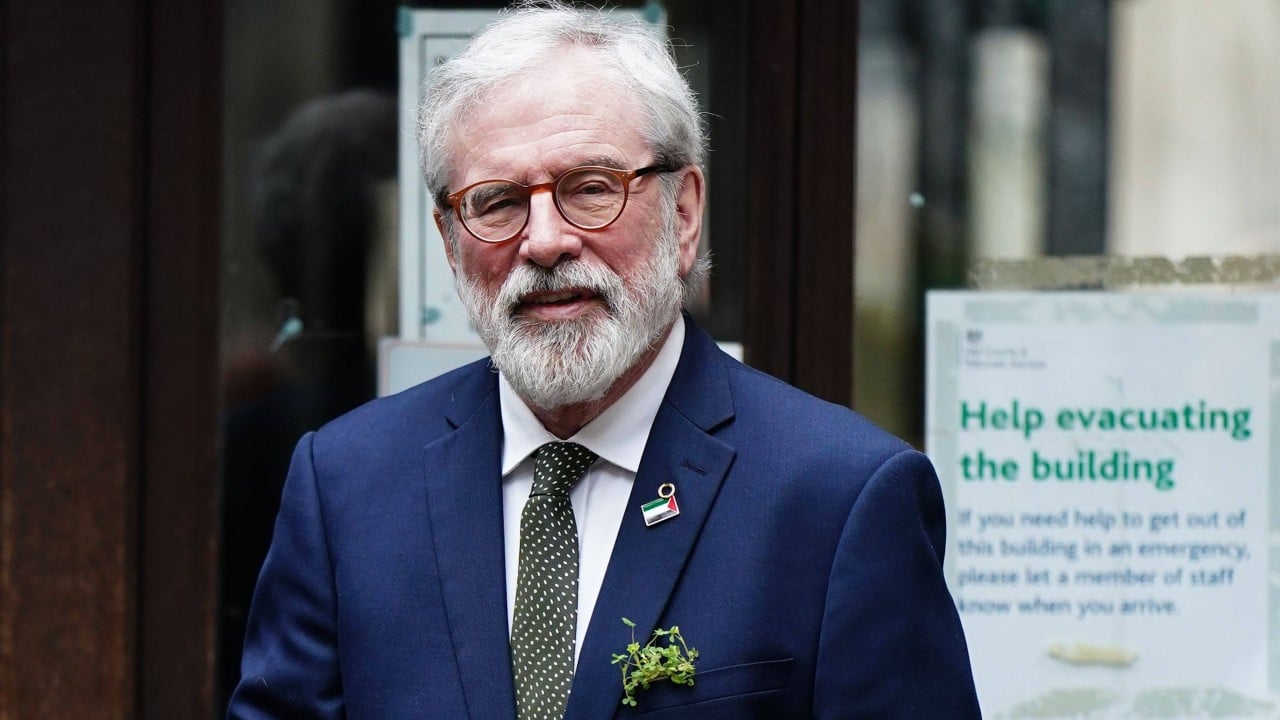
Gerry Adams just told a London courtroom that he was never in the IRA. If you’ve followed Northern Ireland’s history for more than five minutes, you know this is the most consistent, and controversial, line of his 60-year career. Standing in the witness box on St. Patrick’s Day 2026, the former Sinn Féin president didn't just deny planting bombs; he denied ever holding any rank or role in the paramilitary organization.
It’s a bold stance to take when you’re being sued by victims of the 1973 Old Bailey bombing and the 1996 attacks in London’s Docklands and Manchester. These men—John Clark, Jonathan Ganesh, and Barry Laycock—aren’t looking for a massive payout. They’re suing for a symbolic £1. They want "vindication." They want a court to finally say what many British intelligence officers and former IRA members have claimed for decades: that Adams was part of the IRA’s seven-man Army Council. For another view, consider: this related article.
The distinction without a difference
The core of the case rests on a simple but messy question. Can you be the face of a movement’s political wing without being part of its military wing? Adams says yes. He argues that membership in Sinn Féin "does not equate to membership of the IRA."
Lawyers for the victims call this a "distinction without a difference." They’ve brought in a "jigsaw" of evidence to prove that Adams had a foot in both camps. During the trial, we’ve heard from retired RUC officers and former British commanders like Richard Kemp. Kemp told the court it’s "inconceivable" that major bombings on the UK mainland could happen without the sign-off of the Army Council—and that Adams was a key player on that council. Further insight on this trend has been provided by Associated Press.
Adams isn't budging. He’s used his time in the witness box to school the court on Irish history, calling British ignorance of the subject "shocking." He admits he doesn't "distance himself" from the IRA, but he insists his role was always that of a political activist. It's a semantic tightrope he’s walked since the 1970s.
Why this trial is happening now
You might wonder why we’re litigating events from 1973 and 1996 in 2026. Part of it is the ticking clock of the UK’s Legacy Act. This law was designed to shut down Troubles-era civil claims, but these victims got their case in just under the wire.
Another reason? Reputation. Adams recently won a €100,000 libel case against the BBC in Dublin over claims he sanctioned the murder of an informant. That victory gave his "never in the IRA" narrative a boost. This civil trial in London is the counter-punch. Because it’s a civil case, the judge doesn't need "beyond a reasonable doubt." He only needs to decide on the "balance of probabilities." Basically, is it more likely than not that Adams was in the IRA?
The ghost of Cheyne Walk
One of the most heated exchanges in the trial involved the 1972 secret talks at Cheyne Walk in London. Adams was part of a republican delegation that met with British government officials. The victims' lawyer, Sir Max Hill KC, pointed out that others in that group were self-professed IRA leaders.
- The Accusation: You were there as a representative of the IRA.
- The Defense: I was there as a member of Sinn Féin.
Adams even shrugged off a "black beret" as a symbol of membership, despite it being the standard uniform for IRA color parties and funerals. He’s essentially asking the court to ignore what dozens of books, intelligence reports, and former comrades have said in favor of his personal testimony.
The human cost vs. the political legacy
It’s easy to get lost in the legal jargon, but the victims in the gallery are a reminder of why this hurts. Barry Laycock was movingly acknowledged by Adams in court, though the judge quickly told Adams to stop making statements and stick to answering questions.
There’s a massive gap between the "statesman" who helped broker the Good Friday Agreement and the "volunteer" the claimants describe. Adams says he wants to go to his grave content that he helped bring about a peace process. The claimants want him to go to his grave having admitted his full role in the war that preceded it.
What happens next
The trial is wrapping up soon, and the judgment will likely take some time to be delivered. If the judge finds Adams liable, that £1 will be the most expensive coin in Irish political history. It wouldn't put him in jail, but it would shatter the carefully curated legacy of a man who claims he only ever held a ballot box, never an ArmaLite.
If you’re following this case, keep an eye on the specific "hearsay" evidence the judge decides to admit. In civil trials like this, the bar for evidence is lower, and that’s where Adams is most vulnerable.
Watch the final statements from both legal teams next week. They’ll summarize whether 50 years of denials can withstand seven days of intense cross-examination. For the victims, the verdict is about the truth. For Adams, it’s about the history books.