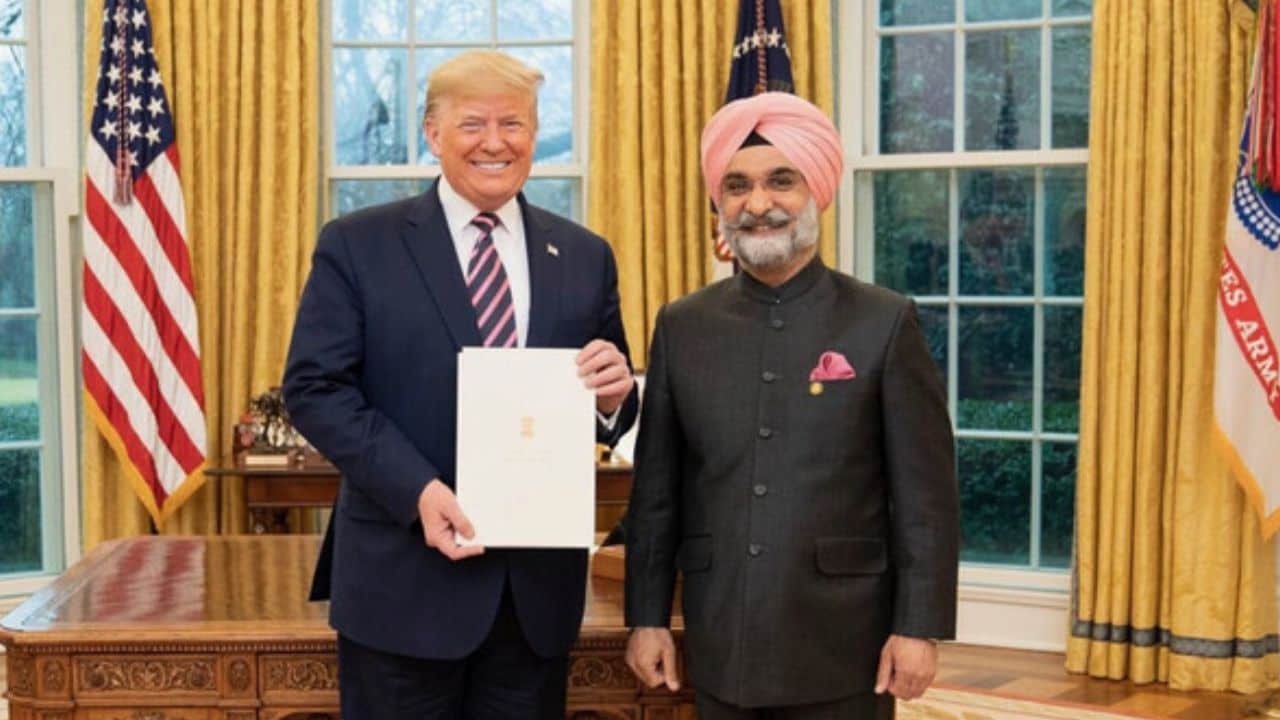
The arrival of Taranjit Singh Sandhu as the Lieutenant Governor of Delhi marks a calculated shift in how India manages its power center. It is not a standard bureaucratic shuffle. By placing a seasoned diplomat—one who navigated the halls of power in Washington D.C. as India's Ambassador—into the messy, often litigious environment of the Raj Niwas, the central government is signaling a move toward "global city" governance. This appointment comes with high-level international recognition, notably from Donald Trump, whose public greeting of Sandhu underscores the deep ties the former diplomat cultivated during his tenure in the United States.
The move attempts to solve a chronic problem. For years, the administration of Delhi has been defined by a grinding friction between the elected state government and the federally appointed Lieutenant Governor. This stalemate has stalled infrastructure, muddied the waters of executive authority, and turned basic municipal functions into political battlegrounds. Sandhu is not an operative born of local party machinery. He is a specialist in high-stakes negotiation. The central intent is to leverage his perceived neutrality and international standing to bypass the typical street-fight politics of the capital, potentially rebranding Delhi as a sophisticated diplomatic hub rather than a site of perpetual internal protest.
The Washington Connection and the Trump Factor
Donald Trump’s public acknowledgment of Sandhu is more than a polite gesture between former acquaintances. It highlights a specific type of capital that Sandhu brings to the table. During his time in D.C., Sandhu was instrumental in keeping the Indo-US relationship steady through two vastly different American administrations. He managed the transition from the Trump era to the Biden presidency with a level of tact that earned him respect across the aisle.
When Trump greets a regional administrator in India, the subtext is clear. There is an expectation of stability. For the central government, this international "stamp of approval" serves a domestic purpose. It frames the new Lieutenant Governor as a figure of stature who is "above" the fray. This isn't just about optics. It is about attracting foreign investment into Delhi’s infrastructure. If the city’s top administrator has a direct line to global leaders and a reputation for getting deals done in the West, the city becomes a safer bet for international capital.
A Diplomat in a Political Minefield
The transition from the world of international treaties to the world of Delhi’s drainage systems and power subsidies is a brutal one. Diplomats operate on protocol and carefully worded communiqués. Delhi’s politics operate on rallies, legal petitions, and public shouting matches. Sandhu’s biggest challenge will be the "gray zone" of the Government of National Capital Territory of Delhi (Amendment) Act.
This law gives the Lieutenant Governor significant control over "services," meaning the transfer and posting of officials. In the hands of a career politician, this power is a weapon. In the hands of a diplomat, the hope is that it becomes a tool for professionalizing the workforce. However, the friction is baked into the system. No matter how many world leaders offer their congratulations, Sandhu must still contend with an elected Chief Minister who views the office of the Lieutenant Governor as an undemocratic intrusion.
The "why" behind this specific choice reveals a deeper strategy. The government wants to move away from the image of the Lieutenant Governor as a mere "enforcer." By picking Sandhu, they are trying to change the narrative to one of "visionary administration." It is an attempt to use soft power to solve a hard power problem.
The Infrastructure Trap
Delhi is a city of contradictions. It houses the world’s most powerful embassies and some of the world’s most strained urban systems. The new administration faces an immediate crisis of scale. Air quality, water shortages, and a crumbling public transport network are not issues that can be solved with diplomatic finesse alone.
Sandhu’s background suggests he will prioritize "Mega-Projects" that can be showcased on a global stage. We can expect a push for smarter urban planning that mimics the models seen in Singapore or Dubai. But these projects often clash with the needs of the city's vast working-class population. When a diplomat looks at a city, they see a gateway for the nation. When a local politician looks at a city, they see a collection of vote banks.
The Budgetary Standoff
Finances will be the first real test. Historically, the Lieutenant Governor has used the power of the purse to vet or block state government initiatives. If Sandhu continues this trend, his diplomatic aura will evaporate within months. To succeed, he has to find a way to allow the state government its "wins" while ensuring that central priorities—specifically security and the development of the Central Vista—remain uncompromised.
This requires a delicate balancing act. He must manage the expectations of his bosses in the central cabinet, who expect him to maintain control, while managing the public perception of a city that feels it is being governed by an unelected official.
Beyond the Usual Bureaucracy
The appointment of a career diplomat to a domestic administrative post is a tactic borrowed from the "technocrat" playbook. It suggests that the government has lost faith in the ability of traditional bureaucrats to handle the unique pressures of the capital. Delhi is no longer just a city; it is a geopolitical asset. During the G20 summit, the flaws in Delhi’s administration were visible to the entire world. The central government does not want a repeat of that embarrassment.
Sandhu is essentially the "Chief Operating Officer" of a city that needs to be ready for the world stage at any moment. His appointment is a recognition that the old ways of managing Delhi through blunt force and police orders are no longer sufficient. The city needs a face that can talk to a CEO or a President just as easily as they can talk to a municipal commissioner.
The Risk of Isolation
There is a significant danger in this approach. Diplomats are often criticized for being out of touch with the ground reality of the people they serve. Sandhu has spent the better part of the last decade in the most elite circles of global power. The concerns of a shopkeeper in Old Delhi or a tenant in a sprawling unauthorized colony are far removed from the climate accords and trade deals of Washington.
If the Raj Niwas becomes an ivory tower, the political backlash will be swift. The local government will paint him as an outsider—a "Lutyens' elite" who doesn't understand the struggles of the common man. To avoid this, Sandhu will need to engage in "street-level diplomacy." He cannot just be a figurehead who receives foreign dignitaries; he must be seen navigating the broken sidewalks and crowded hospitals of the city he now oversees.
The Shadow of the Previous Administration
The shadow of his predecessors looms large. Previous Lieutenant Governors were defined by their confrontations. They were seen as the long arm of the center, tasked with clipping the wings of the local assembly. If Sandhu follows this path, his international reputation will do little to save his tenure from the same cycle of litigation and protest.
The core of the problem remains the overlapping jurisdictions. In Delhi, the police, land, and public order fall under the center (via the LG), while health, education, and water fall under the state. It is a recipe for chaos. A diplomat’s primary skill is finding common ground where none seems to exist. Sandhu’s success will be measured not by how many times he stops the state government, but by how many times he manages to get them to work toward a shared goal.
The Global City Ambition
The ultimate goal of this appointment is the transformation of Delhi into a "Global City." This is a term often used in policy papers but rarely achieved in practice. It means a city that is not only a political capital but also a financial and cultural powerhouse.
Key Pillars of the Sandhu Strategy
- Security Integration: Using his experience to streamline the cooperation between intelligence agencies and local police, especially given Delhi's status as a high-value target.
- Green Diplomacy: Bringing international expertise and funding to tackle the perennial smog that chokes the capital every winter.
- Economic Corridors: Facilitating smoother interactions between the various diplomatic missions and the city's nascent tech and service hubs.
These are ambitious goals. They require a level of administrative harmony that Delhi hasn't seen in two decades. The fact that Trump reached out to congratulate him suggests that the international community is watching. They see Delhi as a test case for whether India can manage its internal political fractiousness while projecting the image of a rising global power.
The Inevitable Friction
Despite the high-profile greetings and the diplomatic polish, the fundamental nature of the job remains adversarial. The Chief Minister of Delhi is a formidable political operator who has built a career on challenging the status quo. He will not be intimidated by a diplomatic resume.
In fact, the contrast between the two could not be sharper. On one side, you have a product of the elite Indian Foreign Service, trained in the nuances of international relations. On the other, a populist movement born out of an anti-corruption crusade. This collision is inevitable. The question is whether Sandhu can use his training to turn this collision into a productive tension rather than a destructive one.
Navigating the Legal Hurdles
The Supreme Court of India has been a frequent arbiter in the disputes between the LG and the Delhi government. Each ruling tries to clarify the boundaries, but politics always finds a way to blur them again. Sandhu will need a top-tier legal team to ensure that his directives are not immediately stayed by the courts.
A diplomat is used to working within the framework of international law, where enforcement is often a matter of consensus. In Delhi, enforcement is a matter of the police and the courts. This shift from "consensus" to "command" will be the most significant adjustment for the new Lieutenant Governor. He must learn to wield the power of his office without appearing authoritarian—a balance that has eluded almost everyone who has held the post before him.
The Timeline for Results
The honeymoon period for this appointment will be remarkably short. The summer heat will bring water shortages. The monsoon will bring flooding. The winter will bring the toxic haze. These are the rhythmic crises of Delhi, and no amount of international prestige can solve them overnight.
The public will look for immediate improvements in service delivery. They will want to see if the "Sandhu touch" can actually clear the bureaucratic hurdles that have stalled the cleaning of the Yamuna river or the expansion of the metro's fourth phase. If the gridlock continues, the narrative will quickly shift from "the diplomat who saved Delhi" to "just another political appointee."
The real test will come when the first major disagreement occurs between the Raj Niwas and the Secretariat. Will Sandhu pick up the phone and try to negotiate a settlement behind closed doors, as he would in a diplomatic crisis? Or will he issue a formal memorandum that ends up on the front page of every newspaper the next morning?
The choice of Taranjit Singh Sandhu is a high-stakes experiment. It is a bet that the skills required to navigate the corridors of the US State Department are the same skills needed to manage the chaotic, vibrant, and often dysfunctional heart of India. It is a bold move, but in a city as complex as Delhi, boldness is often a prerequisite for survival.
Stop looking at this as a simple personnel change. It is the beginning of a new phase in the struggle for the soul of the capital. The diplomat has arrived, but the politics of the street are waiting at the gate.