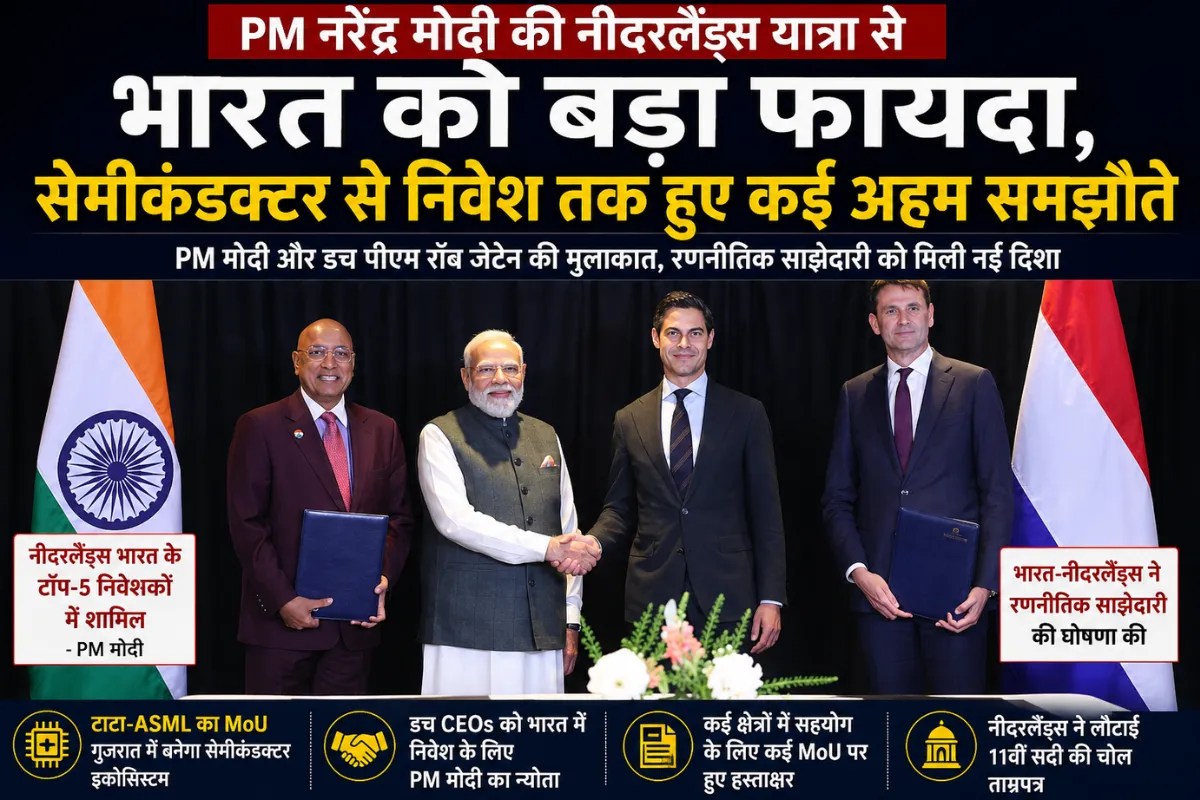
The material architecture of modern geopolitics is determined not by broad diplomatic declarations, but by the physical boundaries of semiconductor manufacturing. Prime Minister Narendra Modi’s state visit to the Netherlands, culminating in the elevation of bilateral ties to a formal Strategic Partnership and a memorandum of understanding (MoU) between Tata Electronics and ASML, marks a structural shift in India’s industrial strategy.
By anchoring its domestic fabrication ambitions to Dutch lithography technology, India is attempting to bypass a critical technological bottleneck. This analysis deconstructs the economic mechanisms, operational constraints, and strategic logic underpins this bilateral realignment.
The Micro-Architecture of the Semiconductor Supply Chain
To understand the strategic necessity of the India-Netherlands alignment, one must analyze the global semiconductor value chain through the lens of asset specificity and market concentration. The production of a front-end semiconductor wafer is highly capital-intensive and possesses a zero-fault tolerance operational environment.
[Silicon Wafer Input] -> [Photolithography (ASML Monopoly)] -> [Etching & Ion Implantation] -> [Front-End Fab Output]
The primary bottleneck in establishing a commercial 300 mm (12-inch) semiconductor fabrication plant, such as the Tata Electronics facility in Dholera, Gujarat, is photolithography. Photolithography is the process of using light to transfer geometric patterns from a photomask to a light-sensitive chemical photoresist on the silicon wafer.
ASML maintains a near-total monopoly on the supply of high-precision photolithography equipment. While advanced sub-7-nanometer nodes require Extreme Ultraviolet (EUV) lithography systems, mature and intermediate nodes—ranging from 28-nanometer to 90-nanometer, which form the backbone of automotive, industrial, and defense electronics—rely on Deep Ultraviolet (DUV) immersion and dry lithography systems.
Without direct OEM (Original Equipment Manufacturer) integration from ASML, a front-end fab cannot achieve operational readiness. The agreement signed between Tata Electronics and ASML functions as an engineering and supply-chain guarantee. It secures the deployment of ASML’s advanced lithography tools and provides the continuous calibration, software synchronization, and spare-part logistics required to sustain high-yield utilization rates.
Capital Efficiency and the Dholera Fab Cost Function
The establishment of India’s first commercial front-end semiconductor fabrication unit involves an estimated investment of ₹91,000 crore (~$11 billion USD). In semiconductor economics, the capital expenditure (CapEx) profile is heavily skewed toward equipment procurement, which typically accounts for 70% to 80% of total fab setup costs.
A single lithography tool can command a capital layout ranging from tens of millions to over a hundred million dollars. The economic viability of the Dholera facility depends on its operational cost function, which is governed by three primary variables:
- Yield Rate ($Y$): The percentage of functional dies harvested from a single 300 mm wafer. Initial production lines face a steep learning curve; low initial yields can deplete capital reserves rapidly.
- Capacity Utilization ($U$): The ratio of actual wafer starts to total theoretical capacity. High fixed depreciation costs require the fab to operate continuously ($24/7$) to minimize per-wafer overhead.
- Time-to-Market ($T$): The duration between breaking ground and achieving qualified mass production. Delayed tool delivery or prolonged calibration phases expand the capital-carrying cost.
The collaboration with ASML directly addresses the time-to-market variable. By embedding Dutch engineering expertise during the facility's design phase, Tata Electronics minimizes the risk of structural incompatibility—such as micro-vibrations, thermal fluctuations, or cleanroom particulate contamination—that can disrupt high-precision lithography tools. Furthermore, the partnership includes dedicated lithography-intensive skill development, creating a local pipeline of specialized optical and systems engineers capable of running these machines at peak operational efficiency.
The Dual-Engine Infrastructure Strategy: Green Hydrogen and Maritime Corridors
The industrial logic of the India-Netherlands relationship extends beyond microchips to encompass the energy and logistical infrastructure required to support advanced manufacturing ecosystems. High-tech industrial clusters are notoriously resource-intensive. A standard front-end fab requires an uninterrupted base-load power supply and millions of gallons of ultra-pure water daily.
To mitigate the environmental and resource strain of its broader industrial expansion, India has integrated its energy strategy with Dutch technical expertise via a joint Green Hydrogen Roadmap. The strategic objective is twofold:
First, it establishes a framework for the localized production and utilization of green hydrogen, leveraging Dutch advancements in electrolyzer efficiency and grid integration. This serves as a structural decarbonization tool for heavy industries, including steel, chemicals, and eventually, high-tech manufacturing power plants.
Second, the adoption of a green and digital sea corridor connecting Indian and Dutch ports—specifically targeting transport hubs managed by operators like APM Terminals and Royal Vopak—restructures the logistics of bilateral trade. By digitizing customs protocols and deploying low-emission maritime infrastructure, the two nations aim to reduce transit times and carbon overhead between India and the European market, where bilateral trade reached $27.8 billion in the 2024–25 fiscal year.
Water Security: The Foundation of Industrial Scaling
A significant constraint on India's industrial scaling is systemic water scarcity. The Ministry of External Affairs confirmed that the bilateral framework includes an elevated strategic partnership on water, institutionalized through a Center of Excellence on Water at IIT Delhi, established in collaboration with the Dutch Ministry of Infrastructure and Water Management.
The operational relevance to industrial policy is direct. The Netherlands’ mastery of hydrologic engineering—evidenced by their sophisticated dike systems and industrial water-recycling frameworks—is being deployed to secure water infrastructure in drought-prone manufacturing zones. A prime example is the joint multi-purpose mega-water project designed to build a fresh-water subway system for the Saurashtra region in Gujarat. By managing salinity ingress and ensuring industrial-grade water security, this project secures the primary physical input required by the nearby Dholera semiconductor cluster.
Strategic Constraints and Operational Counterweights
While the India-Netherlands strategic alignment provides a clear roadmap for technological upgrading, executing this strategy involves significant macroeconomic and geopolitical frictions.
[Geopolitical Export Controls] \
[High Upfront Capital Inputs]   --> [Operational Friction Points]
[Domestic Talent Deficit]     /
- Geopolitical Export Controls: ASML operates under strict regulatory oversight from both the Dutch government and international regimes, influenced heavily by US export control policies. While current restrictions primarily target sub-7nm EUV systems and advanced DUV lithography heading to specific jurisdictions, any future broadening of multilateral export controls could introduce supply-side risks for components and software updates.
- High Upfront Capital Inputs vs. Delayed Cash Flow: The financial burden of the Dholera fab relies on sustained government subsidies via India's Semiconductor Product-Linked Incentive (PLI) scheme. If fiscal priorities shift or if global chip prices collapse due to cyclical oversupply, the capital-carrying cost could strain Tata Electronics' balance sheet before the facility achieves optimal scale.
- The Specialized Talent Deficit: Operating advanced lithography equipment requires deep domain expertise in optical physics, precision mechanics, and chemical engineering. While India possesses a large software engineering talent pool, it faces a structural deficit in front-end hardware fabrication specialists. The skill-development initiatives built into the ASML-Tata MoU will take years to produce senior-level operational engineers, necessitating reliance on expensive foreign technical consultants in the interim.
The Macro-Economic Realignment
The structural integration of Indian manufacturing with Dutch industrial technology must be viewed alongside the recent conclusion of the India-European Union Free Trade Agreement (FTA) negotiations. The FTA provides the institutional scaffolding for long-term capital flows. With cumulative Dutch Foreign Direct Investment (FDI) already standing at $55.6 billion, making the Netherlands India's fourth-largest investor globally, the institutionalization of the Strategic Partnership reduces regulatory risk for private capital.
Rather than relying on generic trade incentives, the Indian state is executing a targeted alignment with single-source technological monopolies. Securing a direct engineering pipeline with ASML provides the technical foundation for the Dholera fab, while parallel roadmaps in green hydrogen and industrial water management build the physical infrastructure required to sustain the facility.
The ultimate success of this strategy depends on the speed of technology transfer and the ability of domestic engineers to master lithographic processes. Industrial policy has moved past simple labor-cost arbitration; long-term economic sovereignty is now dictated by the precision of a nation's position within the global technology stack.