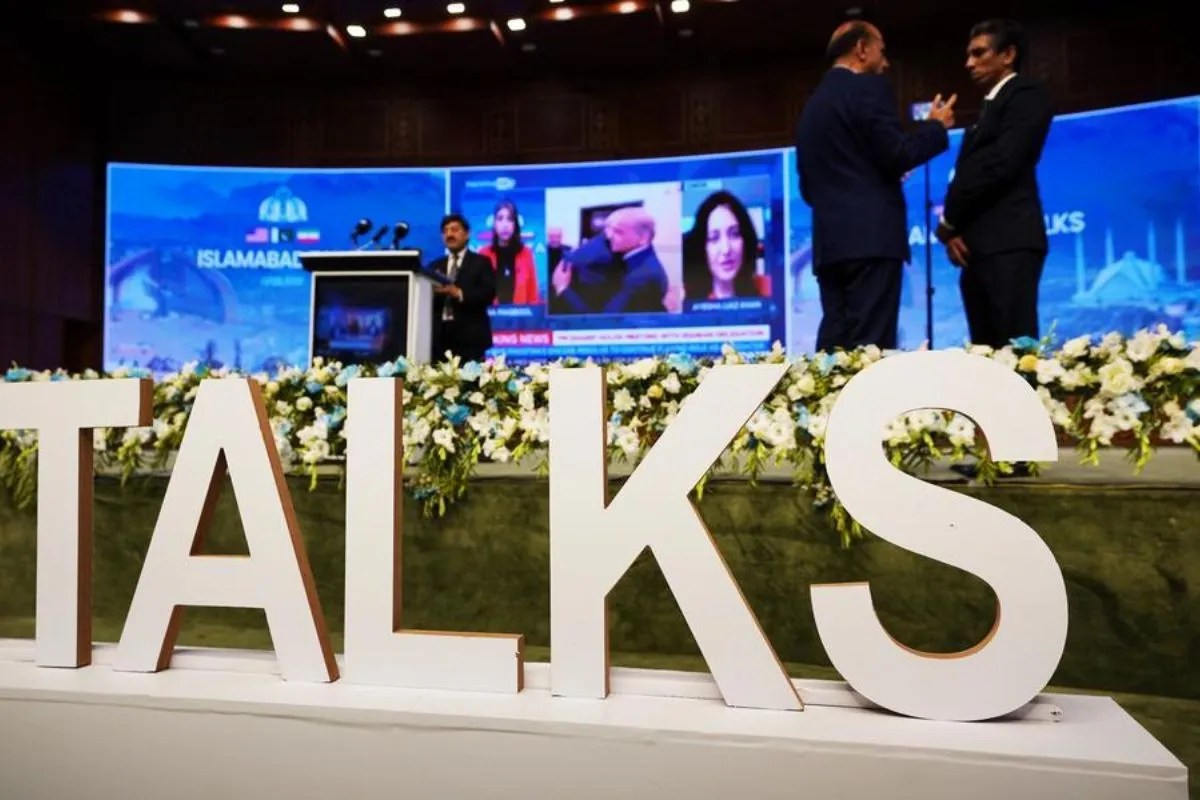
The failure of the United States to secure a strategic energy or security alignment with Pakistan, coupled with Iran’s immediate diplomatic posturing, signals a breakdown in the traditional "influence-for-aid" model that defined the region for seventy years. This collapse is not a result of diplomatic friction alone but a structural misalignment between Pakistan’s immediate fiscal insolvency, Iran’s need for an energy outlet, and the United States' shift toward a containment strategy that no longer views Islamabad as a central pillar. The impasse reveals a new tri-polar tension where energy infrastructure—specifically the stalled Iran-Pakistan (IP) gas pipeline—serves as the primary friction point between Western sanctions and regional survival.
The Triad of Deterrence and the IP Pipeline Bottleneck
The primary driver of the failed negotiations rests on the Sanctions-Solvency Paradox. Pakistan faces a $18 billion penalty if it fails to complete its portion of the Iran-Pakistan pipeline, yet completing it triggers US secondary sanctions that would effectively terminate Pakistan’s access to the International Monetary Fund (IMF).
This creates three distinct structural barriers:
- The Financial Chokehold: Pakistan’s economy currently operates on a subsistence basis regarding foreign exchange reserves. The US refusal to grant a sanctions waiver for the IP pipeline is not merely a policy preference; it is a tactical application of the Countering America's Adversaries Through Sanctions Act (CAATSA). Without a waiver, Pakistan cannot attract the capital investment required to build the remaining 80 kilometers of the pipeline without risking a total freeze of its dollar-denominated assets.
- The Energy Deficit vs. Debt Cycle: Pakistan’s industrial sector experiences a 25% to 30% output gap due to energy shortages. Iran offers gas at rates significantly lower than global LNG spot prices. However, the cost of the US-led "non-alignment" is the continued reliance on expensive, dollar-backed LNG imports, which further exacerbates the balance-of-payments crisis.
- The Security-Economic Divergence: Historically, the US-Pakistan relationship was built on a security-first framework (Centcom-GHQ cooperation). Current US interests have shifted toward the Indo-Pacific, prioritizing India as a regional counterweight. This reduces Pakistan’s leverage, turning what was once a "strategic partnership" into a "transactional monitoring" relationship.
Iran’s Strategic Calculus and the Pivot to Hardline Diplomacy
Following the failure of the US-Pakistan talks, Tehran’s rhetoric has shifted from fraternal cooperation to legalistic demand. Iran has already completed its side of the infrastructure, investing approximately $2 billion. The Iranian statement issued post-talks underscores a transition toward the Litigation Phase of Diplomacy.
Tehran’s strategy now operates on a dual-track mechanism:
- Legal Compulsion: By setting a deadline for the completion of the Pakistani segment, Iran is utilizing the "Take-or-Pay" clause in the 2009 agreement. This is designed to force Islamabad’s hand: either defy the US or pay a penalty that would bankrupt the state.
- Alternative Alignment: Iran is increasingly signaling that if Pakistan cannot fulfill its role as a transit hub, Tehran will prioritize the International North-South Transport Corridor (INSTC) and deepening ties with Moscow and Beijing. This effectively threatens to bypass Pakistan as a regional energy node, relegating it to a geographic cul-de-sac.
The Mechanism of Failed Mediation
The US delegation’s inability to reach a "deal" stems from the absence of a Compensatory Framework. In previous decades, the US would offset Pakistan's loss of Iranian energy with civil nuclear cooperation or massive infrastructure grants (e.g., the Mangla and Tarbela dams). Today, the US offering is restricted to "green energy transition" assistance and small-scale technical support.
There is a fundamental mismatch between what Pakistan needs (immediate, high-volume, cheap baseload power) and what the US is willing to authorize (long-term, decentralized renewable initiatives). The US policy of "strategic patience" assumes that Pakistan will eventually choose IMF stability over Iranian gas. However, this ignores the internal political pressure within Pakistan, where energy inflation acts as a primary catalyst for civil unrest.
Regional Realignment and the China Factor
While the US and Iran occupy the foreground of this dispute, China’s role as the "Lender of Last Resort" defines the boundaries of the possible. The China-Pakistan Economic Corridor (CPEC) is currently in a "consolidation phase," meaning Beijing is hesitant to pour more capital into projects that might be targeted by Western sanctions.
- The Reliability Gap: Pakistan’s inability to secure a US waiver signals to Beijing that the Cope-led energy infrastructure is high-risk.
- The Substitution Effect: If the IP pipeline fails permanently, Pakistan becomes entirely dependent on Chinese-funded coal and solar, or Qatari LNG. This shifts the dependency from a regional neighbor (Iran) to a distant superpower (China) or a US-aligned energy exporter (Qatar), neither of which solves the underlying price-point issue.
Geopolitical Friction Points in the Gas Sector
The breakdown in talks highlights several overlooked technical and geopolitical realities:
- The Sovereign Guarantee Issue: Pakistan cannot provide sovereign guarantees for the IP project because its debt-to-GDP ratio and IMF agreements forbid new contingent liabilities.
- The Technology Barrier: Even if Pakistan ignored sanctions, it lacks the domestic capacity to build the high-pressure compression stations required for the pipeline. These stations require turbines and technology that are almost exclusively produced by firms subject to US export controls.
- The Border Security Nexus: The pipeline route passes through Balochistan, a region of high insurgency. The US withdrawal from Afghanistan has decreased interest in securing this corridor, leaving the project's physical security as an un-costed liability that neither Islamabad nor Tehran can fully mitigate.
The Strategic Shift from Cooperation to Containment
The failure of these negotiations marks the end of the "Frontline State" era. The US is now applying a Containment of Proliferation and Influence model to Pakistan, similar to its approach toward mid-tier powers that maintain close ties with sanctioned regimes.
The Iranian response—issuing a stern statement immediately following the US-Pakistan stalemate—is a calculated move to highlight American interference in Pakistani domestic energy policy. It is an attempt to stoke anti-Western sentiment within the Pakistani electorate, pressuring the government to choose "regionalism" over "globalism."
Predictive Trajectory for South Asian Energy Security
The data suggests that the IP pipeline will remain a "stranded asset" for the foreseeable future. Pakistan will likely pursue a strategy of Calculated Procrastination, attempting to keep Iran at the negotiating table to avoid the $18 billion penalty while simultaneously pleading for a limited "Humanitarian Energy Waiver" from the US.
However, this strategy has a shelf life. As Iran’s own domestic gas demand increases, the window for exporting surplus gas to Pakistan will close. Once Iran pivots its infrastructure toward the East or Russia, Pakistan will lose its most viable path to energy independence.
The most probable outcome is a permanent shift toward high-cost LNG and a gradual degradation of Pakistan's industrial competitiveness. The US "victory" in blocking the pipeline comes at the cost of pushing Pakistan further into a cycle of debt and dependency, while Iran’s pivot ensures that the "Axis of Sanctioned States" (Iran, Russia, and potentially a recalcitrant Pakistan) becomes a more cohesive economic bloc out of sheer necessity.
The immediate strategic requirement for any regional actor is to de-risk energy portfolios away from trans-border pipelines that cross sanctions frontiers. The future of the region is not one of integrated grids, but of fragmented, localized energy islands where political alignment dictates thermal comfort and industrial survival. The failure in Islamabad was not a failure of communication; it was a realization that the interests of a global hegemon and a regional energy power are now officially irreconcilable on Pakistani soil.