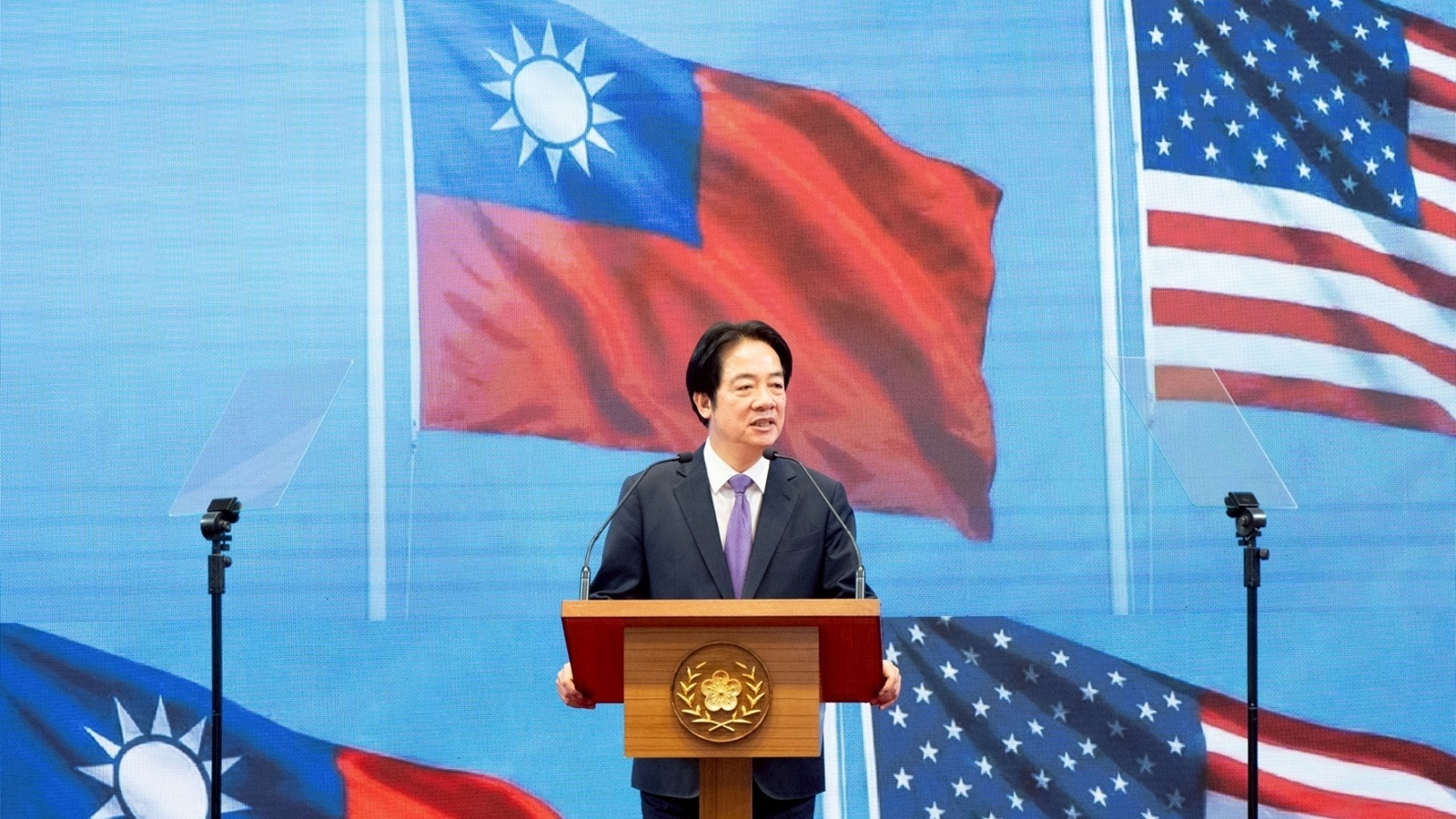
The stability of the Taiwan Strait is governed by a fundamental tension between institutional deterrence and transactional diplomacy. When U.S. President Donald Trump classified a pending $14 billion arms package to Taiwan as a "negotiating chip" dependent on Beijing's concessions, he exposed a structural divergence in how Washington and Taipei calculate national security. For Taipei, hardware procurement is a non-negotiable variable in a cross-strait deterrence equation designed to raise the kinetic cost of invasion for the People's Liberation Army (PLA). For a transactional U.S. executive branch, these defense assets are treated as liquid capital within a broader, multi-variable bilateral negotiation with China.
Resolving this tension requires looking past political rhetoric to evaluate the underlying mechanics of asymmetric defense, supply chain dependencies, and the legislative frameworks that dictate cross-strait security. You might also find this connected coverage useful: Inside the Middle East Leverage Trap That Left Both Washington and Tehran Boxed In.
The Micro-Economic Architecture of Taiwanese Deterrence
Taipei’s defense strategy operates on an asymmetric denial model, fundamentally bound by a strict cost function. The objective is not to match the PLA hull-for-hull or aircraft-for-aircraft, but rather to increase the operational friction and projected casualty rate of an amphibious assault to a level that threatens the political stability of the Chinese Communist Party (CCP).
Taiwan’s parliament recently approved a $25 billion defense spending bill, structurally allocated across two distinct tranches of American military hardware: As extensively documented in recent reports by USA Today, the implications are worth noting.
- Tranche A ($11 Billion Package): Formally approved in December, this allocation prioritizes low-cost, high-survivability, distributed assets. It focuses heavily on anti-ship missiles, unmanned aerial vehicles (UAVs), mobile artillery systems, and integrated command-and-control software designed to survive initial missile salvos.
- Tranche B ($14 Billion Package): Currently held in abeyance by the U.S. Executive Branch. This package contains heavier platforms and logistics infrastructure required to sustain a protracted blockade or secondary defense tier.
When Taiwanese President Lai Ching-te stated that these arms purchases represent the "most important deterrent" to regional instability, he was referencing the concept of a high-density denial zone. By introducing hundreds of mobile, redundant strike platforms across the island's geography, Taiwan alters the risk calculus for Beijing. The capital layout required for Taiwan to maintain this defensive baseline is deterministic; without the continuous influx of precision munitions and software updates, the deprecation rate of Taiwan's existing legacy platforms accelerates rapidly against the PLA's modernization curve.
The Transactional Dilemma: Arms Sales as Negotiating Assets
The classification of the $14 billion arms package as a "bargaining chip" introduces structural risk by transforming a predictable statutory obligation into an unpredictable diplomatic variable. Within a transactional geopolitical framework, defensive arms sales are evaluated through an optimization model that weighs three competing American interests:
- Direct Revenue and Domestic Defense Industrial Base (DIB) Subsidies: The economic capital injected directly into U.S. defense contractors.
- Sino-American Trade Rebalancing: Leveraging the withholding of arms to extract concessions from Beijing on agricultural purchases, intellectual property enforcement, or geopolitical cooperation regarding third-party states like Iran.
- Strategic Ambiguity Maintenance: Modulating the flow of weapons to prevent either a unilateral declaration of independence by Taipei or a preemptive kinetic intervention by Beijing.
This creates a structural bottleneck for Taiwanese defense planners. Military procurement operates on long lead times; systems ordered today frequently require 36 to 48 months for manufacturing, calibration, and integration into existing operational doctrine. When the execution of a procurement contract is conditioned on external bilateral negotiations, the predictability of Taiwan’s defense timeline decays. This delay creates tactical vulnerability windows where legacy systems age out before replacement assets arrive on line.
Statutory Guardrails vs. Executive Discretion
The structural tension within American foreign policy manifests as a conflict between legislative mandates and executive authority. The primary legal mechanism governing this relationship is the Taiwan Relations Act (TRA) of 1979.
[Taiwan Relations Act Mandate] ---> Compels Provision of Defensive Weapons
                                          |
                                          v
[U.S. Executive Discretion]    ---> Controls Timing, Volumetrics, and Delivery Speed
                                          |
                                          v
                                   [Delays / Abeyance]
The TRA legally binds the United States to provide Taiwan with "arms of a defensive character" and to maintain the capacity to resist any resort to force that would jeopardize the security of the island. However, the statute lacks explicit enforcement mechanisms regarding the velocity or specific nomenclature of the systems transferred.
The U.S. Executive Branch retains ultimate control over the export licensing process via the Arms Export Control Act. This allows an administration to technically honor the statutory obligation to support Taiwan while utilizing bureaucratic pauses to stall delivery. This tactical use of administrative delays serves as a diplomatic signal to Beijing.
The structural counterweight to this executive flexibility resides in the U.S. Congress. As demonstrated by House Speaker Mike Johnson’s public endorsement of Lai’s defensive posture, congressional consensus remains firmly anchored to the literal interpretation of the TRA. This internal institutional division ensures that while an administration can pause or gate individual arms tranches to maximize negotiating leverage, completely terminating the security pipeline remains politically untenable due to legislative resistance.
The Semiconductor Shield: Decoupling and the Silicon Counter-Lever
A critical variable in Taiwan’s defense equation is its near-monopoly on advanced semiconductor manufacturing, a position that President Lai described as placing Taiwan at the "core" of global interests. The island's fabrication facilities produce over 90% of the world's most advanced microchips, which are vital components for global consumer electronics, cloud computing infrastructure, and Western military hardware.
This concentrated supply chain creates a dual-incentive structure that influences both U.S. and Chinese strategic calculations:
The Silicon Shield Asymmetry
| Strategic Variable | Impact on Western Allies | Impact on China |
|---|---|---|
| Economic Disruption Cost | High: Immediate halt in advanced tech manufacturing; global supply chain freeze. | High: Disruptions to domestic industrial base and consumer technology assembly. |
| Deterrence Value | Compels U.S. intervention to prevent an adversarial monopoly on advanced silicon. | Raises the cost of kinetic action due to the risk of destroying vital manufacturing infrastructure. |
| Mitigation Horizon | 5–10 years (required to replicate fabrication ecosystem scale globally). | Decades (due to lithography equipment export controls and IP barriers). |
The transactional perspective seeks to mitigate this structural dependency by forcing the geographic redistribution of chip manufacturing assets. The explicit demand for Taiwanese firms, such as TSMC, to shift manufacturing infrastructure to the United States—exemplified by the $165 billion planned investment campus in Arizona—is a deliberate effort to decouple American national security from the physical security of the Taiwan Strait.
However, this decoupling strategy faces severe execution constraints. The semiconductor manufacturing ecosystem relies on a highly localized network of specialized chemical suppliers, precision engineers, and advanced packaging facilities that cannot be easily replicated abroad. Moving the fabrication plants without moving the broader logistical ecosystem creates a fragmented supply chain.
Consequently, even as advanced capacity is built out in the southwestern United States, Taiwan’s domestic facilities will remain the primary hub for leading-edge silicon for the foreseeable future. This ensures that the physical security of the island remains bound to global economic stability.
Strategic Realignment and the Path to Self-Sufficiency
Relying on external security guarantees within a transactional diplomatic environment introduces an unacceptable level of variance for long-term defense planning. To stabilize its deterrence equation, Taipei must adjust its strategic allocation of resources away from a pure dependence on foreign executive approval and toward a more self-sustained defense model.
First, Taiwan must optimize its domestic defense industrial base to achieve self-sufficiency in manufacturing low-cost, high-yield asymmetric munitions. While high-altitude air defense systems and advanced fighter aircraft will still require American aerospace integration, the domestic production of sea mines, anti-ship cruise missiles, and loitering munitions must be accelerated. This reduces the vulnerability of Taiwan's defense posture to diplomatic holds placed on U.S. export licenses.
Second, Taipei must systematically leverage its semiconductor dominance as an explicitly bound asset in bilateral security negotiations. Investment flows into foreign fabrication facilities, like those in Arizona, should be structurally linked to long-term, multi-year procurement schedules for defense hardware. By indexing semiconductor capital expenditure directly to arms delivery velocity, Taipei can establish a transactional counter-lever that aligns the economic incentives of American policymakers with the physical security requirements of the Taiwan Strait.