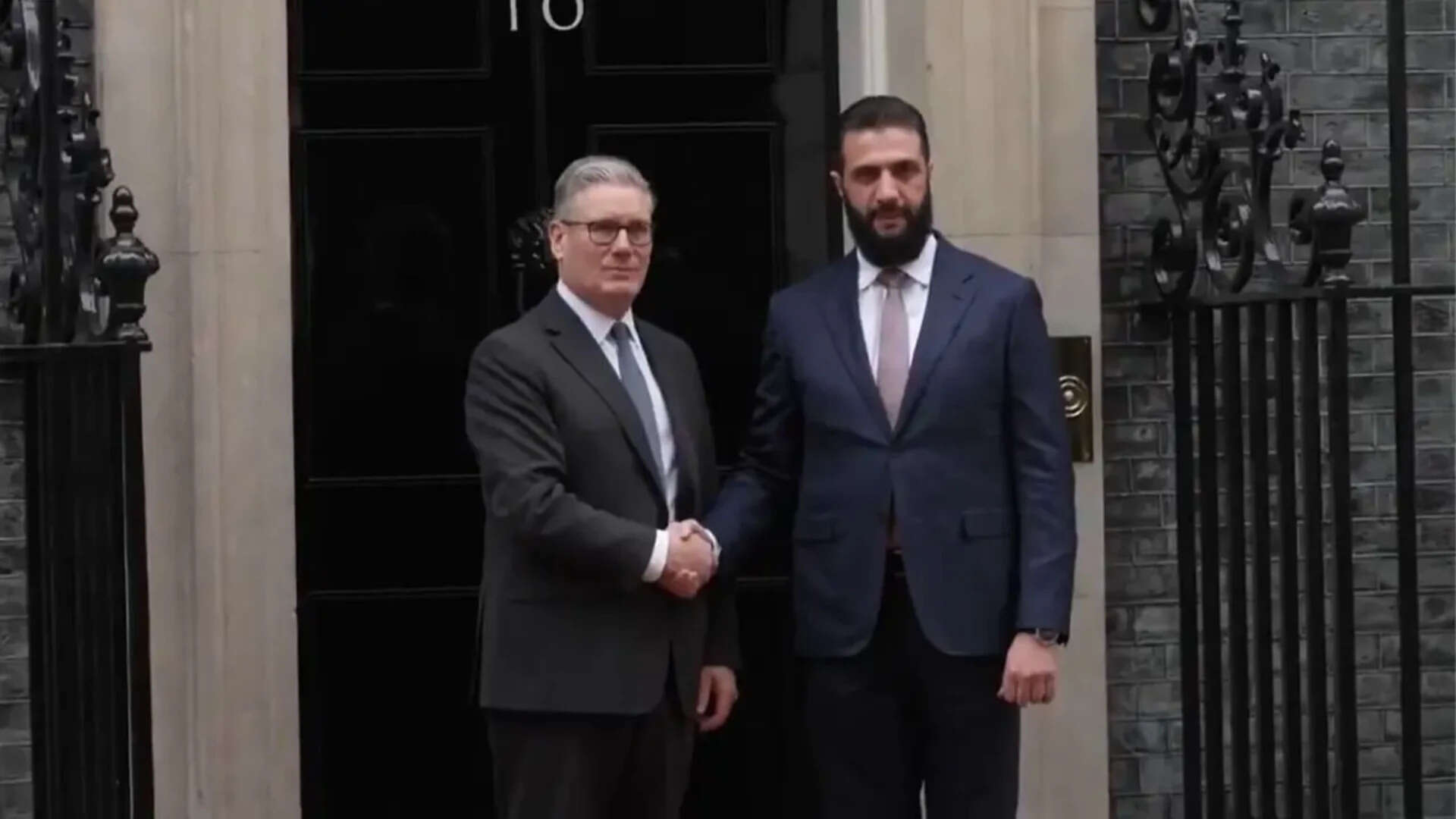
The diplomatic engagement between the British Prime Minister and the Syrian President represents a fundamental shift from a policy of isolation to one of transactional containment. This meeting functions as a recognition that the "frozen conflict" status quo has reached a point of diminishing returns for Western security interests. By prioritizing border mechanics and migration management over ideological alignment, the UK is attempting to construct a pragmatic buffer against regional instability. The success of this pivot depends entirely on whether the Syrian state can—or will—transition from a source of regional friction to a functional partner in maritime and terrestrial enforcement.
The Structural Drivers of Re-engagement
The decision to break years of diplomatic estrangement is not an endorsement of the Syrian internal apparatus but a response to three specific systemic pressures.
The Migration Pressure Valve
Syria remains the primary point of origin for a significant percentage of irregular migration flows entering the European theater. The UK’s objective is to move beyond reactionary maritime patrols toward a proactive "source-country" mitigation strategy. This involves negotiating the technical conditions required for the repatriation of Syrian nationals and the stabilization of internal displacement zones. If the Syrian government provides the security guarantees necessary for "safe return" designations, the UK gains the legal leverage required to accelerate asylum processing and deportations.
The Border Security Feedback Loop
The Levant functions as a transit corridor for illicit trade and militant movement. For the UK, "border security" in this context is a euphemism for the suppression of Captagon trafficking and the containment of extremist remnants. Syria’s specialized knowledge of local insurgent networks and smuggling routes offers a high-value intelligence asset, provided a mechanism for verifiable data-sharing can be established without compromising broader NATO intelligence protocols.
Regional Realignment and the Arab League Precedent
The UK is the last major Western power to align with the regional trend of normalization. Following Syria's readmission to the Arab League, the "Maximum Pressure" campaign lost its collective teeth. By engaging now, the UK seeks to prevent a total monopoly of influence by regional rivals and adversarial superpowers who have already re-established footprints in Damascus.
The Cost-Benefit Architecture of the Meeting
To analyze the meeting’s effectiveness, one must quantify the concessions on both sides. The Syrian administration seeks international legitimacy and the lifting of sectoral sanctions (specifically those impacting construction and energy), while the UK seeks quantifiable reductions in small boat crossings and increased counter-terrorism cooperation.
The Syrian Objective Function:
- Legitimacy Recovery: Utilizing the photo-op to signal to domestic and regional audiences that the era of pariah status is over.
- Economic Liquidity: Securing "humanitarian carve-outs" in sanctions regimes that allow for the import of dual-use infrastructure technology.
- Internal Consolidation: Leveraging British recognition to discourage remaining domestic opposition.
The UK Objective Function:
- Migration Volume Reduction: Achieving a measurable drop in Syrian nationals attempting the Channel crossing.
- Counter-Narcotics Enforcement: Disrupting the production and export of synthetic stimulants that destabilize regional partners.
- Geopolitical Intelligence: Establishing a direct line of communication to monitor Iranian and Russian operational shifts within Syrian territory.
Mechanics of Migration Management
The dialogue focuses on the technicalities of the "Safe Country" status. For the UK to legally deport individuals to Syria, it must satisfy the requirements of international law regarding the principle of non-refoulement—the practice of not forcing refugees or asylum seekers to return to a country in which they are liable to be subjected to persecution.
The current strategy involves the creation of "monitored zones." These would be specific geographic areas within Syria where the UK and its international partners provide funding for reconstruction and basic services in exchange for Syrian guarantees of amnesty for returning citizens. The bottleneck here is verification. Without a third-party monitor (such as a specialized UN agency or a neutral diplomatic mission), the UK risks legal challenges in domestic courts that could freeze the entire deportation pipeline.
The Captagon Variable and Security Trade-offs
Syria has transformed into a narco-state where the production of Captagon serves as a primary source of hard currency. The UK’s demand for "border security" is inherently at odds with the Syrian state’s current economic survival strategy. This creates a friction point:
- Enforcement Paradox: If the Syrian state cracks down on smuggling to satisfy British demands, it loses a vital revenue stream.
- The Substitute Offer: To offset this loss, the UK may have to facilitate "early recovery" aid—a diplomatic term for infrastructure investment that stops just short of full-scale reconstruction.
The UK is essentially bidding against the profit margins of organized crime. If the aid packages do not exceed the revenue generated by illicit trade, the Syrian commitment to border security will remain performative rather than operational.
Managing the Risk of Diplomatic Moral Hazard
The primary risk of this engagement is "moral hazard"—the possibility that by rewarding the Syrian government for its presence at the table, the UK encourages further leverage-seeking behavior. If Damascus perceives that migration surges lead to higher-level diplomatic invitations, it has a perverse incentive to facilitate, rather than hinder, the movement of people toward Europe.
To mitigate this, the UK is likely employing a "staged-compliance" framework.
- Phase 1: Intelligence Exchange. Low-risk sharing of data regarding human trafficking rings.
- Phase 2: Pilot Repatriations. Small-scale return of voluntary migrants to verify safety protocols.
- Phase 3: Sectoral Sanction Relief. Easing restrictions on specific industries (e.g., healthcare, telecommunications) in direct response to sustained reductions in illegal departures.
Each stage functions as a checkpoint. If the Syrian side fails to meet the metrics of the previous phase, the process reverts to isolation. This avoids the trap of "front-loading" concessions before results are achieved.
The Geopolitical Context: Russia and Iran
The meeting does not occur in a vacuum. Syria remains a primary theater for Russian and Iranian power projection. The UK's re-entry into this space introduces a "third-way" option for Damascus, potentially diluting the influence of Moscow and Tehran.
However, the Syrian government’s agency is constrained. Significant portions of the security apparatus are integrated with Iranian-backed militias, and the air defense and maritime infrastructure are under Russian oversight. The UK’s "border security" agenda must, therefore, navigate around these foreign deployments. Any British-Syrian agreement on border patrolling must account for the fact that the Syrian state does not have total monopoly over its own frontiers.
Tactical Realities of the London Visit
The choice of London for this first visit is symbolic. As a permanent member of the UN Security Council and a leader in the G7, the UK provides a level of validation that regional Arab capitals cannot. For Starmer, the visit is a domestic political necessity. The "Stop the Boats" mandate requires results that are impossible to achieve without talking to the countries where the journeys begin.
The optics of the meeting—likely held in a secure, functional setting rather than one of high-state ceremony—signal that this is a working session rather than a celebration. The focus on "migration and border security" on the agenda serves to insulate the Prime Minister from accusations of being "soft" on a controversial regime. It frames the visit as an act of national defense rather than a diplomatic olive branch.
Failure Modes and Contingencies
The probability of this engagement yielding a total resolution to the migration crisis is low. Several failure modes exist:
- The Verification Gap: The Syrian government promises safety for returnees but fails to prevent local security forces from conducting arrests, leading to a collapse of the UK’s legal framework for deportations.
- The Revenue Shortfall: The UK cannot provide enough financial incentive to replace the income Syria generates from the Captagon trade.
- External Sabotage: Regional actors who benefit from Syrian instability or Western exclusion may move to disrupt the new security arrangements.
If these efforts stall, the UK will likely pivot toward a "containment-plus" strategy—doubling down on maritime enforcement in the Mediterranean while maintaining the newly opened diplomatic channel as a tool for crisis management rather than conflict resolution.
Strategic Recommendation for Post-Visit Action
The UK must now formalize a Verifiable Compliance Matrix. This document should define the exact "Migration Reduction Targets" and "Smuggling Interdiction Rates" required for the continuation of high-level dialogue.
The government should avoid vague promises of "improved relations" and instead focus on a bilateral treaty that ties humanitarian aid directly to the installation of international monitors at key border crossings and returnee processing centers. This transforms the relationship from one of trust—which is non-existent—to one of audited transactions. The goal is not a "new era" of friendship, but a cold, functional mechanism to manage a shared geography of risk. Failure to implement rigorous, independent auditing of Syrian security guarantees will result in a legal and political backlash that could permanently disable the UK’s broader migration strategy.