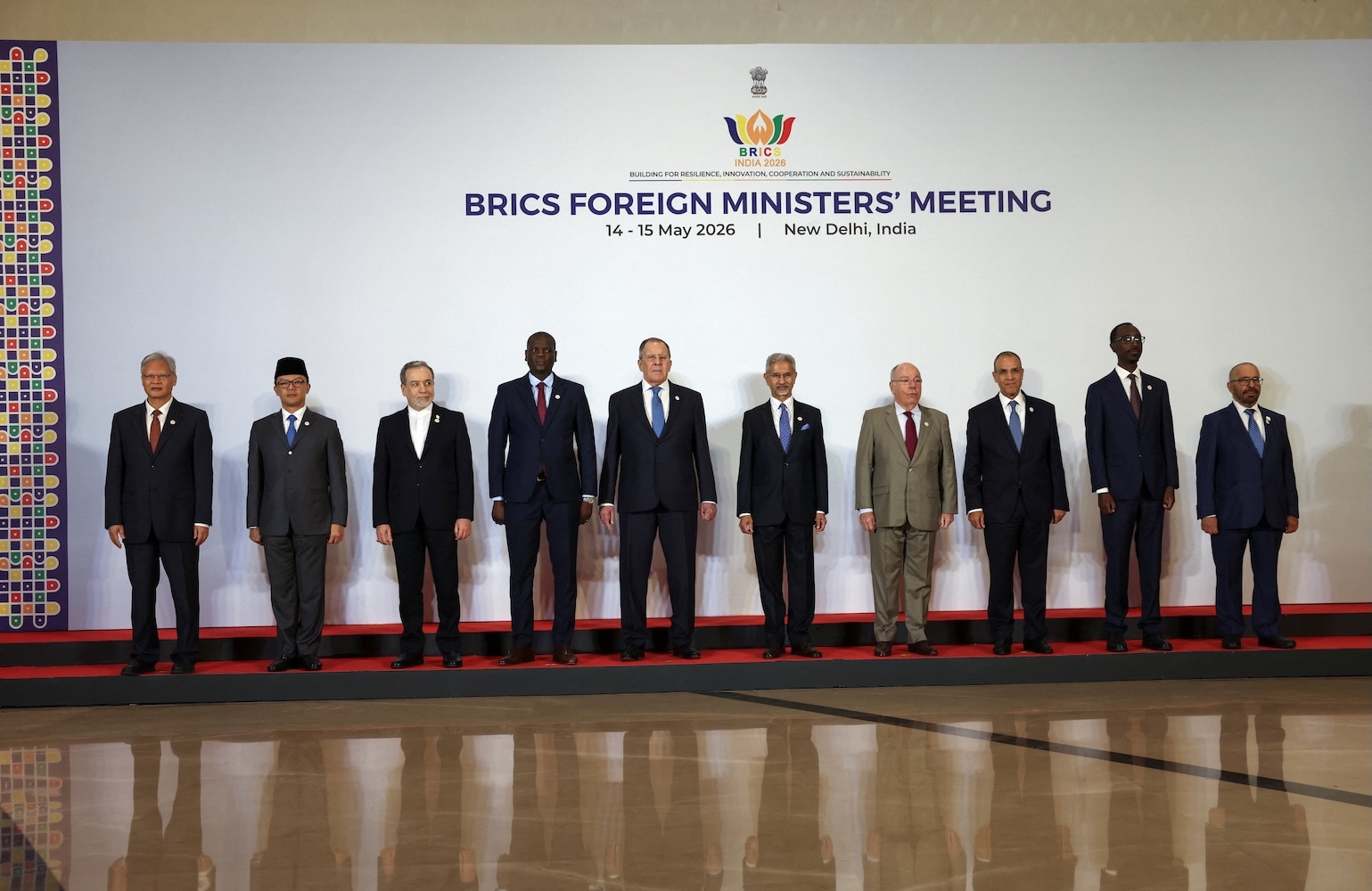
The foreign ministers gathered in India this week are not just trading handshakes and photo opportunities. They are attempting to hold together a fragile coalition of oil giants and energy-hungry giants while the Middle East burns. While the official communique will likely speak of multipolarity and shared economic goals, the reality inside the meeting rooms is far more fractured. The escalating conflict involving Iran and the constant threat to global oil supplies have placed the BRICS+ nations in an impossible position where their individual survival strategies are starting to cannibalize their collective ambitions.
Since its expansion, BRICS has transitioned from a small club of emerging economies into a massive, clashing assembly of producers and consumers. Russia and Iran need high oil prices to fund their sanctioned economies. India and China need cheap, stable energy to prevent domestic unrest and fuel industrial growth. These goals are fundamentally irreconcilable. As tensions between Israel and Iran threaten to shutter the Strait of Hormuz, the group faces a reckoning that no amount of diplomatic signaling can hide.
Crude Reality and the Price of Discord
The primary tension within the bloc is no longer about defying the US dollar. It is about the price of a barrel of oil. For New Delhi, every one-dollar increase in the price of crude expands its current account deficit and threatens the stability of the rupee. For Moscow and Tehran, that same dollar represents the lifeblood of their resistance against Western economic pressure.
This is not a theoretical disagreement. It is a structural flaw. When BRICS invited major oil exporters into the fold, it effectively invited the world’s most volatile geopolitical variables to sit at the head of the table. India’s hosting of this summit serves as a reminder that the world’s most populous nation is increasingly wary of being tethered to an energy-producing clique that benefits from global instability.
The Strait of Hormuz Trap
If Iran follows through on its periodic threats to disrupt maritime traffic in the Persian Gulf, the first victims will be its own partners. Over 20% of the world’s total petroleum consumption passes through that narrow waterway. China and India are the biggest buyers of the oil flowing out of that chokepoint.
Tehran views its control over the strait as its ultimate leverage against the West, but using that lever would effectively sabotage the economic engines of its only major allies. This creates a bizarre dynamic where Beijing and New Delhi must quietly pressure Iran to show restraint, even as they publicly support Iran’s right to sovereign defense. The internal friction is palpable. Diplomatic sources suggest that the private discussions in India have been dominated by "contingency mapping"—a polite term for figuring out how to survive if a fellow member starts a regional fire.
The Sanctioned Centrifuge
Russia and Iran are currently the most sanctioned nations on earth. They view BRICS as a lifeboat. However, the other members—Brazil, India, South Africa, and the newer entrants like Egypt and the UAE—are not ready to go down with the ship.
These nations still rely heavily on the global financial system. They want the benefits of a "non-Western" trade bloc without the "anti-Western" baggage that Moscow and Tehran bring. This creates a two-speed BRICS. On one side, you have the ideological crusaders who want to tear down the existing financial architecture. On the other, you have the pragmatists who simply want a better seat at the table and cheaper fuel.
The Rupee-Rouble Experiment Stalls
The push for "de-dollarization" has hit a brick wall of logistical reality. India tried to trade in local currencies with Russia, only to find itself holding billions of Russian roubles it couldn't spend, while Russia sat on a mountain of Indian rupees it didn't want. The experiment was a logistical nightmare.
The ministers in India are now forced to reckon with the fact that replacing the dollar requires more than just a shared hatred of the Treasury Department. It requires a level of trust and economic integration that simply does not exist between a country like Brazil and a country like Iran. Without a unified currency or a clearinghouse that doesn't trigger secondary sanctions, the talk of an alternative financial system remains a pipe dream.
Energy Security vs Global Ambition
The expansion of BRICS was supposed to signal the end of American hegemony. Instead, it has highlighted the internal contradictions of the Global South.
Consider the position of the United Arab Emirates and Saudi Arabia. They joined the group to diversify their alliances, but they remain deeply integrated with Western security frameworks. They are not interested in a BRICS that functions as a paramilitary or anti-Western alliance. Their presence in the group acts as a moderating force, much to the frustration of the bloc's more radical members.
The China Factor
Beijing remains the silent gravity well around which all these nations orbit. China is the primary customer for Russian and Iranian oil, often purchased at significant discounts due to the "sanction's tax." While this benefits China’s bottom line, it creates resentment among other members who pay closer to market rates.
China’s role as the "mediator" is also being tested. It brokered the Saudi-Iran rapprochement, but that deal is looking increasingly thin as the Gaza conflict spills over into Lebanon and Yemen. If China cannot keep its energy providers from each other's throats, the entire premise of a BRICS-led "Pax Asia" collapses.
India’s Balancing Act
New Delhi’s role as the host of this ministerial meeting is a masterclass in strategic ambiguity. India is part of the Quad—a security partnership with the US, Japan, and Australia—while simultaneously chairing meetings with some of Washington’s fiercest rivals.
Prime Minister Modi’s government has made it clear that India’s interest is India. It will buy Russian oil if it’s cheap, and it will buy American weapons if they are effective. But this "multi-aligned" strategy is becoming harder to maintain as the gap between the West and the Russia-Iran axis widens. The Indian foreign ministry is currently trying to ensure that the BRICS agenda focuses on "development" and "South-South cooperation"—vague terms that allow them to avoid taking sides in the escalating energy war.
The Hidden Logistics Crisis
Beyond the headlines of war and diplomacy lies a more concrete problem: insurance and shipping. The majority of the world’s tanker fleet and maritime insurance providers are based in the West or G7-aligned nations.
When BRICS members trade oil, they are often still reliant on the very infrastructure they claim to be bypassing. Creating a "BRICS P&I Club" (Protection and Indemnity) for shipping insurance has been discussed for years, yet nothing has materialized. Without this, even if they trade in yuan or gold, the physical movement of oil remains vulnerable to Western regulatory whims. The ministers in India know this. They know that until they can insure their own ships and protect their own sea lanes, they are still living in a world defined by the US Navy and the London insurance market.
The Myth of the Monolith
The biggest mistake analysts make is treating BRICS as a unified entity. It is not. It is a collection of rivals who happen to have a common interest in reducing Western influence.
But "reducing Western influence" is not a functional economic policy. You cannot build a global trade system on a foundation of "what we are against." You have to build it on "what we are for." Right now, the members of BRICS are for very different things.
- Russia is for survival and territorial expansion.
- China is for global industrial dominance and regional hegemony.
- India is for domestic growth and maintaining a middle-power balance.
- Iran is for regional influence and the removal of sanctions.
- Brazil is for agricultural exports and environmental leadership.
These interests do not align. In fact, they often collide. When Russian oil floods the market at a discount, it hurts the profit margins of the UAE and Saudi Arabia. When China builds infrastructure in Africa, it competes directly with Indian investments.
The Oil Weapon’s Double Edge
The threat of an oil supply disruption is the ghost at the banquet. If the conflict in the Middle East escalates to a full-scale war involving Iran, the "unity" of BRICS will evaporate in 48 hours.
China and India would be forced to seek alternative supplies from West Africa, the US, and Guyana, effectively paying a premium to the very Western entities they seek to bypass. Russia might see a temporary spike in its revenue, but it would lose its most important customers to economic collapse. The oil weapon, once thought to be a tool for the Global South to exert pressure on the North, has become a liability that threatens to tear the South apart from within.
The Nuclear Wildcard
Hovering over the energy discussion is Iran’s nuclear program. For years, BRICS members have officially supported the JCPOA and Iran's right to peaceful energy. However, a nuclear-armed Iran would fundamentally change the security calculus for the Gulf members of the bloc.
Saudi Arabia and the UAE did not join BRICS to be part of a nuclear-armed Persian umbrella. If the security situation deteriorates further, the "energy alliance" will take a backseat to national survival, likely driving these members back toward deeper security guarantees with Washington.
The Institutional Inertia
For all the talk of a new world order, BRICS remains an informal club without a permanent secretariat or a binding charter. This lack of structure was once seen as a strength, allowing for flexibility. Now, it is a glaring weakness.
The ministers in India are tasked with creating "operating procedures" for a group that has outgrown its own logic. How do you resolve a trade dispute between two members? How do you coordinate a response to a global energy shock? Currently, the answer is: you don’t. You just hope the high price of oil doesn't crash your economy before the next summit.
The photos from India will show smiling ministers and a display of solidarity. But look at the data, the shipping routes, and the currency reserves. The "BRICS unity" being touted is a thin veneer over a deep, structural anxiety. The group is effectively a house of cards built on a barrel of oil, and the wind is picking up.
The real test isn't whether they can agree on a joint statement today. It's whether they can still afford to be in the same room when the price of crude hits $120 and the tankers stop moving. For a bloc that prides itself on being the future, it is remarkably captive to the ancient volatilities of the Middle East. If the ministers leave India without a concrete mechanism to insulate their economies from the very conflicts their own members are fueling, then BRICS is not an alternative to the world order. It is just another symptom of its decay.
The era of easy growth and cheap energy that birthed the BRIC concept is dead. What remains is a hard-edged struggle for resources where "partnership" is often just a polite word for a temporary truce. India knows this. China knows this. And the oil-producing members know that their leverage is a diminishing asset in a world looking for a way out of the chaos. The meeting in India isn't the beginning of a new era; it’s a desperate attempt to manage the end of an old one.
Move your money into infrastructure and diversified energy portfolios that don't rely on the Strait of Hormuz. The "multipolar world" is currently a world of multiple, simultaneous crises, and no one in that room in India has the map to lead the way out.
:max_bytes(150000):strip_icc():focal(819x186:821x188)/Murdaugh-Family-e90854a716884d608fb6fd925e18d840.jpg)
