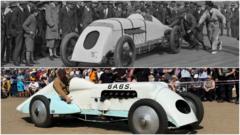
The 1926 land speed record set by J.G. Parry-Thomas in the vehicle known as Babs represents more than a chronological milestone; it is a case study in the transition from intuitive mechanical assembly to purposeful aerodynamic engineering. To analyze the return of Babs to Pendine Sands for its centenary is to evaluate the convergence of three critical vectors: aeronautical-to-automotive power transfer, the physical constraints of unpaved surfaces, and the structural risks of chain-driven propulsion systems.
The Power-to-Weight Disruption
The core advantage of Babs was not a refinement of existing automotive engines, but the brutal application of wartime aviation technology to a land-based chassis. The heart of the vehicle was the Liberty L-12, a 27-liter, 45-degree V12 aero engine.
The engineering logic followed a clear hierarchy of needs:
- Displacement as a Proxy for Torque: At a time when forced induction was in its infancy, raw displacement was the primary method for overcoming the massive rolling resistance of sand.
- Thermal Efficiency vs. Weight: The L-12 provided approximately 400 to 450 horsepower. While modern engines achieve this with a fraction of the mass, the 1920s bottleneck was metallurgical. The L-12 offered the highest power-to-weight ratio available in the post-WWI era.
- Chassis Adaptation: Parry-Thomas did not merely "drop" the engine into a car. He lowered the center of gravity by modifying the Higham Special chassis, recognizing that lateral stability is the primary variable in preventing roll at speeds exceeding 160 mph.
The mechanical trade-off was significant. The sheer size of the Liberty engine forced a high hood line, which created a massive frontal area ($A$). The aerodynamic drag force ($F_d$) increases with the square of velocity ($v$), as expressed in the equation:
$$F_d = \frac{1}{2} \rho v^2 C_d A$$
where $\rho$ is air density and $C_d$ is the drag coefficient. Because Babs had a high $C_d$ due to its exposed suspension and blunt radiator, Parry-Thomas had to rely on sheer $v^2$ output from the V12 to overcome the drag wall.
Pendine Sands as a Stochastic Surface
The choice of Pendine Sands was not aesthetic; it was an operational necessity dictated by the lack of paved infrastructure capable of supporting high-velocity testing. However, sand introduces a high degree of entropy into the velocity equation.
The surface at Pendine is a non-Newtonian fluid under certain moisture conditions. To achieve the 1926 record of 171.02 mph, Parry-Thomas had to optimize for Traction Coefficient vs. Shear Strength.
- Moisture Content: If the sand is too dry, it lacks the shear strength to provide forward thrust, leading to wheel spin.
- Saturation: If the sand is too wet, the vehicle faces "aquaplaning" risks or extreme rolling resistance as the narrow tires sink into the slurry.
- Tidal Compression: The record attempts were timed specifically for the period after the tide recedes, utilizing the natural compaction of the sand to create a temporary, high-density "highway."
The risk profile of this surface is non-linear. At 100 mph, a slight ripple in the sand is a vibration; at 170 mph, it becomes a launch trigger. Babs lacked modern suspension damping, meaning the chassis had to absorb these impulses through structural flex, a precarious strategy for a vehicle weighing over two tons.
The Chain Drive Vulnerability
One of the most criticized yet necessary design choices in Babs was the use of exposed chain drives to transfer power from the gearbox to the rear wheels. This created a critical failure point that eventually led to the fatal 1927 accident.
The logic behind the chain drive was based on the limitations of contemporary universal joints and differential housings. A shaft-drive system capable of handling the torque of a 27-liter V12 would have been prohibitively heavy and raised the center of gravity. The chain drive allowed Parry-Thomas to:
- Keep the driver's seat lower between the frame rails.
- Easily swap gear ratios by changing sprockets.
- Reduce unsprung weight on the rear axle.
However, the "chain-drive paradox" is that as velocity increases, the centrifugal force acting on the chain links increases exponentially. Any oscillation or debris—common on a beach—could cause the chain to whip or snap. In the high-speed regime, a snapped chain acts as a high-velocity projectile. This mechanical bottleneck highlights the era's primary engineering constraint: power generation had outpaced material science and drivetrain safety.
Restoration as Forensic Engineering
The burial of Babs in the dunes for 42 years after the 1927 crash created a unique chemical environment. The restoration led by Owen Wyn Owen was not a cosmetic exercise but an act of forensic engineering.
The saline environment of Pendine Sands accelerated galvanic corrosion. When the car was exhumed in 1969, the structural integrity of the aluminum components and steel frame had been compromised. The restoration process required:
- Metallurgical Analysis: Determining which original components could sustain the vibrational loads of a running engine.
- Reverse Engineering: Many components of the Higham Special were bespoke; without original blueprints, the team had to use the corroded remnants to calculate original tolerances.
- Preservation of Pathina: Balancing the need for a functional machine with the historical requirement to show the "scars" of its burial.
The fact that Babs can still run at Pendine today is a testament to the over-engineering of the 1920s. The components were designed with massive safety factors because the precise limits of the materials were unknown.
The Shift from Mechanical to Digital Speed
Comparing the 171 mph record of 1926 to modern attempts reveals the total shift in the land speed record paradigm.
| Variable | 1926 (Babs) | Modern (Bloodhound LSR/Project Invictus) |
|---|---|---|
| Power Source | Internal Combustion (Piston) | Jet/Rocket Turbine |
| Stability Logic | Weight and CG | Active Aero and Downforce |
| Surface | Compressed Sand | Dried Alkali Lake Beds |
| Control System | Mechanical Linkage | Fly-by-wire / Computational Fluid Dynamics |
In 1926, the "sensor" was the driver’s sensory input. Parry-Thomas had to feel the slip angle of the tires through the steering column and adjust the throttle based on the audible pitch of the L-12. Today, data acquisition systems sample thousands of variables per second, removing the "stochastic" element that defined the Babs era.
The Economic and Cultural Valuation of the Centenary
The return of Babs to the beach is a strategic move in "Heritage Branding." For the region of Pendine and the museum infrastructure, the car serves as a primary asset in a niche tourism market.
The "Value of Authenticity" in the automotive world has reached a peak. A replica of Babs would hold negligible interest; the original chassis, containing the very metal that was submerged in the sand for four decades, carries a "historical premium." This premium is driven by the scarcity of "heroic era" machines that possess a documented, uninterrupted provenance from record-breaking to burial to resurrection.
Operational Risks of Continued Exhibition
Moving a 100-year-old record-breaking vehicle from a controlled museum environment back to a corrosive beach environment involves a calculated risk assessment.
- Chloride Contamination: Even a brief exposure to sea air initiates the corrosion cycle in vintage steel.
- Structural Fatigue: Loading and unloading a vehicle of this mass puts stress on the frame that it was not designed to handle in its aged state.
- Public Safety: Managing the exclusion zones on a public beach for a running demonstration requires a rigorous safety protocol, as vintage brakes and steering lack the redundancy of modern systems.
The decision to run the car despite these risks is a prioritization of "Living History" over "Static Preservation." It acknowledges that the true value of Babs is not in its form, but in its function—the visceral roar of a 27-liter aero engine that, for a brief window in 1926, made Parry-Thomas the fastest human on earth.
The strategic imperative for the future of Babs involves a transition from active running to high-fidelity digital preservation. As metallurgical fatigue makes further beach runs increasingly hazardous, the curators must utilize 3D laser scanning and digital twin technology to capture the mechanical state of the vehicle. This ensures that even when the physical components become too fragile for the sand, the engineering logic of the 1926 record remains accessible for analysis. The centenary serves as the logical inflection point for this transition: one final demonstration of mechanical force before the vehicle is retired to a state of permanent, climate-controlled observation.