The air inside a standard office building has a specific, synthetic taste. It is the flavor of recycled oxygen, static electricity, and the slow, rhythmic hum of a server room cooling itself down. For years, the global workforce accepted this as the price of productivity. We traded the sun for the steady flicker of a 40-watt bulb. We swapped the smell of rain on pavement for the scent of industrial-grade carpet cleaner.
Then, everything changed. We learned that we could work from anywhere, but "anywhere" quickly became the kitchen table, the sofa, or a cramped corner of a bedroom. The walls simply moved closer. Expanding on this idea, you can find more in: The No Ball Games Sign Is Not Your Problem.
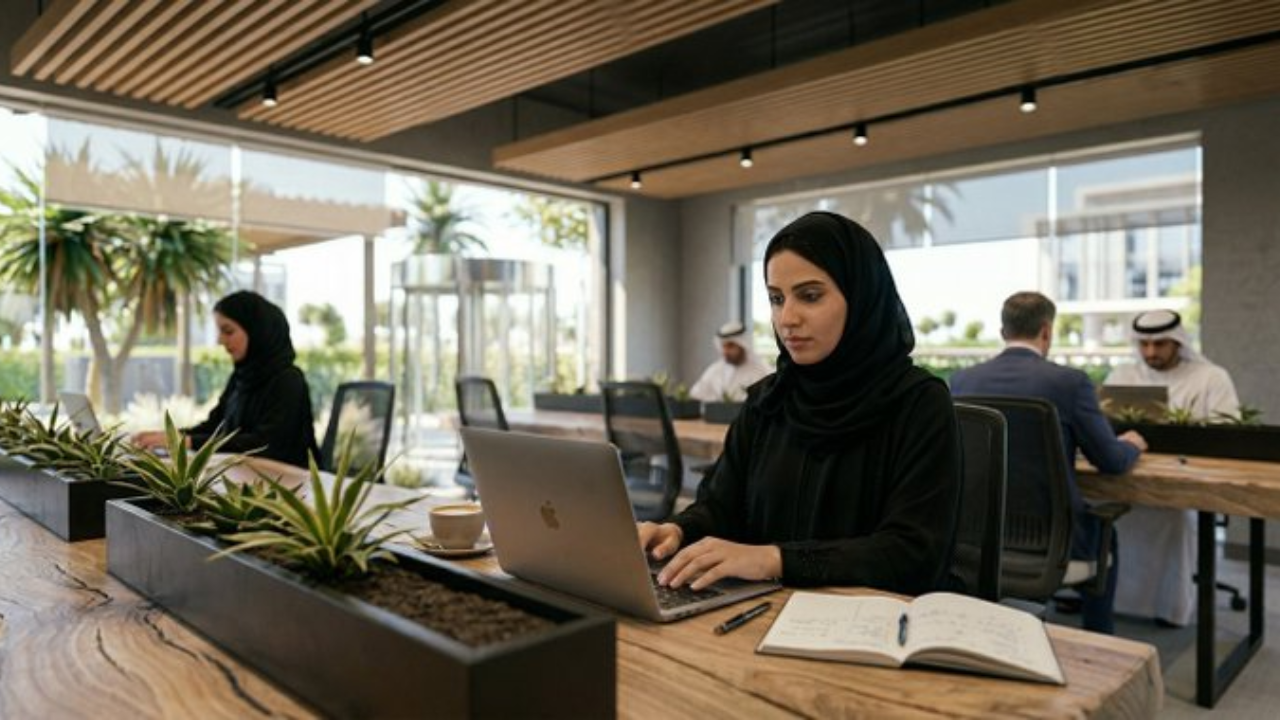
Dubai, a city built on the audacity of turning sand into skyscrapers, recently looked at its manicured green spaces and saw something more than just a place to jog or walk a dog. They saw an escape hatch. The "Work from Park" initiative isn't a minor infrastructure update. It is a fundamental rejection of the idea that high-level output requires four walls and a ceiling.
Consider Sarah. She is a fictional composite of the modern digital nomad, a software architect who has spent three years staring at a gray partition. Her back aches from a chair that promised "ergonomic excellence" but delivered only stiffness. Her eyes are perpetually dry. One Tuesday morning, she packs her laptop, not into a briefcase, but into a backpack. She doesn't head toward the glass towers of DIFC. Instead, she heads toward the shade of a Ghaf tree in a public park. Analysts at Refinery29 have provided expertise on this trend.
Under the new initiative, Sarah finds a dedicated workspace integrated into the landscape. There is high-speed Wi-Fi that doesn't drop when a cloud passes. There are solar-powered charging stations hidden in the curves of modern benches. The technical barriers to remote work—the hunt for a plug, the shaky hotspot, the glare on the screen—have been engineered out of existence.
Dubai is betting on the fact that the human brain operates differently when it can see the horizon.
The Biological Case for Green Space
Scientific research into "biophilia" suggests that humans possess an innate tendency to seek connections with nature. When we are surrounded by greenery, our cortisol levels—the primary marker of stress—begin a steady decline. Our heart rates stabilize. This isn't just a "nice to have" perk; it is a physiological reset.
In a traditional office, the brain is constantly filtering out distractions: the clatter of a printer, the murmur of a colleague's phone call, the harsh blue light of the monitor. This requires a significant amount of "directed attention," which is a finite resource. When that resource is depleted, we experience brain fog. We make mistakes. We get cranky.
Contrast this with the "soft fascination" provided by a park. The movement of leaves in the wind, the pattern of shadows on the grass, the distant sound of water—these things capture our attention without demanding it. This allows the brain's directed attention mechanisms to recharge. By moving the "office" to the park, the city is effectively providing a natural cognitive enhancer to every citizen with a laptop.
Engineering the Great Outdoors
Turning a public park into a viable work hub is an immense technical challenge. You cannot simply put a router in a bush and call it a day. The heat of the Arabian Peninsula is a formidable opponent. To make this work, the initiative relies on smart design that balances comfort with connectivity.
The workstations are strategically placed to take advantage of natural cooling corridors. Advanced materials are used for the furniture to ensure they don't become heat sinks under the midday sun. The Wi-Fi infrastructure is built on a mesh network that provides seamless coverage across vast acreages, ensuring that a video call doesn't stutter just because you decided to move from a bench to a beanbag.
But the real magic lies in the power source. Dubai is utilizing solar technology to keep these hubs off the traditional grid. It is a closed loop of productivity: the same sun that once drove workers indoors is now the very thing powering their ability to stay outside.
The Invisible Stakes of Social Architecture
There is a deeper, more subtle shift happening here. For decades, the "park" and the "office" were diametrically opposed. One was for leisure; the other was for labor. By blurring these lines, the city is addressing a growing crisis of urban isolation.
In the old model, you commuted in a pod (a car or a train) to a pod (a cubicle) and then returned to a pod (an apartment). You could live in a city of millions and never truly interact with a soul.
When you work in a public park, you are part of a shared ecosystem. You see the retiree reading a newspaper. You see the parents with toddlers. You see the birds. You are reminded that you are a member of a living, breathing community, not just a line item on a spreadsheet. This "passive social contact" is the glue that holds a society together. It mitigates the loneliness that has become an epidemic in the digital age.
The initiative also levels the playing field. Not every worker has a spacious home office or a membership to a high-end co-working space. For many, the "home office" is a noisy, crowded reality. By turning public parks into premium workspaces, the city is democratizing the "view from the corner office." Every resident, regardless of their housing situation, now has access to a world-class work environment.
The Problem with the Old Way
We have been conditioned to believe that if we aren't suffering slightly, we aren't working hard. There is a strange, lingering guilt associated with being comfortable. We feel that we must be tethered to a desk to be "professional."
But the data tells a different story. Productivity isn't measured by hours spent in a chair; it is measured by the quality of the output. A worker who spends four hours in a state of deep, relaxed focus in a park will almost always outperform a worker who spends eight hours fighting through a headache in a windowless room.
The traditional office was designed for the industrial age, a time when workers needed to be physically present to operate machinery or move paper. In the information age, our primary "machinery" is our minds. And the mind is a finicky instrument. It requires inspiration. It requires movement. It requires the occasional glimpse of a butterfly to solve a complex coding problem.
A New Urban Rhythm
Imagine a workday that begins with a walk through a botanical garden. You set up your station near a fountain. The air is cool, and the Wi-Fi is blazing fast. You hammer out your most difficult tasks by noon, fueled by fresh air and natural light.
Lunch isn't a sad sandwich eaten over a keyboard. It is a stroll to a nearby food truck or a picnic on the grass. In the afternoon, you join a brainstorming session. Your team isn't huddled in a stale boardroom; you are sitting in a circle on a shaded deck. The ideas flow more freely because the environment feels expansive.
This isn't a vacation. It is a more intelligent way to live.
The "Work from Park" movement is a signal that the era of the "office drone" is coming to a close. It is an admission that the environments we build should serve our humanity, not the other way around. It recognizes that we are biological creatures who happened to invent computers, and that we function best when those two worlds are in harmony.
The skyscrapers aren't going anywhere. They will always have their place in the skyline. But the future of work isn't just about reaching higher into the clouds. It is about grounding ourselves back in the earth. It is about realizing that the most advanced technology in the world is useless if it keeps us trapped in a box.
The door is open. The signal is strong. The grass is waiting.