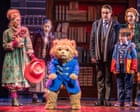
The commercial triumph of Paddington: The Musical at the Olivier Awards is not an anomaly of critical sentiment but the result of a precise alignment between intellectual property (IP) scalability and the shifting risk-reward ratios of West End production. While traditional theater criticism focuses on the "charm" or "warmth" of the production, an analytical deconstruction reveals a sophisticated execution of the High-Trust IP Framework. By leveraging a brand with 98% global recognition and neutralizing the inherent risks of live performance through high-fidelity technical engineering, the production has established a new benchmark for family-oriented theatrical assets.
The victory signifies the maturation of the "All-Ages Commercial Vehicle," a sector that historically struggled to balance high-cost puppetry with the unit economics of mid-sized venues. This success is built upon three operational pillars: demographic bridging, structural sentimentality, and the mitigation of "adaptation friction." In other updates, take a look at: The Invisible Line Between Peace and the Empty Plate.
The Demographic Bridging Mechanism
The financial viability of a West End musical depends on the Multigenerational Conversion Rate (MCR). Unlike niche dramas or adult-skewing comedies, Paddington operates as a four-quadrant asset. The production maximizes revenue by solving the "Chaperone Boredom" bottleneck, a common failure point in children’s entertainment where the purchasing adult (the primary economic actor) perceives the ticket price as a sunk cost for childcare rather than a personal utility.
The adaptation achieves high MCR through two distinct psychological layers: Investopedia has analyzed this critical issue in great detail.
- Legacy Resonance: For the 40–60 age demographic, the character triggers nostalgia-based endorphin release linked to Michael Bond’s original texts.
- Visual Spectacle: For the 4–12 age demographic, the production utilizes advanced animatronics and physical comedy to maintain engagement cycles that mirror short-form digital media.
By satisfying both cohorts, the production increases the probability of repeat attendance and high-margin merchandise upsells, which often constitute 15–20% of the total per-capita spend in this category.
Mapping Adaptation Friction
The primary risk in adapting a beloved literary or cinematic character is Cognitive Dissonance Friction (CDF). This occurs when the physical manifestation on stage fails to match the "mental model" held by the audience. For Paddington, this risk was particularly high due to the recent success of the film franchise, which set a high bar for visual effects.
The Olivier-winning production neutralized CDF through a strategy of Aesthetic Continuity. Instead of attempting a literal recreation of CGI, the creative team opted for an "Enhanced Stylization" approach. This involves:
- Tactile Verisimilitude: Using physical textures (fur, wood, fabric) that convey a sense of "realness" that CGI cannot replicate in a 3D space.
- Scale Distortion: Intentionally manipulating the size of the Paddington puppet relative to human actors to emphasize his vulnerability, thereby automating audience empathy without requiring complex dialogue.
This technical choice reduces the "Uncanny Valley" effect, ensuring that the audience’s emotional labor is spent on the narrative rather than on reconciling the character's appearance.
The Cost Function of Mechanical Storytelling
The Olivier Awards for technical achievement highlight the heavy capital expenditure (CAPEX) required to compete in the modern West End. The Paddington production functions as a high-performance machine where the "cost of failure" is magnified by the complexity of the puppets.
The production's operational success can be viewed through the lens of The Reliability Equation:
$$R(t) = e^{-\lambda t}$$
Where $R$ is the probability of a show running without technical failure, and $\lambda$ is the failure rate of the mechanical components. In high-stakes theater, the redundancy of puppet operators and the modularity of the set design are critical to maintaining the performance schedule. A "Dark Night" (a canceled performance due to technical issues) in a 1,000-seat theater can result in a direct revenue loss exceeding £60,000, excluding long-term brand damage.
The "Musical" designation adds a further layer of complexity. Music acts as a pacing regulator, forcing the mechanical elements of the show to synchronize with a fixed temporal grid. This reduces the variability of the performance, creating a "productized" experience that is identical every night—a necessity for a global brand that plans to export the production to international markets like Broadway or Tokyo.
Sentimentality as a Value Proposition
Critiques of the show often highlight its "kindness," but from a strategic perspective, kindness is a Risk Mitigation Layer. In an increasingly fragmented and polarized cultural market, "radical kindness" serves as a universal lubricant for global distribution. It minimizes the risk of cultural "misfire" when the IP is moved across different geographic territories.
The structural sentimentality of the production follows a predictable but highly effective Tension-Release Cycle:
- The Displacement Phase: Paddington arrives as an outsider (High Tension/High Empathy).
- The Institutional Friction: The character interacts with rigid British systems (The Brown family, the legal system, etc.).
- The Harmonic Resolution: The system adapts to the character rather than forcing the character to assimilate (Low Tension/Catharsis).
This cycle is a potent psychological tool that ensures high "Exit Sentiment" scores, which are the primary driver of Word-of-Mouth (WoM) marketing. In the era of algorithmic social media, a high Exit Sentiment is more valuable than a positive critical review in a legacy broadsheet.
Competitive Positioning and the Award Signal
The Olivier Awards serve as a market signal to investors and international promoters. Winning "Best New Musical" or specific technical categories functions as a "Quality Seal" that de-risks the asset for future iterations.
In the competitive landscape of the West End, Paddington successfully out-maneuvered legacy revivals and avant-garde original works by positioning itself as a Stability Asset. For theater owners, a show like Paddington offers:
- Predictable Occupancy: High baseline demand regardless of the specific lead actor's fame.
- Merchandising Synergy: A pre-existing supply chain of plush toys and apparel.
- Duration Longevity: A narrative that does not age or become "dated" as quickly as politically charged or contemporary-set dramas.
The second limitation of this model is the "IP Ceiling." While Paddington is a dominant force, the reliance on pre-existing IP creates a bottleneck for original creative development within the industry. However, from a pure capital-allocation perspective, the Olivier sweep validates the shift toward high-concept, IP-driven "spectacle" as the only sustainable path for large-scale musical theater.
Technical Execution of the "Hard Stare"
The specific mention of the "Hard Stare" in the production's discourse is more than a nod to the source material; it is a masterclass in Micro-Expression Amplification. On a stage, subtle facial movements are lost to anyone beyond the first five rows. The production team solved this through "Physicalized Intent."
When the Paddington puppet performs the "Hard Stare," the entire lighting rig and soundscape shift to amplify the moment. This is a deployment of Multimodal Reinforcement, where the lack of facial mobility in the puppet is compensated for by environmental cues. This ensures that the comedic beat "lands" for every seat in the house, maintaining the value of the ticket price for the upper-gallery attendees.
Strategic Forecast and Market Expansion
The success of Paddington: The Musical will trigger a surge in "High-Fidelity Puppet IP" investments. We can expect a contraction in the development of "Mid-Tier Original Musicals" (those with budgets between £3m–£6m) as capital migrates toward "Mega-IP Assets" (£10m+) that offer the same demographic bridging seen here.
The logical next step for the Paddington entity is the implementation of a Hub-and-Spoke Distribution Model. This involves:
- The Flagship (London): A permanent residency that serves as the "source of truth" for the brand.
- The Touring Units: High-efficiency, scaled-down versions optimized for 2-week residencies in regional markets.
- The Immersive Spin-offs: Utilizing the set designs and puppet tech for smaller-scale, non-musical "experiences" in high-footfall tourist zones.
To maintain this momentum, the production must resist "Feature Creep"—the tendency to add complexity in subsequent iterations that does not contribute to the MCR. The current iteration's strength lies in its structural simplicity. The strategic play is to treat the production not as a piece of art, but as a modular software package that can be localized and deployed with minimal variance.
The Olivier Awards have not just celebrated a "charming" bear; they have coronated a highly optimized commercial engine. The theatrical industry must now grapple with the reality that the most successful "art" of the decade is that which most closely resembles a perfectly engineered consumer product.
For producers looking to replicate this success, the directive is clear: identify an IP with high legacy resonance, solve the demographic bridge, and invest heavily in the tactile technology required to neutralize adaptation friction. The era of the "Hard Stare" is also the era of hard data.