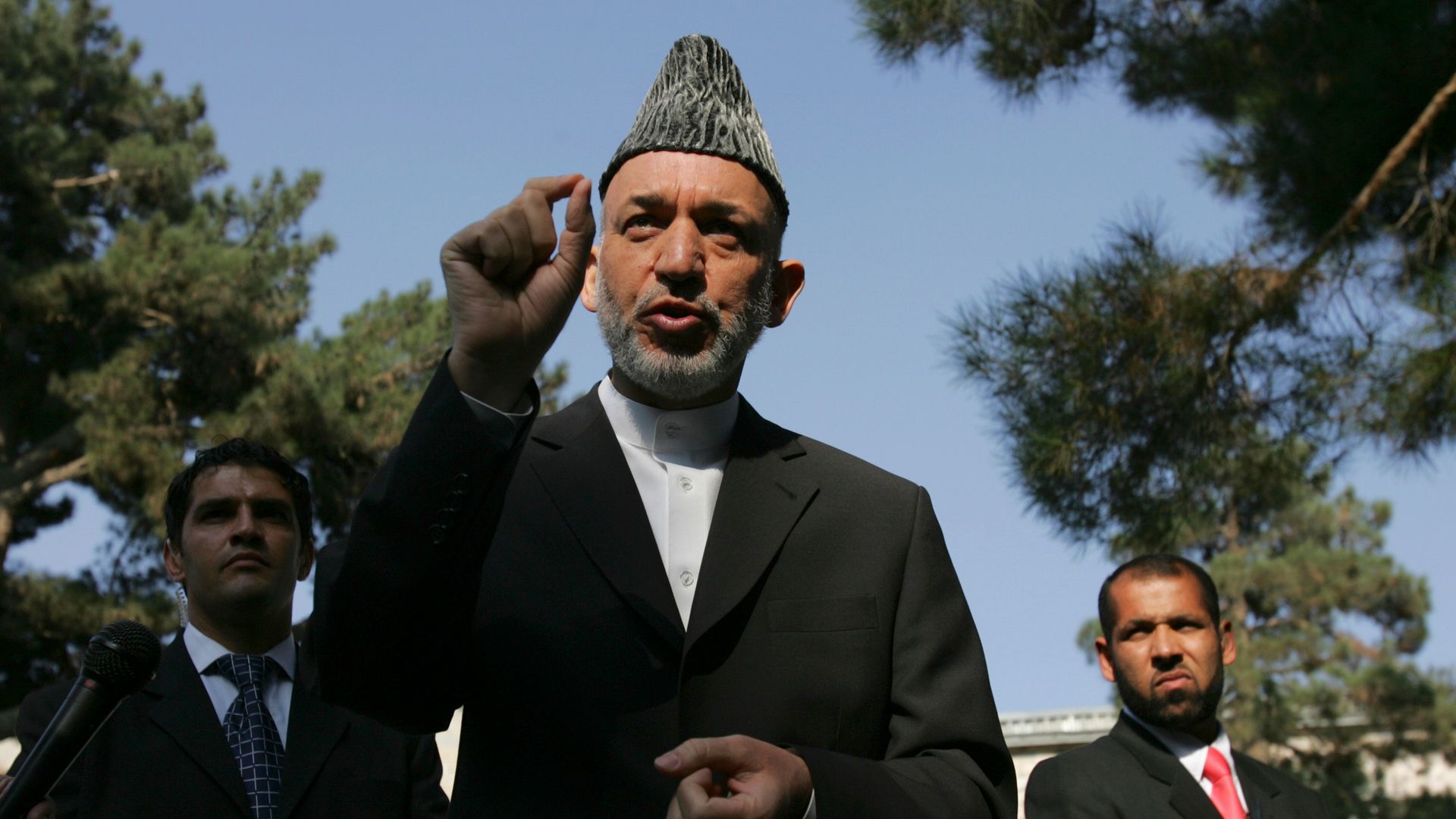
Hamid Karzai has never been one to mince words when it comes to the complex, often bloody relationship between Kabul and Islamabad. The former Afghan president recently leveled a heavy accusation, claiming the Pakistani government is actively working to "create anarchy" within Afghanistan. This isn’t just a retired politician seeking relevance. It is a calculated warning about a regional power play that has shifted from covert influence to overt destabilization. Karzai’s thesis suggests that Pakistan views a chaotic Afghanistan as more manageable than a stable, independent neighbor that might align with regional rivals.
The geopolitical friction between these two nations centers on the Durand Line, the porous 2,600-kilometer border that remains a flashpoint for ethnic tensions and security lapses. For decades, Islamabad has pursued a policy often described as "strategic depth." The logic is cold and pragmatic. By ensuring Afghanistan remains under the influence of friendly—or at least distracted—entities, Pakistan hedges against its perceived existential threat from India. However, Karzai argues this strategy has curdled into a deliberate attempt to dismantle Afghan social and political cohesion.
The Mechanics of Managed Instability
Anarchy is rarely an accident in high-stakes diplomacy. It is a tool. When Karzai speaks of Pakistan fostering chaos, he is pointing to the tactical use of militant proxies and the weaponization of trade routes. By fluctuating the openness of border crossings like Torkham and Chaman, Islamabad exerts immediate economic pressure on the Afghan populace. This isn't just about customs duties. It is about demonstrating who controls the lifeline of the Afghan economy.
The "how" of this destabilization involves a sophisticated mix of military posturing and intelligence operations. Reports frequently surface of cross-border shelling and the sanctuary provided to various factions that oppose the current administration in Kabul. Even with the Taliban in power—a group historically backed by Pakistan—the relationship has soured. The student has become the master, or at least a very rebellious subordinate. Islamabad now finds itself grappling with a Taliban government that refuses to recognize the Durand Line and provides a base for the Tehrik-i-Taliban Pakistan (TTP), which conducts strikes inside Pakistani territory.
The Blowback Factor and Regional Fallout
Karzai’s accusations highlight a massive miscalculation in Pakistani foreign policy. If the goal was to create a weak neighbor, they succeeded too well. A fractured Afghanistan is a breeding ground for radicalism that does not respect international borders. The fire Islamabad helped light in its neighbor's house is now leaping across the fence. We are seeing an increase in domestic terror attacks within Pakistan’s borders, specifically targeting security forces in Khyber Pakhtunkhwa and Balochistan.
This is the "why" behind Karzai's urgency. He understands that a descent into total anarchy doesn't just hurt the Afghans; it creates a vacuum that global terror franchises are all too happy to fill. The regional players—China, Russia, and Iran—are watching with increasing alarm. China, in particular, requires stability to protect its massive investments in the China-Pakistan Economic Corridor (CPEC). A chaotic Afghanistan makes the entire region a "no-go" zone for the Belt and Road Initiative.
The Trade Weapon
Economics is the quietest form of warfare. Afghanistan is landlocked. It relies on Pakistani ports for the majority of its international trade. By frequently changing transit trade rules or stalling thousands of containers at Karachi port, Pakistan can trigger instant inflation in Kabul. This economic strangulation fuels public resentment against the Afghan government, contributing to the very "anarchy" Karzai warns about.
- Customs delays: Perishable goods rot at the border, bankrupting Afghan farmers.
- Visa restrictions: Limiting the movement of people prevents the cross-pollination of business and education.
- Currency manipulation: The flux of Pakistani Rupees in Afghan markets creates a volatile shadow economy.
A Legacy of Failed Interventions
Karzai knows this cycle better than anyone. During his presidency, he spent years trying to balance American demands with Pakistani interference. He saw firsthand how intelligence agencies played both sides of the "War on Terror." His current stance is a reflection of a man who realizes that as long as Afghanistan is viewed as a chessboard for its neighbors, it will never be a home for its people.
The tragedy of the situation is that the Afghan people are caught between a repressive domestic regime and a predatory neighbor. Karzai’s critique isn't a defense of the Taliban; it's a defense of Afghan sovereignty. He argues that even a flawed Afghan state is better than a territory dissolved into warring fiefdoms managed by foreign handlers.
The Path Toward Permanent Friction
There is no easy fix here because the distrust is foundational. Pakistan fears an ethno-nationalist movement that unites Pashtuns on both sides of the border. Afghanistan fears a neighbor that will never allow it to have an independent foreign policy. This is a zero-sum game played with the lives of millions.
To move beyond the cycle of anarchy, there must be a fundamental shift in how Islamabad views its security. As long as "strategic depth" involves the destabilization of Kabul, the border will remain a zone of perpetual conflict. Karzai has thrown down the gauntlet. He has named the architect of the current chaos, but naming the problem is only the first step in a long, grueling process of reclamation.
The international community must stop viewing this as a local border dispute and start seeing it as the primary engine of regional instability. Sanctions, diplomatic pressure, and redirected aid are the only levers left. If Pakistan continues to prioritize a weak Afghanistan over a stable one, it may find that the anarchy it sought to export has finally come home to stay.
Monitor the upcoming regional summits in Tashkent and Doha for any shifts in transit trade agreements, as these will be the first indicators of whether Islamabad is willing to de-escalate or if it intends to tighten the noose.
.png?1683568805)