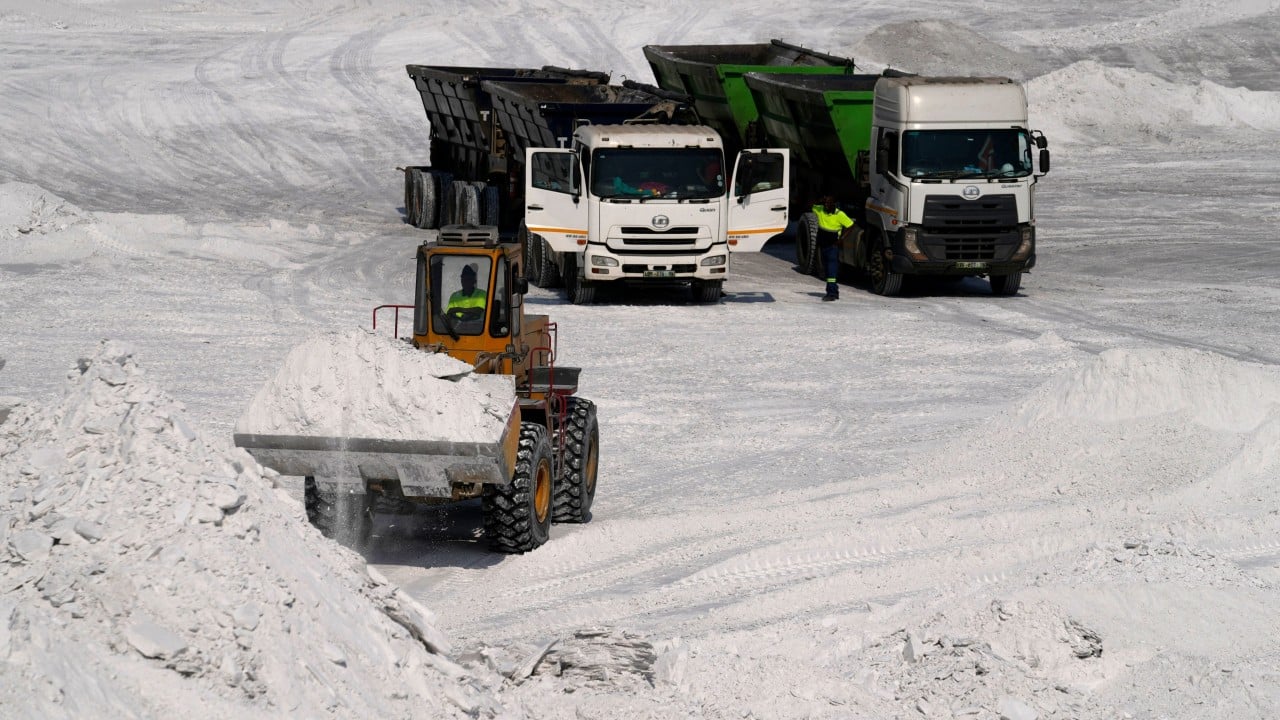
Holding a smartphone feels like holding a piece of glass and aluminum, but you are actually gripping a handful of rare earth elements that were likely pulled from a hole in the ground thousands of miles away. If those elements disappeared tomorrow, your screen would go dark. Your car’s electric motor would seize. The precision guidance systems in a fighter jet would become paperweights.
For decades, we ignored where the dirt came from. We looked at the shiny finished product and forgot the messy, toxic, and complicated process of extraction. Now, the United States is waking up to a reality where a single geopolitical rival—China—holds the leash on the very materials required for a high-tech future. Breaking that grip isn't just about trade policy. It is a desperate, messy scramble that requires the U.S. to shake hands with people it used to ignore. Learn more on a related issue: this related article.
The Weight of Seventeen Stones
Think of a man named Elias. He isn't real, but his struggle is. Elias works in a small laboratory or perhaps a government procurement office. He stares at a periodic table and realizes that seventeen specific elements—the Lanthanides, plus Scandium and Yttrium—are the invisible oxygen of his industry. These aren't actually "rare" in the sense that gold is rare; you can find them in many places. The problem is that they are rarely found in concentrations high enough to mine profitably, and they are incredibly difficult to separate from one another.
[Image of rare earth elements periodic table] Additional journalism by Reuters highlights similar views on the subject.
China currently controls about 60% of the world's rare earth production and a staggering 90% of the processing. Processing is the true bottleneck. It involves a grueling series of chemical baths, using acids that leave behind radioactive waste and scorched earth. For thirty years, the West was happy to let China handle the environmental bill. We got the cheap magnets; they got the poisoned groundwater. It was a convenient arrangement until the wind changed.
Now, the math has shifted. When China hinted at restricting exports of these minerals, the chill felt in Washington wasn't just cold—it was subzero.
Pragmatism Over Purity
In the old days of diplomacy, the U.S. might have demanded certain democratic reforms or human rights guarantees before signing a major trade deal. That was the era of "ideology first." But when you are staring down a supply chain crisis that could cripple your military-industrial complex, your moral compass starts to point toward whoever has the biggest pile of Neodymium.
We are seeing the birth of a new, gritty pragmatism. The U.S. State Department is currently courting nations it previously kept at arm's length. They are scouring the globe for "friendly" dirt. This means looking at Vietnam, Brazil, and parts of Africa with a fresh, less judgmental eye.
Consider the Mineral Security Partnership. It sounds like a dry bureaucratic committee. In reality, it is a high-stakes club where the U.S. and its allies are trying to outbid China for the future. They are promising investment and infrastructure to developing nations in exchange for one thing: a guaranteed slice of the mineral pie. The message is clear: we will worry about the politics later; right now, we need the rocks.
The Mountain Pass Ghost
To understand how we lost the lead, look at Mountain Pass. Tucked away in the California desert, it was once the world’s premier source of rare earths. It should have been a fortress of American self-reliance. Instead, it became a cautionary tale of globalization gone wrong.
Environmental regulations tightened. Labor costs rose. Meanwhile, China subsidized its own industry, flooded the market, and crashed the price of rare earths. Mountain Pass couldn't compete. It went bankrupt. At one point, the only way the mine could survive was by shipping its raw ore to China for processing. We were literally digging up our own resources and handing them to our competitor because we had forgotten how to refine them ourselves.
Reviving Mountain Pass has become a symbol of the American comeback. But you can't just flip a switch and undo thirty years of atrophy. The skills have vanished. The chemists who knew the secrets of solvent extraction have retired. The infrastructure is rusted. Rebuilding a supply chain is like trying to regrow a forest that was clear-cut decades ago. It takes time, and time is the one thing the U.S. doesn't have.
The Hidden Cost of a Green Future
There is a deep, uncomfortable irony at the heart of the "Green Revolution." To build a world powered by wind and sun, we have to engage in some of the most destructive mining on the planet. An electric vehicle (EV) requires six times the mineral inputs of a conventional car. A single offshore wind turbine needs two tons of rare earth magnets to function.
We want the clean air, but we are terrified of the dirty work.
This creates a "Not In My Backyard" (NIMBY) paradox. Every politician wants an EV factory in their district, but almost none of them want a rare earth processing plant next door. The chemical tailing ponds required to separate Terbium from Dysprosium are not exactly tourist attractions. This is why the U.S. is looking abroad. It is easier to fund a mine in a distant country than to navigate the legal and social minefield of opening one in Nevada or Maine.
Pragmatic diplomacy is essentially an admission of guilt. It is an admission that we cannot meet our climate goals or our national security needs while maintaining a pristine, isolated economy. We are forced to be part of the world, for better or worse.
The Magnet That Pulls the Strings
Why does a tiny magnet matter so much? It’s about efficiency. Rare earth magnets are incredibly powerful for their size. This allows motors to be smaller, lighter, and more powerful. In a cruise missile, that weight savings means more range. In a smartphone, it means more room for a battery.
China understands this better than anyone. They aren't just selling dirt; they are selling the magnets. By moving up the value chain, they ensure that the world isn't just dependent on their mines, but on their factories. If you want the best magnets, you go to China. If you go to China, you play by their rules.
The U.S. response is to try and build a "circular" economy. This involves recycling old electronics to reclaim the minerals. Imagine a world where your old iPhone isn't just trash, but a tiny mine waiting to be harvested. It sounds poetic. It is also incredibly difficult. The amount of energy and effort required to pull a fraction of a gram of Neodymium out of a discarded earbud is currently more expensive than just digging a new hole in the ground.
Money. It always comes back to the money.
Shifting Alliances in the Dark
The new map of the world isn't drawn with borders; it’s drawn with geological deposits. We are seeing the rise of "minero-states." Mongolia, for instance, sits on vast untapped reserves. Suddenly, U.S. officials are making frequent trips to Ulaanbaatar. They aren't there for the scenery. They are there because Mongolia could be the pressure valve that breaks the Chinese monopoly.
But China isn't sitting still. They have spent the last two decades building roads, ports, and railways across Africa and South America through the Belt and Road Initiative. They didn't do this out of the goodness of their hearts. They did it to secure the rights to the minerals underneath the soil.
The U.S. is playing catch-up in a game where the opponent has already rounded third base. This is why the diplomacy feels so hurried, so pragmatic. There is no time for the usual lectures on governance. The conversation has shifted to: "What can we build for you so we can buy your rocks?"
The Fragility of the Status Quo
We live in a world built on the assumption that the supply chain will always flow. We assume that when we click "buy," a complex machine of ships, trains, and refineries will hum to life and deliver our desires. But that machine is brittle. It is held together by seventeen elements and a very thin layer of geopolitical stability.
The U.S. pivot toward mineral-based diplomacy is a sign that the era of easy globalization is over. We are entering a period of "friend-shoring," where we only trade with people we trust—or people we can't afford to ignore. It is a world where the dirt under our feet is more valuable than the ideas in our heads.
Behind every headline about trade wars and tariffs, there is a person like Elias, looking at a list of minerals and wondering if the lights will stay on. The stakes are invisible until they aren't. We are learning, painfully and slowly, that the high-tech future isn't made of code and cloud computing. It is made of rock, acid, and the willingness to do whatever it takes to keep the magnets spinning.
The ground is shifting. You can feel it if you stand still long enough. We used to fight over oil, a liquid that burns and vanishes. Now we are fighting over stones that last forever and power the things that think for us. It’s a different kind of hunger. It’s a different kind of war. And in this fight, the most important tool isn't a weapon—it's a shovel and a handshake.



