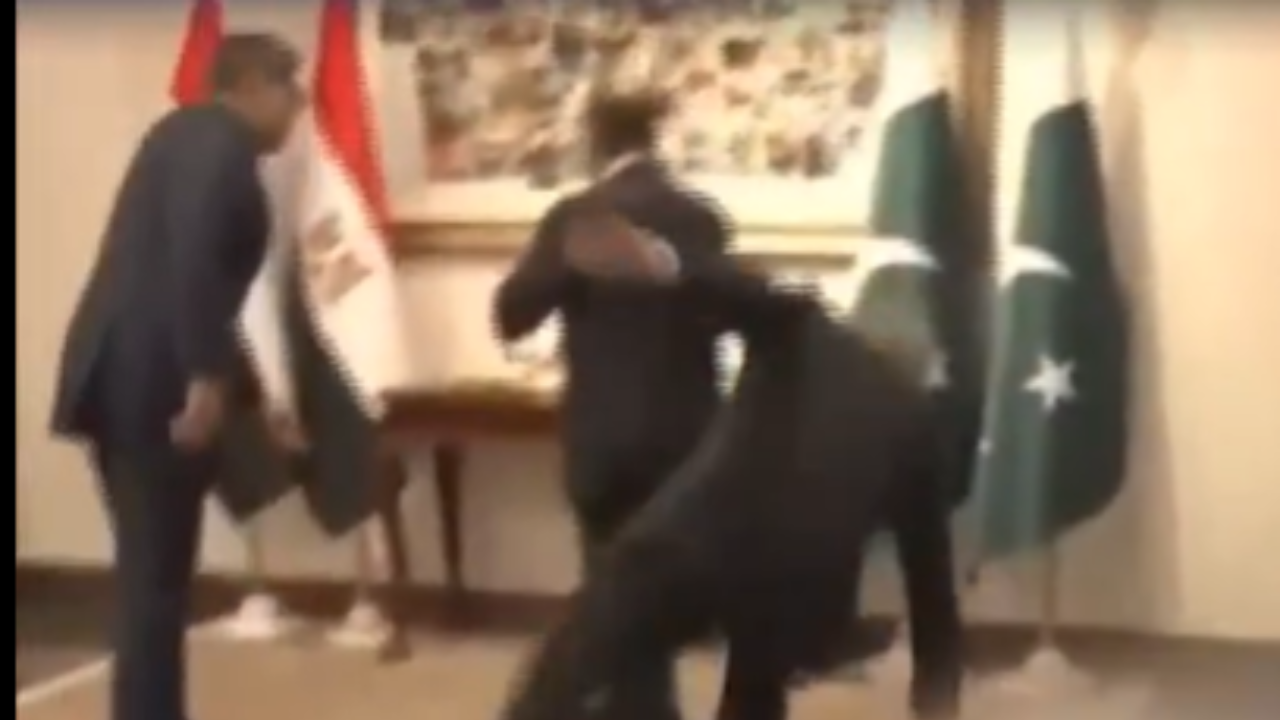
The internet loves a stumble. When Pakistan’s Deputy Prime Minister and Foreign Minister, Ishaq Dar, lost his footing while welcoming Egyptian Foreign Minister Badr Abdelatty, the digital world did what it does best: it laughed, it memed, and it missed the entire point.
Media outlets rushed to frame the incident as a "diplomatic gaffe" or a "viral embarrassment." They focused on the optics of a senior official hitting the pavement during a high-stakes Middle East peace summit. But focusing on the trip is the intellectual equivalent of staring at a finger when it points to the moon.
Ishaq Dar didn’t just fall; he inadvertently exposed the sheer absurdity of the modern diplomatic theater. We live in an era where global stability is supposedly maintained by men in crisp suits performing a choreographed dance of handshakes and red carpets. We pretend these rituals are the bedrock of peace. They aren’t. They are a facade.
The Myth of the "Dignified" Statesman
The "lazy consensus" suggests that a leader’s physical composure is a proxy for their political competence. If a man can’t walk down a set of stairs, how can he navigate the complexities of a regional ceasefire? This is a logical fallacy that persists because it’s easy to digest.
In reality, the most "dignified" leaders in history have often been the most destructive. Polished optics are usually a mask for internal rot. I’ve watched C-suite executives and high-level bureaucrats spend weeks agonizing over the "optics" of a merger or a treaty, only to ignore the fundamental structural flaws that lead to total collapse six months later.
Dar’s fall was a glitch in the Matrix. It was a brief, jarring reminder that these "titans" of industry and state are aging biological entities subject to gravity, just like the rest of us. The embarrassment shouldn't be that he fell; the embarrassment is that we still place so much weight on the performance of "stately grace."
Gravity vs. Geopolitics
While the cameras were busy replaying Dar’s slip, the actual substance of the meeting—the Middle East peace talks—remained as stagnant as ever. Pakistan and Egypt are attempting to position themselves as mediators in a conflict where the primary actors have little interest in external mediation.
The "viral moment" served as a perfect distraction from the uncomfortable truth: diplomatic summits are increasingly performative. We are obsessed with the protocol because we are terrified of the policy. If we focus on whether Ishaq Dar’s shoes had enough grip, we don’t have to talk about the fact that Pakistan’s economy is currently on a ventilator, or that Egypt is walking a razor-thin line between regional influence and domestic instability.
The competitor articles want you to think this fall was a "setback" for Pakistan's image. Wrong. Pakistan's image is dictated by its debt-to-GDP ratio and its ability to secure IMF bailouts, not by its Deputy PM’s balance.
Why Viral Failures Are a Distraction Metric
In the attention economy, a stumble is gold. It generates clicks, drives engagement, and fills the 24-hour news cycle. But for the serious observer, viral failures are noise.
Think about the "People Also Ask" queries that inevitably follow these events: "Is Ishaq Dar okay?" "What happened at the airport?" These questions are fundamentally useless. They satisfy curiosity but provide zero insight.
A better question would be: "Why are we still using 19th-century red-carpet protocols in a 21st-century digital world?"
The red carpet itself is a relic. It’s a literal trap designed for a time when we needed visual signifiers of power. Today, power is signaled through data, capital flow, and kinetic capability. A man falling on a piece of carpet is only a "story" if you believe the carpet matters.
The Cost of Perfectionism
I’ve seen organizations paralyzed by the fear of a "viral gaffe." They spend millions on media training, protocol officers, and image consultants. This obsession with the "seamless" presentation creates a culture of risk aversion.
When you prioritize not falling, you stop moving forward.
If Ishaq Dar had been so focused on his footing that he missed the meeting entirely, would that have been a "success" because there was no video? Of course not. The hyper-fixation on these moments creates a perverse incentive structure where leaders prioritize looking the part over doing the job.
Dismantling the Protocol Industrial Complex
There is an entire industry built around ensuring these meetings go off without a hitch. From the specific angle of the flags to the precise timing of the motorcade, every second is scripted.
When that script breaks—when a minister trips or a microphone fails—the "experts" panic. They shouldn't. They should embrace the chaos. The most productive conversations I’ve ever witnessed happened after something went wrong. A spilled coffee or a missed cue breaks the ice better than any pre-written talking points.
If anything, the fall made Dar more human. In a world of AI-generated statements and sterile press releases, a human error is the only thing we can actually trust.
The Real Crisis Isn't the Fall
While you were watching the clip for the fifth time, did you look at the exchange rate of the PKR? Did you look at the progress of the Gaza ceasefire negotiations that this meeting was supposedly about?
Probably not.
The competitor's piece is "junk food" journalism. It provides a quick hit of schadenfreude but leaves you nutritionally empty. It reinforces the status quo by suggesting that the "problem" was the fall.
The problem is the theater.
The problem is that we measure diplomatic success by the lack of physical awkwardness rather than the achievement of tangible outcomes. Ishaq Dar’s fall didn't hurt Pakistan's standing in the Middle East. Pakistan's standing is determined by its strategic depth, its nuclear status, and its economic resilience—none of which are affected by gravity.
Stop looking at the carpet. Start looking at the ledger.
If you want to understand power, watch how a leader reacts after they fall. Do they get up and get to work, or do they retreat into a shell of image management? Dar got up. He continued the meeting. That’s the only part of the story that matters, yet it’s the part the "viral" narrative ignores.
We are so addicted to the "gotcha" moment that we’ve lost the ability to analyze the "what" and the "why." We are a civilization that would watch Rome burn as long as the Emperor tripped while holding the torch.
The next time a leader falls, don't laugh. Ask yourself what they were trying to hide with the ceremony that preceded the stumble. The fall isn't the failure; the ceremony is.
Get off the floor and look at the map.