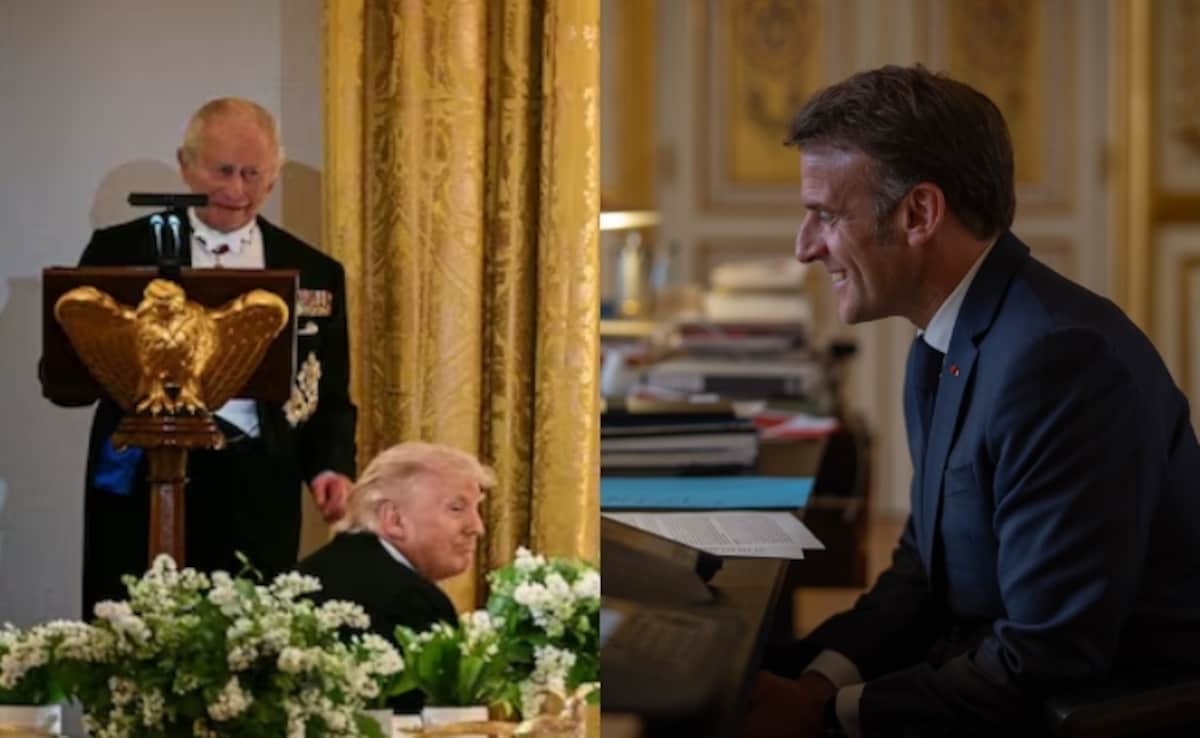
The intersection of statecraft and historical irony functions as a high-stakes arena where linguistic dominance serves as a proxy for geopolitical leverage. When King Charles III utilized a public forum to remind Donald Trump that the United States might still be speaking French—referencing the pivotal role of the French monarchy in the American Revolutionary War—he wasn't merely engaging in a "jab." He was deploying a structured rhetorical maneuver designed to reset the hierarchy of historical debt. President Emmanuel Macron’s subsequent labeling of the remark as "chic" is not a superficial compliment; it is a validation of a specific diplomatic architecture that prioritizes historical continuity over transactional modernism.
The Architecture of Historical Leverage
To understand the efficacy of this exchange, one must deconstruct the Triad of Sovereign Legitimacy: tradition, military history, and linguistic influence. King Charles III, representing an institution built on millennial continuity, used a specific historical inflection point—the 1781 Siege of Yorktown—to disrupt the contemporary power dynamic often dominated by American economic hegemony.
The French intervention, led by Rochambeau and de Grasse, represents the "original debt" of the American state. By highlighting this, the British monarch performed a dual-layered diplomatic pivot. First, he aligned the British Crown with French historical contributions, creating a European united front of "Old World" authority. Second, he subtly challenged the populist isolationism often associated with the Trump administration’s rhetoric by reminding the audience of the inherent multilateralism required for the very existence of the United States.
Linguistic Hegemony as a Cost Function
Language is rarely a neutral medium; it is a primary indicator of cultural and administrative gravity. The hypothetical scenario where Americans speak French represents a shift in the global Administrative Standard. In geopolitical theory, the language of the hegemon reduces friction in trade, legal frameworks, and military coordination.
The "jab" functions as a reminder of the fragility of English-language dominance. Had the French Crown leveraged its 18th-century military success into permanent North American territorial control, the global "Cost of Governance" would be indexed in French. Macron’s endorsement of this remark as "chic" signals an awareness of this Linguistic Capital. For the French Presidency, "chic" is a technical term for the elegant exercise of soft power—the ability to dominate a room through intellectual and historical context rather than raw GDP or military spending metrics.
The Mechanics of Public Statecraft
The interaction between Charles, Trump, and Macron reveals three distinct operational modes of modern diplomacy:
- The Institutionalist Mode (Charles): Utilizing long-range historical perspectives to minimize the stature of temporary political figures. By invoking the 18th century, the monarch suggests that current political cycles are mere blips in a much larger civilizational arc.
- The Disruptive Mode (Trump): Operating on immediate, personality-driven optics. This mode often struggles against historical rhetoric because it lacks the "deep time" anchors that monarchy or established European republics provide.
- The Opportunistic Validation Mode (Macron): Seizing on a third party’s remark to reinforce national prestige. Macron’s reaction was a tactical acquisition of the King's rhetorical success.
The effectiveness of the remark relies on the Theory of Relative Status. In a room of world leaders, status is often measured by who can make the most "expensive" joke—expensive in the sense that it requires deep cultural literacy to understand and even deeper historical standing to deliver without appearing insecure.
Divergent Strategic Narratives
A critical tension exists between the Anglo-American "Special Relationship" and the Franco-American "First Ally" narrative. The British King’s reference to French influence is a rare moment where British and French strategic narratives converged to neutralize American exceptionalism.
The logic of the remark creates a Historical Bottleneck for American populist rhetoric. If the United States is "self-made," the argument for isolationism gains ground. If the United States is a product of European superpower competition—specifically French intervention—then the obligation to maintain transatlantic alliances becomes a structural necessity rather than a choice.
Cultural Signaling and the European Bloc
Macron’s choice of the word "chic" targets a specific demographic of the global elite. It reinforces the concept of Distinction, as defined by sociologist Pierre Bourdieu. To find the joke "chic" is to signal membership in a class that understands the nuances of 18th-century naval history and its impact on 21st-century border policy.
This creates a barrier to entry for political movements that rely on simplified, nationalistic messaging. When the King of England and the President of France share a linguistic "in-joke" at the expense of an American leader, they are re-asserting the dominance of the European Intellectual Infrastructure. This infrastructure dictates the "rules of the game" for international decorum, effectively forcing outsiders to either adapt to these sophisticated norms or be branded as culturally illiterate.
The Geopolitical Feedback Loop
The immediate impact of this rhetorical exchange is the reinforcement of the Franco-British Entente within the context of NATO and G7 relations. While the UK has exited the European Union, its cultural and historical interests remain deeply embedded in the European project of maintaining relevance against rising Pacific powers and a volatile American electorate.
The second-order effect is the signaling to the American diplomatic corps. The "French jab" serves as a warning that European allies are prepared to use their cultural and historical depth as a psychological defensive measure. It suggests that if the United States retreats from its role as the guarantor of the liberal order, it loses the "right" to its own history of independence, which was bought with European blood and money.
Strategic recommendation for the American State Department
The U.S. diplomatic apparatus must pivot from reactive posturing to a proactive Historical Reconciliation Strategy. Relying on contemporary military and economic metrics is insufficient when engaging with institutions that measure their age in centuries. To counter the "Chic" defense, American representatives should:
- Internalize the Debt: Openly acknowledging the French and European roots of American sovereignty removes the leverage used in these "jabs." By owning the history, the U.S. prevents it from being used as a rhetorical weapon.
- Operationalize the "Special Relationship" Beyond Security: The U.S. must engage with the UK and France on a cultural-intellectual level that matches their own. This requires a shift from transactional diplomacy to "Deep-Statecraft" that respects historical continuity.
- Segment Rhetorical Responses: Distinguish between domestic populist rhetoric and international sovereign communication. The King's remark was effective because it exploited the gap between how a leader speaks to their base and how they are perceived by historical peers.
The transition from a unipolar world to a fragmented, multipolar one necessitates a mastery of these subtle power dynamics. The "French jab" was not a moment of levity; it was a calibrated assessment of the shifting foundations of Western leadership.